What Is DALL-E 2? OpenAI's Second-Generation Image Model
DALL-E 2 was a landmark in AI image generation. Learn about its history, current capabilities, and where it still fits in today's AI image landscape.
DALL-E 2 changed how people thought about artificial intelligence and creativity when it launched in April 2022. For the first time, anyone could type a sentence and watch as a computer generated original images that matched their description with surprising accuracy. The technology felt almost magical.
But by May 2026, OpenAI officially deprecated DALL-E 2, replacing it with newer models like gpt-image-1. The timeline tells a story about how fast AI development moves. A model that seemed groundbreaking became outdated in just four years. Understanding DALL-E 2 matters because it represents a pivotal moment in AI history and offers lessons about the technology that powers modern image generation tools.
This article explains what DALL-E 2 was, how it worked, why it mattered, and where it fits in today’s AI landscape. You’ll learn about its architecture, capabilities, limitations, and the broader context of text-to-image generation as it exists now.
What DALL-E 2 Was and Why It Mattered
DALL-E 2 was OpenAI’s second-generation text-to-image model. The name combines WALL-E (the Pixar robot character) with Salvador Dalí (the surrealist artist), hinting at both its computational nature and creative potential.
Other agents start typing. Remy starts asking.
Scoping, trade-offs, edge cases — the real work. Before a line of code.

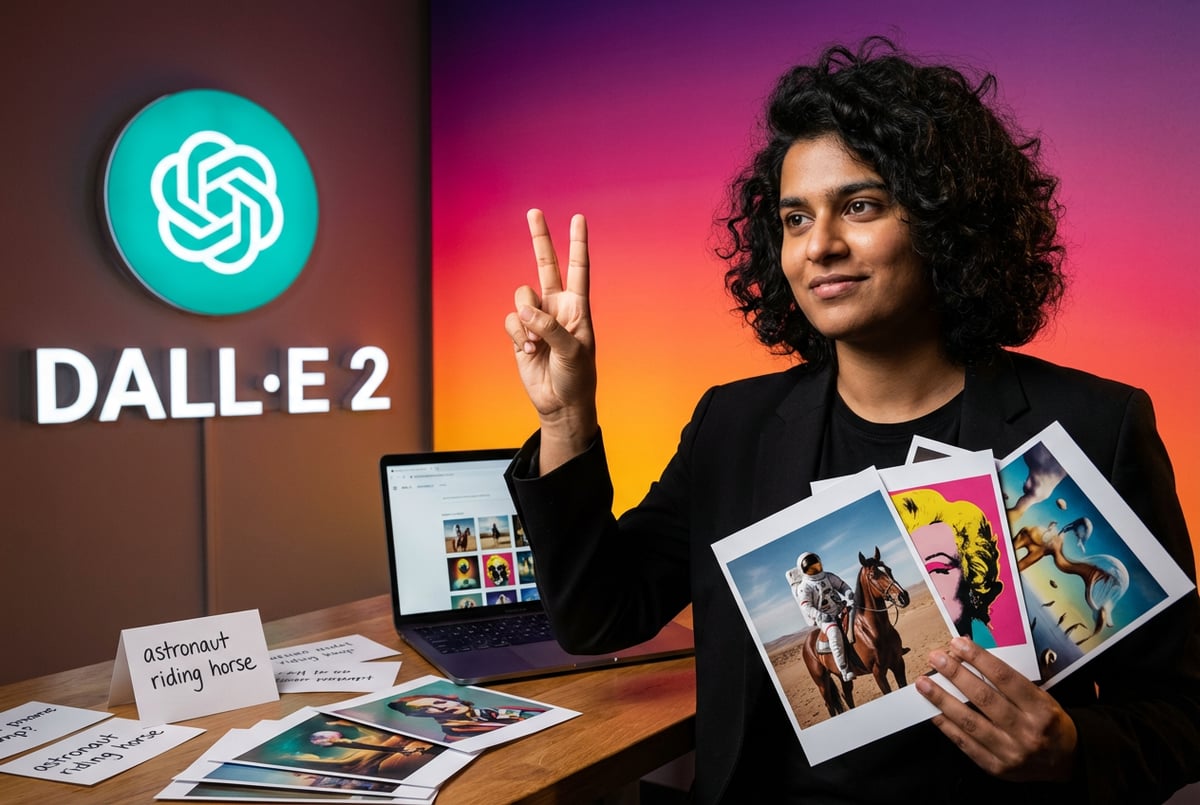
When OpenAI released DALL-E 2 to the public on April 6, 2022, the response was immediate and intense. People had seen AI-generated images before, but nothing quite like this. The model could create photorealistic images, artistic renderings, and surreal compositions from simple text prompts. You could ask for “a photo of an astronaut riding a horse in the style of Andy Warhol” and get exactly that.
The Technical Foundation
DALL-E 2 represented a significant architectural shift from the original DALL-E. While the first version used an autoregressive transformer similar to GPT-3, DALL-E 2 adopted a diffusion-based approach combined with CLIP (Contrastive Language-Image Pre-training) guidance.
The model had two main components. First, a prior model that converted text prompts into CLIP image embeddings. Second, a decoder that transformed those embeddings into actual images. This two-part architecture gave DALL-E 2 more control over image quality compared to its predecessor.
The diffusion model worked by starting with random noise and gradually removing it over multiple steps. At each step, the model predicted what the final image should look like based on the text prompt. This iterative process allowed for high-resolution outputs with better coherence across complex scenes.
DALL-E 2 had 3.5 billion parameters, significantly fewer than the original DALL-E’s 12 billion. Despite the smaller size, the architectural improvements meant better performance in most practical scenarios.
What Made It Special at Launch
Several capabilities set DALL-E 2 apart when it first appeared. The model could generate images in multiple styles including photorealistic imagery, paintings, digital art, and even emoji. It could combine unrelated concepts in coherent ways, creating images of things that didn’t exist in reality.
The in-painting feature let users edit specific parts of existing images by describing what they wanted to change. The variations capability could generate different versions of an image while preserving its core elements. These editing tools were genuinely new and useful for creative workflows.
Text rendering remained a challenge, but DALL-E 2 handled it better than earlier models. The system could understand complex prompts with multiple objects and relationships, though it sometimes struggled with precise spatial arrangements.
How DALL-E 2 Actually Worked
Understanding the technical details helps explain both the capabilities and limitations of DALL-E 2. The system relied on several interconnected components working together.
CLIP: The Bridge Between Text and Images
CLIP formed the foundation of DALL-E 2’s understanding. This separate model had been trained on hundreds of millions of image-text pairs from the internet. It learned to encode both text and images into a shared embedding space where similar concepts stayed close together.
When you gave DALL-E 2 a text prompt, CLIP would first convert that text into a mathematical representation called an embedding. This embedding captured the semantic meaning of your prompt in a way the image generation system could understand.
CLIP’s training meant it understood relationships between concepts. It knew that “astronaut” related to “space,” that “horse” was an animal with four legs, and that “Andy Warhol” implied a specific artistic style with bright colors and repeated patterns.
The Diffusion Prior
The prior model served as an intermediary step. It took the text embedding from CLIP and predicted what the corresponding image embedding should look like. This prediction wasn’t an actual image yet, just another mathematical representation in CLIP’s embedding space.
Remy doesn't write the code. It manages the agents who do.
Remy runs the project. The specialists do the work. You work with the PM, not the implementers.
This component used a diffusion model architecture. It learned to gradually denoise random embeddings into meaningful image embeddings that matched the input text. The process happened entirely in the abstract embedding space before any actual pixels were generated.
The Image Decoder
The decoder took the predicted image embedding and generated the actual visual output. This component also used diffusion, but at the pixel level. It started with random noise at the target resolution and iteratively refined it over many steps.
At each step, the decoder predicted how to remove some of the noise based on the image embedding from the prior. It used cross-attention mechanisms to ensure the generated pixels aligned with the semantic content encoded in the embedding.
The decoder generated images at 1024x1024 resolution by default. Users could request different aspect ratios, and the model would adjust accordingly. The generation process typically took 10-30 seconds depending on server load.
Training Process
OpenAI trained DALL-E 2 on a large dataset of images paired with text descriptions. The exact size and composition of this dataset remained undisclosed, but it likely included hundreds of millions of image-text pairs from various internet sources.
The training happened in stages. First, CLIP was trained to align text and image representations. Then the prior learned to map text embeddings to image embeddings. Finally, the decoder learned to generate actual images from those embeddings.
This multi-stage approach meant each component could specialize in its specific task. CLIP focused on understanding semantic relationships. The prior focused on predicting visual concepts from language. The decoder focused on rendering those concepts into coherent images.
Capabilities and Use Cases
DALL-E 2 found applications across creative industries, though its use was never as widespread as initial excitement suggested.
Creative Exploration and Concept Art
Artists and designers used DALL-E 2 for rapid prototyping of visual ideas. Instead of sketching multiple concepts, they could generate dozens of variations from text descriptions in minutes. This accelerated the early stages of creative projects.
The model excelled at combining disparate concepts in novel ways. A designer could request “a modern chair designed by Frank Lloyd Wright made of coral” and get coherent results that blended architectural styles with organic forms. These unexpected combinations often sparked new creative directions.
Game designers found value in generating background assets, texture ideas, and character concepts. While the outputs rarely went directly into final products, they served as useful reference material and inspiration.
Marketing and Advertising
Marketing teams experimented with DALL-E 2 for creating placeholder images, mood boards, and concept presentations. The ability to generate custom visuals quickly made it useful during brainstorming sessions.
However, commercial use came with restrictions. OpenAI’s terms required attribution and prohibited certain types of content. The risk of generating images that resembled copyrighted material also limited direct use in professional campaigns.
Some agencies used DALL-E 2 outputs as starting points that human artists would then refine and customize. This hybrid approach balanced speed with control and quality.
Education and Research
Researchers studied DALL-E 2 to understand how AI models represent and generate visual information. The model’s architecture influenced subsequent developments in multimodal AI systems.
Remy is new. The platform isn't.
Remy is the latest expression of years of platform work. Not a hastily wrapped LLM.
Educators used DALL-E 2 to demonstrate AI capabilities and limitations. Students could experiment with prompts and observe how the model interpreted different instructions, learning about both natural language processing and computer vision in the process.
The model also found applications in accessibility tools. Researchers explored using it to generate visual descriptions for blind users or to create custom illustrations for educational materials.
Personal Creative Projects
Individual creators used DALL-E 2 for personal art projects, social media content, and hobbyist experimentation. Those early months of limited access created a tight-knit community of “latent space explorers” who shared interesting generations and prompt techniques.
This community aspect was significant. Users developed shared vocabularies for describing effective prompts. They discovered which artistic styles and descriptive phrases worked best. Forums and Discord servers became hubs for exchanging tips and showcasing impressive results.
Limitations and Challenges
DALL-E 2’s impressive capabilities came with significant limitations that became apparent through widespread use.
Compositional Reasoning Problems
The model struggled with precise spatial relationships and object positioning. A prompt like “a red cube on top of a blue sphere” might result in the sphere on top of the cube, or the objects side by side. Complex scenes with multiple specified relationships often came out incorrect.
Counting proved difficult. Asking for “exactly three dogs” might produce two, four, or five dogs. The model seemed to understand the general concept of “multiple dogs” but couldn’t consistently generate specific quantities.
Physical relationships were inconsistent. Objects might float inexplicably, shadows might point in wrong directions, and reflections might not match their source objects. The model lacked real understanding of physics and spatial logic.
Text Rendering Issues
While DALL-E 2 improved text generation compared to earlier models, it still struggled with readable text within images. Letters often appeared garbled, misspelled, or in incorrect fonts. Long text strings rarely came out legible.
This limitation made the model impractical for generating things like posters, signs, logos, or any design where text accuracy mattered. Users learned to work around this by adding text separately in traditional image editing software.
Bias and Representation
OpenAI acknowledged that DALL-E 2 exhibited biases present in its training data. When asked to generate images of “a CEO” or “a nurse,” the model tended to produce images reflecting stereotypical demographics rather than diverse representations.
The company implemented mitigation strategies, including modifying prompts behind the scenes to encourage more diverse outputs. However, these interventions created their own issues, sometimes resulting in historically inaccurate or contextually inappropriate representations.
Content Filtering Challenges
OpenAI implemented strict content filters to prevent generation of violent, sexual, or harmful imagery. The system rejected prompts containing certain keywords and analyzed outputs for problematic content.
These filters sometimes triggered false positives, blocking legitimate creative requests. The opaque nature of the filtering system frustrated users who couldn’t understand why certain benign prompts were rejected.
The filters also couldn’t catch all problematic outputs. Users occasionally discovered ways to work around restrictions through careful prompt engineering, forcing OpenAI to continuously update its moderation systems.
Lack of Fine Control
Built like a system. Not vibe-coded.
Remy manages the project — every layer architected, not stitched together at the last second.
Users had limited control over specific aspects of generated images. You couldn’t specify exact colors using RGB values, precise object sizes, or exact camera angles. The model interpreted prompts probabilistically, meaning identical inputs could produce different outputs.
This randomness was sometimes desirable for creative exploration, but problematic when consistency mattered. Creating a series of related images with the same character or style required extensive prompt engineering and luck.
The Ethical Debates
DALL-E 2’s release intensified ongoing debates about AI-generated art and its implications for creators.
Artist Concerns About Training Data
Many artists objected to their work being used in training datasets without consent or compensation. While OpenAI didn’t disclose its training data sources, the model clearly learned from copyrighted artwork available online.
Surveys showed that 74% of artists considered AI-generated artwork unethical when it incorporated existing works without permission or attribution. The fact that DALL-E 2 could generate images “in the style of” specific living artists particularly concerned the creative community.
Platforms took different approaches. DeviantArt initially faced backlash over its AI tools before implementing opt-out policies. Getty Images banned AI-generated content entirely. Shutterstock partnered with OpenAI, attempting to create a licensing framework.
Copyright and Ownership Questions
Legal uncertainty surrounded the copyright status of AI-generated images. In August 2023, U.S. courts ruled that only humans could obtain copyright for works, creating confusion about whether AI-generated art could be protected.
This meant logos, designs, or artwork created with DALL-E 2 couldn’t be trademarked or copyrighted in traditional ways. Anyone could potentially use or duplicate AI-generated images without legal recourse.
The ambiguous legal status limited commercial applications. Businesses hesitated to build brands around imagery that might not receive legal protection.
Impact on Creative Professions
Concerns emerged about technological unemployment for illustrators, photographers, and graphic designers. If AI could generate images quickly and cheaply, would companies still hire human creators?
Evidence from the DALL-E 2 era suggested a more nuanced reality. The technology complemented rather than replaced human creativity for most professional applications. Skilled artists could use AI tools to accelerate their work while maintaining quality standards that pure AI generation couldn’t meet.
However, the technology did impact some market segments. Stock photography, generic illustrations, and low-budget creative work faced direct competition from AI-generated alternatives.
Deepfakes and Misinformation
The ability to generate realistic images raised concerns about misinformation. While DALL-E 2 included filters blocking generation of public figures, determined users sometimes found workarounds.
OpenAI added watermarks to generated images and later implemented Content Authenticity Initiative tags to help identify AI-generated content. These measures provided some traceability but couldn’t prevent all misuse.
How DALL-E 2 Compares to Modern Alternatives
By 2026, the AI image generation landscape had evolved significantly beyond what DALL-E 2 offered.
OpenAI’s Own Successors
DALL-E 3 launched in September 2023 with improved prompt adherence and image quality. It handled complex prompts better and generated more accurate text within images. However, OpenAI deprecated both DALL-E 2 and DALL-E 3 on May 12, 2026, replacing them with gpt-image-1 and gpt-image-1-mini.
These newer models use different architectural approaches. Instead of separate diffusion models, they integrate image generation directly into multimodal language models. GPT-4o can now generate images natively while maintaining conversation context, allowing for more intuitive iterative refinement.
Seven tools to build an app. Or just Remy.
Editor, preview, AI agents, deploy — all in one tab. Nothing to install.
The new models demonstrate superior prompt following, better text rendering, and improved handling of complex multi-object scenes. They can process up to 10-20 distinct objects in a single prompt compared to DALL-E 2’s more limited capabilities.
Midjourney’s Artistic Focus
Midjourney emerged as DALL-E 2’s primary competitor, particularly for artistic and aesthetic applications. The platform focused on creating visually striking images rather than photorealistic accuracy.
By 2026, Midjourney held over 25% market share in AI image generation. The platform achieved this without external venture funding, growing to $500 million in annual revenue through subscription fees alone.
Midjourney excelled at creating cohesive artistic styles and handling complex lighting and composition. However, it struggled with precise prompt adherence and practical applications like product photography or technical illustrations.
Stable Diffusion’s Open Source Approach
Stable Diffusion provided an open-source alternative that users could run locally or customize extensively. This flexibility attracted developers and researchers who wanted more control over their AI image generation tools.
The open-source nature meant the community could create custom models fine-tuned for specific styles, subjects, or use cases. Tools like ControlNet and LoRA enabled precise control over image generation that proprietary systems couldn’t match.
However, running Stable Diffusion required technical knowledge and powerful hardware. The barrier to entry was higher than with hosted services like DALL-E 2 or Midjourney.
Specialized Tools for Specific Needs
Newer platforms emerged targeting specific niches. Ideogram specialized in text rendering within images, achieving 90% accuracy compared to DALL-E 2’s roughly 30% success rate. This made it valuable for creating signs, posters, and designs where readable text mattered.
Leonardo AI focused on game assets and character design. Adobe Firefly emphasized commercial safety by training only on licensed content. Flux models prioritized speed and photorealism.
This specialization reflected market maturation. Instead of one tool trying to do everything, different platforms optimized for different workflows and requirements.
Building AI Workflows Beyond Image Generation
While DALL-E 2 represented an important milestone in AI-generated imagery, modern workflows increasingly combine multiple AI capabilities into integrated systems. This is where platforms like MindStudio become relevant.
MindStudio provides access to over 200 AI models through a unified interface, including modern image generation models alongside text processing, data analysis, and other AI capabilities. Instead of managing separate subscriptions and APIs for different AI tools, you can build complete automation workflows that incorporate image generation as one component among many.
For example, a marketing team might build a workflow that monitors social media mentions, analyzes sentiment, generates appropriate response images using current AI image models, and posts replies automatically. This type of integrated automation wasn’t possible with standalone tools like DALL-E 2.
The visual workflow builder in MindStudio lets non-technical users create these multi-step AI processes without coding. You can connect image generation to other business tools, databases, and communication platforms to create complete solutions rather than isolated capabilities.
Practical Applications Today
Modern AI workflows that incorporate image generation often serve specific business functions. Customer service teams use them to generate visual product recommendations. E-commerce platforms create custom product imagery at scale. Content teams produce supporting graphics for articles and social posts.
Everyone else built a construction worker.
We built the contractor.
One file at a time.
UI, API, database, deploy.
The key difference from the DALL-E 2 era is integration. Image generation now happens as part of larger processes rather than as a standalone activity. The images feed into other systems, get processed by additional AI models, or trigger subsequent workflow steps.
This integrated approach solves some of the limitations that made DALL-E 2 challenging for business use. When image generation is just one step in an automated workflow, inconsistencies can be caught and corrected programmatically. Multiple attempts can happen automatically. Human review can be triggered only when needed.
What We Learned from DALL-E 2
DALL-E 2’s relatively brief prominence offers lessons about AI development and adoption that remain relevant.
Technology Moves Faster Than Institutions
The legal, ethical, and social frameworks for dealing with AI-generated content lagged behind technological capabilities. By the time discussions about copyright and artist compensation reached serious policy debates, the technology had already moved on to new models and approaches.
This pattern continues. The EU AI Act and other regulations implemented in 2025-2026 address concerns that emerged during the DALL-E 2 era, but newer AI capabilities raise different questions that existing frameworks don’t cover.
Early Adopter Excitement Fades Quickly
The intense enthusiasm that greeted DALL-E 2’s launch dissipated within months as limitations became apparent and novelty wore off. The “latent space explorers” who formed communities around early AI art mostly moved on to newer tools or returned to traditional creative methods.
This suggests that sustainable AI applications need to solve real problems rather than just demonstrate impressive capabilities. The tools that succeeded long-term were those that integrated into existing workflows and addressed specific pain points.
Architectural Approaches Matter
DALL-E 2’s shift from autoregressive to diffusion-based architecture demonstrated how different technical approaches could produce significantly different results. The subsequent move to transformer-based architectures in models like GPT-4o showed continued evolution.
No single architectural approach dominates. Different methods excel at different tasks. The most capable systems increasingly use hybrid architectures that combine multiple techniques.
Open vs Closed Approaches Create Different Ecosystems
DALL-E 2’s closed nature limited customization and experimentation compared to Stable Diffusion’s open-source model. However, the controlled access also enabled better content filtering and potentially reduced misuse.
The market ultimately supported both approaches. Some users preferred the simplicity and reliability of hosted services. Others valued the control and customization of open-source alternatives.
Quality and Capability Improvements Are Continuous
The rapid succession of models—DALL-E to DALL-E 2 to DALL-E 3 to GPT-4o image generation—illustrated how quickly AI capabilities advance. What seemed impossible becomes possible, then becomes standard, then becomes outdated in remarkably short timeframes.
This pace of change creates challenges for anyone building systems that depend on specific AI capabilities. Architectures need to accommodate model upgrades without complete rebuilds.
The Current State of AI Image Generation
As of 2026, AI image generation has become a mature technology with clear leaders and specialized tools for different needs.
Market Leaders and Their Strengths
GPT-4o leads in text rendering and integrated workflows. Midjourney dominates artistic and aesthetic generation. Flux excels at photorealism and speed. Ideogram specializes in typography and text accuracy. Adobe Firefly offers commercial safety and licensing clarity.
Remy doesn't build the plumbing. It inherits it.
Other agents wire up auth, databases, models, and integrations from scratch every time you ask them to build something.
Remy ships with all of it from MindStudio — so every cycle goes into the app you actually want.
The market supports multiple successful platforms because different tools serve different purposes. Professional workflows often use several different models depending on the specific task.
Technical Capabilities
Modern models handle complex prompts with 10-20 distinct objects. Text rendering has improved dramatically, with some models achieving 90%+ accuracy. Generation speeds have increased, with some models producing images in under 5 seconds.
Resolution limits have expanded. Photorealism has improved to the point where generated images are often indistinguishable from photographs. Style consistency across multiple images has become possible through various techniques.
Remaining Limitations
Despite improvements, AI image generation still struggles with certain tasks. Precise spatial reasoning remains challenging. Counting specific quantities of objects is inconsistent. Complex physics and realistic motion are difficult to render correctly.
Novel viewpoints of specific subjects are hard to generate consistently. Maintaining exact character consistency across many images requires specialized tools or techniques beyond basic text-to-image generation.
Integration Into Professional Workflows
AI image generation has found stable niches in professional use. Marketing teams use it for concept development and placeholder content. Game developers use it for texture generation and reference material. Product teams use it for mockups and visualization.
However, most professional applications combine AI generation with human refinement. Pure AI outputs rarely go directly into final products. The value comes from accelerating early stages of creative work rather than replacing human expertise entirely.
Looking Forward
The trajectory from DALL-E 2 to current systems suggests several continuing trends.
Multimodal Integration
Image generation is increasingly integrated with other AI capabilities within single models. GPT-4o can generate text, images, and audio from a unified architecture. This multimodal approach enables more sophisticated applications than specialized single-purpose tools.
Future development likely continues this trend. Systems that understand and generate across multiple modalities will enable workflows that weren’t possible with separate specialized models.
Better Fine-Grained Control
Tools for controlling specific aspects of generated images continue improving. Techniques like ControlNet, depth maps, and pose guidance give users more precise control while maintaining the speed and flexibility of AI generation.
This increased control helps address one of DALL-E 2’s key limitations. As control mechanisms improve, AI image generation becomes more practical for professional applications requiring consistency and precision.
Video and 3D
Extensions of image generation techniques into video and 3D content represent active areas of development. OpenAI’s Sora and similar systems apply diffusion and transformer architectures to video generation.
These extensions face additional technical challenges around temporal consistency and computational requirements. However, the fundamental approaches that made DALL-E 2 possible apply to these new domains.
Regulatory Frameworks
Legal and regulatory frameworks for AI-generated content continue evolving. The EU AI Act implemented in 2026 requires transparency about training data and AI-generated content labeling. Similar regulations are emerging in other jurisdictions.
These frameworks address concerns that emerged during the DALL-E 2 era about training data sources, artist compensation, and content authenticity. However, they also create compliance requirements that affect how AI image generation tools can operate commercially.
Key Takeaways
Several important points emerge from understanding DALL-E 2’s history and context:
- DALL-E 2 represented a significant milestone in AI image generation when it launched in April 2022, but was quickly superseded by more capable models.
- The architecture used diffusion models with CLIP guidance, a different approach from both the original DALL-E and current transformer-based methods.
- Limitations included spatial reasoning problems, text rendering issues, and challenges with fine-grained control.
- Ethical concerns about training data, artist compensation, and copyright remain relevant to current AI image generation systems.
- The rapid evolution from DALL-E 2 to modern alternatives demonstrates how quickly AI capabilities advance.
- Professional applications increasingly integrate image generation into larger automated workflows rather than using it as a standalone tool.
- The market now supports multiple specialized tools for different use cases rather than attempting one-size-fits-all solutions.
- Regulatory frameworks are beginning to address concerns that emerged during the DALL-E 2 era, but technology continues advancing faster than policy.
Other agents ship a demo. Remy ships an app.
Real backend. Real database. Real auth. Real plumbing. Remy has it all.
Conclusion
DALL-E 2 marked a turning point in how people thought about AI and creativity. The model demonstrated that computers could generate original, creative images from text descriptions with surprising sophistication. It sparked important conversations about technology, art, and the future of creative work.
However, DALL-E 2 also illustrated how rapidly AI technology evolves. By the time the broader world caught up to understanding what DALL-E 2 could do, developers had already moved on to more capable systems. The model’s official deprecation in May 2026 formalized what had been true for some time: the technology had evolved beyond what DALL-E 2 offered.
Today, AI image generation is a practical tool integrated into professional workflows across many industries. The capabilities that seemed magical in 2022 are now standard features. New challenges and possibilities have emerged that DALL-E 2 never contemplated.
Understanding DALL-E 2’s history provides context for current AI image generation tools and insight into how this technology might continue developing. The pattern of rapid iteration, evolving capabilities, and persistent challenges likely continues. Anyone working with AI-generated imagery should expect ongoing change rather than settled, stable technology.
The lessons from DALL-E 2 extend beyond image generation specifically. They apply to AI development broadly: technology advances faster than institutions, early excitement fades as limitations become apparent, different architectural approaches enable different capabilities, and practical value comes from integration rather than isolated capabilities.
For teams looking to incorporate AI image generation into their work, the key is building flexible systems that can adapt as underlying models improve. Platforms that support multiple AI models and allow workflow automation provide more resilience to technological change than solutions locked to specific tools.
DALL-E 2 is now history, but the questions it raised about AI, creativity, and society remain active and important. The technology continues advancing, but the fundamental challenges around training data ethics, artist compensation, copyright, and the appropriate use of AI-generated content persist. These issues will shape how AI image generation develops and how society integrates these capabilities going forward.