
AI Industry Strategy
Vendor moves, compute economics, what each lab is betting on. Less product, more strategy — Anthropic compute shortages, OpenAI vs Anthropic vs Google bets, business-of-AI takes.
How to Check If Your Brand Appears in AI Search: Tools and Strategies
More buyers use AI tools to discover products. Learn how to audit your brand's visibility in ChatGPT, Gemini, and Perplexity and improve your presence.

Stop Re-Prompting the Same Thing: How to Pick Between Prompts, Skills, Plugins, and MCP in 5 Minutes
Conflating prompts, skills, plugins, and MCP connectors wastes 40%+ of your AI time. Use this decision tree to pick the right scaffolding primitive every time.
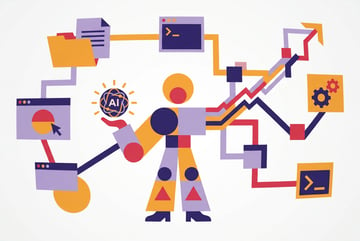
What Is a Harness? The Infrastructure That Turns AI Models into Agents
A harness wraps an AI model so it can read files, run commands, and call tools. Learn how Claude Code, Codex, and Cursor use harnesses to enable agentic work.

What Is Proactive AI? How Agents Are Shifting from Reactive to Anticipatory
The next wave of AI agents won't wait for prompts. Learn how Claude Dreaming, Hermes crons, and proactive agent design are changing what AI can do for you.

A 500-Megawatt AI Data Center Needs 30,000 Truckloads to Build — The Physical Scale of the AI Jobs Boom
A 500MW data center is the size of a midsize city airport and takes 30,000 truckloads to build. The AI jobs story isn't software

AI Workflows vs Agentic Workflows: What's the Difference and Which Do You Need?
AI workflows follow fixed steps. Agentic workflows let the model decide the path. Learn the key differences and when to use each for business automation.

Anthropic Valued Above $1 Trillion on Secondary Markets — 5 Reasons It Surpassed OpenAI's $850B
Anthropic's implied secondary market valuation has crossed $1 trillion, topping OpenAI's $850B. Here are the five factors that drove the reversal.

Anthropic's $200B Google Cloud Commitment: 4 Ways It Reshapes AI Infrastructure in 2025
Anthropic committed $200B to Google Cloud over 5 years, sending Google stock up 10%. Here's what this means for AI infrastructure and Claude availability.

Anthropic Hit $30B ARR in 4 Months: 6 Data Points That Show How Fast It's Pulling Ahead of OpenAI
Anthropic went from $9B to $30B ARR in four months — the fastest revenue growth in any company's history. Here are the six data points that explain how.

Anthropic's SpaceX Compute Deal: 5 Surprising Facts About the Partnership Nobody Expected
Anthropic is taking over Colossus 1 — the same data center XAI was only using 11% of. Here are five facts about the deal that caught everyone off guard.

Claude Code Is Doing $2.5B in Annualized Revenue — Just from the Terminal Tool
Claude Code's terminal tool alone is generating $2.5B in annualized revenue — larger than most public SaaS companies. Here's what's driving that number.

Claude vs GPT-4o in Enterprise Coding: 42-54% vs 21% Market Share — What the Data Actually Shows
Claude holds 42-54% of enterprise coding spend vs OpenAI's 21%, per Menlo Ventures. Here's what's driving the gap and what it means for your tool choices.

Elon Called Anthropic 'Missanthropic' in March — Then Signed a Compute Deal With Them in April
Elon Musk publicly called Anthropic 'the most hypocritical company' in March 2026. Weeks later, SpaceX signed a major compute deal with them. Here's why.

Elon's Terrafab vs TSMC: A $55-119B Chip Fab Bet That Only Makes Sense If Anthropic Stays
Elon's Terrafab cost estimate jumped from $25B to $119B. The Anthropic compute deal is now the demand justification that makes the math work.

Prompts vs Skills vs Plugins vs MCPs: The 10-Minute Framework That Stops You Wasting 40% of Your AI Time
Most AI users conflate prompts, skills, plugins, and MCPs — and waste 40%+ of their time. This 10-minute framework clarifies exactly when to use each.

XAI Is Becoming SpaceX AI: 3 Things the Grok 4.3 Launch Reveals About Elon's AI Strategy
XAI is ceasing to exist as a separate company and rebranding as SpaceX AI. Grok 4.3's launch reveals three things about where Elon's AI strategy is…

Anthropic Is Beating OpenAI: 8 Data Points That Show How Fast Claude's Lead Is Growing
From $9B to $30B ARR in four months. 54% enterprise coding share vs OpenAI's 21%. Eight data points that show Claude's lead is accelerating fast.

Anthropic Dev Day: 6 New Managed Agent Features That Change How Claude Handles Long-Running Work
Dreaming, Outcomes, multi-agent orchestration, Claude Finance — Anthropic's dev day introduced the most complete managed-agent stack yet.

Anthropic Managed Agents vs Open-Source Agent Frameworks: Which Should You Build On?
Anthropic now has native Dreaming, Outcomes, and orchestration. But open source shipped these primitives first. Here's how to choose your stack.

Anthropic Restricts Third-Party Agents, OpenAI Opens Up: Which Provider Should You Build On?
Anthropic locked down always-on agent subscriptions. OpenAI opened Codex to everyone. Here's how to pick the right provider for your agentic workflow.
Anthropic Takes Over Colossus 1: 7 Things the SpaceX Deal Means for Claude Users Right Now
Anthropic just leased 100% of SpaceX's 220K-GPU Colossus 1. Here's what it means for rate limits, pricing, and Claude availability.

Anthropic vs OpenAI Valuation: How the Colossus Deal Pushed Anthropic Past $1 Trillion
Anthropic now implies $1T+ on secondary markets vs OpenAI's $850B. The compute race just reshuffled the AI power rankings.

Claude Code Is Doing $2.5B in Annualized Revenue — Bigger Than Most Public SaaS Companies
Claude Code — just the terminal tool, not the full Claude product — is doing $2.5B ARR. Here's what that number reveals about the coding AI market.

Dario Amodei's 80x Growth Claim: What Anthropic's Q1 2026 Revenue Numbers Actually Mean
Dario disclosed 80x annualized revenue growth in a single quarter. We break down what that number means and why the Colossus deal follows from it.