Best AI Agent Builders That Support Multiple LLM Providers
Compare the top AI agent builders that let you switch between OpenAI, Anthropic, Google, and other LLM providers from a single platform.
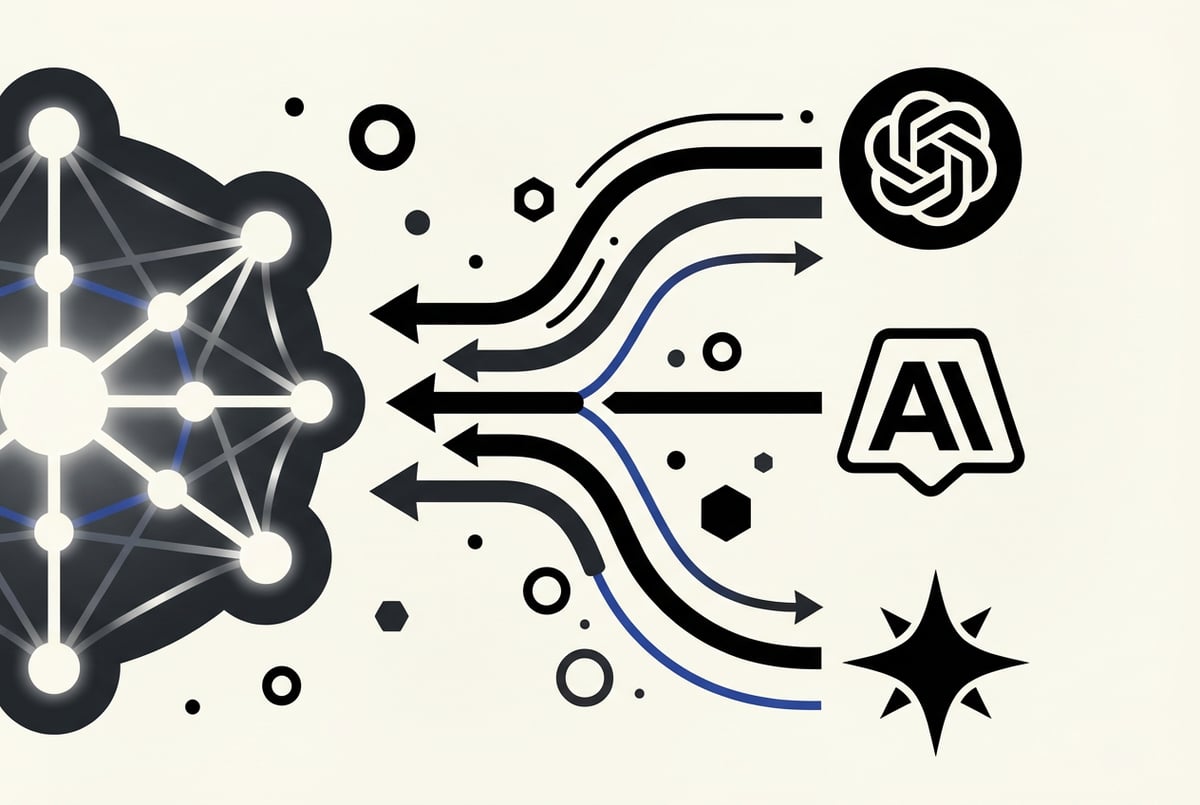
Why Multi-LLM Support Matters in 2026
Most AI agent builders lock you into a single language model provider. This creates problems when you need different capabilities for different tasks, when pricing changes, or when a better model comes out.
Multi-LLM platforms solve this by connecting to multiple providers from one interface. You can use GPT-5 for complex reasoning, Claude Opus 4.5 for detailed analysis, Gemini 3 for speed, and open-source models for cost-sensitive tasks. All without managing separate API keys or rebuilding your workflows.
The numbers show why this matters. Organizations using multi-LLM approaches report 60% lower operational costs compared to single-provider setups. They also avoid vendor lock-in risks that affect 42% of AI projects.
The Real Cost of Single-Provider Lock-In
When you build on one LLM provider, you face several risks. Pricing can change without notice. Model performance varies across different task types. API rate limits constrain your scaling. Most critically, you can’t take advantage of new models as they emerge.
A Fortune 100 healthcare company discovered this when their single-provider setup cost them $500,000 to $1,000,000 per use case. After switching to a multi-LLM platform, they reduced time to delivery by 80% and cut costs by similar margins.
Multi-LLM platforms give you options. When GPT-5 performs better for code generation but costs more, you route those tasks there. When Claude handles long documents better, you use that. When you need fast, cheap responses, you tap Gemini or open-source models.
Top AI Agent Builders with Multi-LLM Support
Several platforms now offer native multi-LLM support. Each takes a different approach to model routing, pricing, and ease of use.
MindStudio: No-Code Multi-LLM Workflows
MindStudio connects to over 200 AI models from OpenAI, Anthropic, Google, Meta, and other providers. The platform handles API keys, rate limiting, and model updates automatically.
Users report building their first multi-agent workflow in 5 to 15 minutes. The visual interface lets non-technical teams create agents that switch between models based on task requirements. You can prototype with Claude, then switch to GPT-5 or Gemini without rewriting code.
The platform charges pass-through pricing with no markup on model costs. If OpenAI charges $10 per million tokens, that’s what you pay. This contrasts with platforms that add 20% to 50% on top of base model costs.
MindStudio’s built-in orchestration handles complex workflows where different agents use different models. A research agent might use Claude for analysis, while a writing agent uses GPT-5, and a data extraction agent uses a specialized open-source model. The system coordinates all three without manual intervention.
Key features include dynamic tool use, built-in memory management, and 600+ third-party integrations. Teams use MindStudio for customer service automation, internal knowledge bases, data processing workflows, and content generation pipelines.
StackAI: Enterprise-Grade Governance
StackAI focuses on regulated industries that need strict compliance and audit trails. The platform supports multiple LLM providers while maintaining detailed logs of every model interaction.
Organizations praise StackAI for its clarity in the build-to-deployment process. You can turn an idea into a working API without friction. The platform includes role-based access controls, audit logs, and controlled environments that satisfy IT and compliance requirements.
StackAI works well for mid to large companies where business teams need to launch automations quickly while engineers retain control through code or API nodes. The platform emphasizes document-driven workflows with strong support for RAG pipelines.
Pricing follows enterprise contract models rather than simple per-seat or usage-based approaches. This fits organizations that want predictable costs and dedicated support.
Vellum: Developer-First Multi-Model Platform
Vellum provides both visual workflows and SDK extensibility. The platform targets teams that want to prototype quickly but need code-level control for production deployments.
The platform includes built-in evaluation frameworks for testing different models against each other. You can run the same prompt through GPT-5, Claude, and Gemini, then compare accuracy, cost, and latency. This helps teams make data-driven decisions about model selection.
Vellum’s observability tools track the complete agent lifecycle. You see not just outputs, but reasoning paths, tool selections, and evidence grounding. This transparency helps teams debug issues and improve performance over time.
The platform supports both cloud deployment and self-hosted options. Organizations in regulated industries can run Vellum on their own infrastructure while maintaining multi-LLM capabilities.
n8n: Open-Source Workflow Automation
n8n offers a visual workflow builder with nodes for major LLM providers. The open-source nature means you can self-host and customize without licensing fees.
Teams use n8n when they need very deep customization or prefer full control over their infrastructure. The tradeoff is more setup work and less built-in governance compared to commercial platforms.
Other agents start typing. Remy starts asking.
Scoping, trade-offs, edge cases — the real work. Before a line of code.

The platform includes pre-built templates for common AI agent patterns. You can start with a template, then modify it to add multi-model logic. Popular use cases include data processing pipelines, customer service automation, and internal tool integration.
LangChain and LangGraph: Code-First Frameworks
LangChain provides a Python framework for building AI applications with multiple LLM providers. LangGraph extends this with stateful, multi-actor capabilities for complex agent systems.
These frameworks give maximum flexibility but require developer skills. You write code to connect models, manage state, and orchestrate agent interactions. This works well for teams that need custom behavior or want to build proprietary agent architectures.
The downside is complexity. A typical LangChain production deployment costs $500 to $2,000+ per month when you factor in model APIs, hosting, and development time. Teams often prototype in no-code platforms, then migrate complex components to LangChain as needed.
CrewAI: Role-Based Multi-Agent Teams
CrewAI specializes in multi-agent architectures where different agents have specific roles. Each agent can use a different LLM based on its function.
The platform generates over 10 million agents per month, with 40% of Fortune 500 companies using it for pilot projects. CrewAI excels at complex workflows that require agent collaboration.
You define agents with specific roles like researcher, writer, or analyst. Each agent uses the most appropriate model for its task. The system handles coordination and task delegation automatically.
Key Features to Evaluate
When comparing multi-LLM platforms, several features separate basic support from production-ready capabilities.
Dynamic Model Routing
The best platforms route queries to different models based on complexity, cost, or performance requirements. Simple questions go to fast, cheap models. Complex reasoning tasks go to more capable models.
This routing can reduce operational costs by up to 75% while maintaining quality. One implementation reduced costs from $0.03 per query to $0.007 by routing 80% of requests to smaller models.
Look for platforms that let you define routing rules without code. MindStudio, for example, lets you set conditions like “if query length exceeds 500 words, use Claude, otherwise use Gemini.” This gives you cost control without sacrificing performance.
Unified API Management
Managing multiple LLM provider APIs yourself is tedious. You need separate API keys, handle different rate limits, manage retries, and update when providers change their APIs.
Platforms with unified API management abstract this complexity. You connect your API keys once, then the platform handles everything else. When OpenAI changes their API, the platform updates its integration automatically.
This saves significant engineering time. Teams report spending 80% less time on API maintenance when using unified platforms versus managing integrations directly.
Context Window Management
Different LLMs have different context window sizes. GPT-5 handles 200,000 tokens. Claude Opus 4.5 supports similar lengths. Gemini 3 varies by model size. Open-source models often have smaller windows.
Good platforms manage this automatically. They track token usage, compress context when needed, and route to models that can handle your data size. This prevents errors and ensures consistent behavior.
Some platforms also implement caching strategies that reduce token usage by up to 87%. Repeated context gets cached, so you only pay for new tokens in follow-up requests.
Cost Tracking and Optimization
One coffee. One working app.
You bring the idea. Remy manages the project.
Multi-LLM setups make cost tracking complex. Each provider charges differently. Some charge per token, others per request. Rates vary by model and can change monthly.
Platforms with built-in cost tracking show exactly what you’re spending across all providers. You can set budgets, get alerts when costs exceed thresholds, and see which models deliver the best ROI for your use cases.
This visibility helps teams make informed decisions. When one model costs 3x more but only performs 10% better, you can switch to a cheaper option. When a critical workflow justifies premium models, you can allocate budget accordingly.
Evaluation and Testing Tools
To know which model works best for your use case, you need to test them. The best platforms include evaluation frameworks that run the same prompts across multiple models.
You can compare accuracy, response time, cost, and output quality. Some platforms use LLM-as-a-Judge methods where one model evaluates outputs from others. This scales testing without manual review.
Teams that implement systematic evaluation see 30% to 50% improvements in agent performance over six months. They identify which models work best for specific tasks, then optimize their routing accordingly.
Observability and Debugging
When agents use multiple models, debugging gets harder. You need to see which model handled each step, what tokens it used, and why it made specific decisions.
Advanced platforms provide distributed tracing that captures complete execution paths. You see the full chain from user input through model selection, tool invocation, and final response.
This transparency matters for production systems. When an agent makes a mistake, you can trace exactly what happened and fix the issue. Without observability, you’re debugging blind.
Pricing Models Across Platforms
Multi-LLM platforms use different pricing approaches. Understanding these models helps you predict total costs.
Pass-Through Pricing
Some platforms charge exactly what LLM providers charge, with no markup. MindStudio follows this model. If you use $100 in OpenAI API calls, you pay $100 to OpenAI plus any platform fees.
This transparency makes budgeting simpler. You can calculate costs based on published LLM pricing, then add platform subscription fees. There are no surprises or hidden markups.
Usage-Based with Markup
Other platforms add a percentage on top of base model costs. Markups typically range from 20% to 50%. So if an LLM call costs $10, you pay $12 to $15 total.
These markups cover the platform’s infrastructure, support, and development costs. For high-volume workloads, this can add up significantly.
Subscription Plus Usage
Many platforms charge a monthly subscription for platform access, then add per-token or per-request fees. Subscriptions range from $50 to $5,000+ per month depending on features and scale.
This model works well for predictable workloads. You pay a base fee for the platform, then variable costs scale with usage. Look for platforms that offer volume discounts or flat-rate options for high usage.
Enterprise Contracts
For large deployments, platforms offer custom enterprise pricing. These contracts bundle platform access, support, training, and sometimes guaranteed response times.
Enterprise pricing typically starts around $50,000 per year but can exceed $300,000 for complex implementations. The benefit is predictable costs and dedicated support.
Implementation Patterns and Best Practices
Remy doesn't build the plumbing. It inherits it.
Other agents wire up auth, databases, models, and integrations from scratch every time you ask them to build something.
Remy ships with all of it from MindStudio — so every cycle goes into the app you actually want.
Teams that successfully deploy multi-LLM agents follow specific patterns.
Start with Clear Use Cases
Don’t build agents because you can. Start with specific problems that AI can solve better than current solutions.
Customer service automation delivers the most predictable ROI. These agents handle 60% to 80% of common questions, reducing human workload while improving response times. Success metrics are clear: tickets resolved, time to resolution, customer satisfaction.
Internal knowledge management also works well. Agents that answer employee questions about policies, procedures, and systems save hours of searching through documentation. Teams report 25% to 40% reduction in time spent finding information.
Data processing and analysis suits multi-LLM approaches. Different models handle different parts of the workflow. One extracts data, another cleans it, a third analyzes patterns, and a fourth generates reports. Each uses the optimal model for its task.
Design for Model Flexibility
Build agents that can switch models without breaking. This means abstracting model-specific behavior and using standardized interfaces.
Good platforms handle this automatically. You design workflows around tasks, not specific models. The platform manages model selection, retries, and failover.
This flexibility becomes critical when models change. OpenAI updates GPT models frequently. Anthropic iterates on Claude. Google releases new Gemini versions. Your agents should adapt to these changes without manual updates.
Implement Progressive Testing
Don’t launch agents at full scale immediately. Start with a small subset of requests, monitor performance, then expand gradually.
A typical rollout might handle 5% of traffic in week one, 20% in week two, 50% in week three, and 100% in week four. This gives you time to catch issues before they affect all users.
Use A/B testing to compare different models or configurations. Send half your traffic to one setup, half to another, then measure which performs better. This data-driven approach beats guessing.
Monitor Continuously
AI agents aren’t set-and-forget solutions. Model performance drifts over time as data patterns change. New edge cases emerge. User expectations evolve.
Set up monitoring that tracks accuracy, cost, latency, and user satisfaction. When metrics decline, investigate and adjust. This might mean retraining, switching models, or refining prompts.
Organizations that implement continuous monitoring report 30% to 60% better long-term performance than those that don’t. They catch problems early and optimize based on real usage patterns.
Real-World Use Cases and ROI
Multi-LLM agents deliver measurable value across industries.
Customer Service Automation
A telecommunications company deployed multi-model agents for customer support. Simple questions went to fast, cheap models. Complex technical issues routed to GPT-5. Billing questions used a specialized model fine-tuned on their data.
Results: 70% of inquiries resolved without human intervention, 40% reduction in average handle time, 60% lower support costs, and 15% improvement in customer satisfaction scores.
The multi-model approach saved $2.1 million annually compared to using premium models for all queries.
Healthcare Documentation
A healthcare provider used multi-LLM agents to automate clinical documentation. The system converted doctor-patient conversations into properly formatted medical records.
Other agents ship a demo. Remy ships an app.
Real backend. Real database. Real auth. Real plumbing. Remy has it all.
Different models handled different parts: transcription, medical terminology extraction, form population, and compliance checking. Each model specialized in its task, producing more accurate results than a single general-purpose model.
The implementation reduced documentation time from 28 hours per week to 8 hours, giving doctors 20 additional hours for patient care. Error rates dropped from 3 per report to 0.3 on average.
Financial Services Processing
A financial institution automated prior authorization processing using multi-agent systems. The workflow involved data extraction, policy checking, decision logic, and documentation generation.
Processing time dropped from several hours to 15 seconds. First-submission approval rates hit 92%. The system handled over 10,000 authorizations per month with minimal human intervention.
Cost per authorization fell from $2,200 to $9, delivering $22 million in annual savings.
Software Development Assistance
A technology company built development agents that helped engineers write code, review pull requests, and debug issues. Different models handled different aspects based on their strengths.
Claude excelled at code review and architectural suggestions. GPT-5 performed well for implementation and documentation. Gemini handled quick lookups and standard patterns. Open-source models ran simple refactoring tasks.
Developer productivity increased 72%. Code quality improved as agents caught bugs before human review. Time spent on routine tasks dropped by half.
Security and Compliance Considerations
Multi-LLM deployments introduce security challenges that need careful management.
Data Governance
When you send data to multiple LLM providers, you need clear policies about what data goes where. Some providers retain data for training. Others offer zero-data-retention guarantees.
Classify your data by sensitivity. Public information can use any model. Confidential data requires providers with strict data policies. Protected health information or financial data needs HIPAA or PCI DSS compliant deployments.
Platforms like MindStudio and StackAI provide controls for routing sensitive data only to approved models. You can block certain data types from specific providers automatically.
Access Controls
Multi-agent systems create numerous non-human identities that need management. Each agent needs specific permissions, and those permissions need regular review.
Implement role-based access control that limits what agents can access. A customer service agent doesn’t need access to financial systems. A data processing agent doesn’t need customer contact information.
Organizations that implement proper AI access controls prevent 87% of potential security incidents. Those without controls face significantly higher breach risks.
Audit Trails
Every agent action needs logging. When an agent makes a decision, you need to know which model it used, what data it accessed, and what reasoning it followed.
Good platforms provide immutable audit logs that satisfy regulatory requirements. These logs help with forensic analysis when issues occur and prove compliance during audits.
Audit logging is non-negotiable for regulated industries. Financial services, healthcare, and government organizations must demonstrate complete traceability of AI decisions.
Model Verification
Not all models handle sensitive tasks equally well. Some models hallucinate more. Others handle specific domains better. Some maintain consistency, while others vary significantly between runs.
Test models thoroughly before deploying them for critical workflows. Verify they meet accuracy requirements. Check that they follow policies and constraints. Confirm they handle edge cases appropriately.
Organizations that skip verification face higher error rates and potential compliance violations. Those that implement systematic verification catch problems before they reach production.
Built like a system. Not vibe-coded.
Remy manages the project — every layer architected, not stitched together at the last second.
The Future of Multi-LLM Platforms
Several trends will shape how multi-LLM platforms develop.
Standardized Protocols
The Model Context Protocol (MCP) and Agent-to-Agent (A2A) protocols are emerging as standards for AI agent communication. These protocols let agents built on different platforms work together.
Think of these as HTTP for AI agents. Just as websites communicate through standard protocols, AI agents will use MCP and A2A to share tasks, exchange information, and coordinate actions.
Microsoft, Google, Anthropic, and other major players support these standards. Adoption is growing rapidly. By late 2026, most enterprise AI will likely run on orchestrated agent stacks using these protocols.
Improved Model Routing
Current routing logic is relatively simple: if-then rules based on query length, topic, or user preferences. Future systems will use reinforcement learning to optimize routing automatically.
These systems will learn which model performs best for each type of query. They’ll balance cost, latency, and accuracy dynamically. They’ll adapt as models improve or pricing changes.
Early implementations show 20% to 30% improvements in cost-efficiency while maintaining quality. As routing algorithms improve, these gains will increase.
Specialized Vertical Solutions
Generic multi-LLM platforms work for many use cases, but specialized solutions for specific industries are emerging. Healthcare-focused platforms understand medical workflows. Financial services platforms handle regulatory requirements. Legal platforms manage document review and case analysis.
These vertical solutions combine multi-LLM capabilities with domain expertise. They include pre-built agents for common tasks, compliance frameworks, and industry-specific integrations.
Vertical AI agents are growing at 62.7% CAGR, the fastest segment in the market. Organizations in regulated industries particularly value these specialized solutions.
Enhanced Observability
Current observability tools show what happened. Future tools will predict problems before they occur and suggest optimizations automatically.
These systems will detect model drift, identify inefficient routing patterns, and recommend configuration changes. They’ll flag potential compliance issues and security risks proactively.
Organizations using advanced observability report 40% to 60% better agent performance and significantly lower operational overhead.
Common Challenges and Solutions
Teams implementing multi-LLM agents face predictable challenges.
Challenge: Inconsistent Model Behavior
Different models respond differently to the same prompt. One model might be verbose, another concise. One formal, another casual. This inconsistency confuses users.
Solution: Use prompt engineering to standardize outputs. Define clear output formats in your prompts. Test different models with the same prompts to understand their behavior patterns. Consider fine-tuning or using system prompts that enforce consistent style.
Challenge: Cost Prediction
When agents can use any of ten models, costs become hard to predict. Budget planning gets difficult.
Solution: Start with usage caps and monitoring. Set maximum spending per day or per user. Track actual usage patterns for several weeks, then create forecasts based on real data. Many platforms offer cost projection tools based on historical usage.
Challenge: Model Selection Confusion
With so many models available, teams struggle to decide which to use for each task.
- ✕a coding agent
- ✕no-code
- ✕vibe coding
- ✕a faster Cursor
The one that tells the coding agents what to build.
Solution: Start with clear performance requirements. Define metrics like accuracy threshold, maximum latency, and cost ceiling. Test 2-3 models that meet these requirements, then pick the best performer. Don’t overthink it—you can change models later if needed.
Challenge: Integration Complexity
Connecting agents to existing systems often proves harder than expected. APIs don’t match, data formats differ, authentication schemes vary.
Solution: Use platforms with extensive pre-built integrations. MindStudio offers 600+ integrations. StackAI focuses on common enterprise systems. These pre-built connectors eliminate most integration work. For custom systems, look for platforms with flexible API support and good documentation.
Challenge: Performance Degradation
Agents work well initially, then quality drops over time. This happens as data patterns shift or edge cases emerge.
Solution: Implement continuous evaluation and retraining. Set up automated tests that run regularly. When performance drops below thresholds, trigger review and optimization. Keep feedback loops that capture user corrections and edge cases.
Getting Started: A Practical Roadmap
Here’s how to move from evaluation to production with multi-LLM agents.
Phase 1: Evaluation (Weeks 1-2)
Identify a specific use case with clear success metrics. Customer service, document processing, and data analysis work well for first projects.
Test 2-3 platforms with your actual data. Don’t rely on demos with sample data. Use real queries, real documents, and real complexity.
Compare platforms on these factors: ease of use for your team, model selection available, integration with your existing systems, pricing transparency, support quality, and security features.
MindStudio offers a good starting point for teams without deep technical expertise. The visual interface and extensive integrations let you build working agents quickly. If your team includes developers who want code-level control, also evaluate Vellum or LangChain.
Phase 2: Pilot (Weeks 3-8)
Build a minimal viable agent that solves your use case. Don’t try to handle every edge case initially. Focus on the 80% of common scenarios.
Deploy to a small user group—maybe 5% to 10% of your target audience. Monitor closely. Collect feedback. Measure actual performance against your success metrics.
Expect to iterate. Your first version won’t be perfect. Plan for 3-5 rounds of refinement based on real usage.
During the pilot, test different models for key tasks. You might discover that Claude works better than GPT-5 for your specific use case, or that Gemini delivers adequate quality at lower cost.
Phase 3: Scaling (Weeks 9-16)
Once your pilot proves successful, expand gradually. Increase your user base by 20% to 30% every week or two. This gives you time to handle scaling issues before they affect everyone.
Implement proper monitoring and alerting. Track success rates, error rates, costs, and user satisfaction. Set up alerts when metrics fall outside acceptable ranges.
Document your implementation. Create runbooks for common issues. Train your team on troubleshooting. Build processes for handling exceptions.
Consider adding more sophisticated features: multi-agent workflows for complex tasks, custom model routing based on learned patterns, integration with additional systems, and advanced analytics and reporting.
Phase 4: Optimization (Ongoing)
After reaching full deployment, focus on continuous improvement. Analyze usage patterns to find optimization opportunities. Test new models as they become available. Refine prompts based on real interactions.
Remy doesn't write the code. It manages the agents who do.
Remy runs the project. The specialists do the work. You work with the PM, not the implementers.
Conduct monthly reviews of costs, performance, and user feedback. Look for trends that indicate needed changes. Celebrate wins and learn from failures.
Many organizations see compounding benefits over time. As agents handle more tasks, they get better at their jobs. As you optimize routing, costs drop while quality improves. As users trust the system more, adoption increases.
Evaluating Your Current Position
Before selecting a platform, assess where your organization stands.
Technical Capabilities
Do you have developers who can write code? Teams with engineering resources can use platforms like LangChain that offer maximum flexibility. Teams without developers should focus on no-code options like MindStudio or StackAI.
What’s your infrastructure? Cloud-native organizations can use SaaS platforms easily. Companies with on-premises requirements need platforms that support self-hosting.
Use Case Complexity
Simple automation like basic question answering or document classification works well on any platform. Complex multi-step workflows with conditional logic and external integrations require more capable platforms.
Most teams start simple, then add complexity over time. Choose platforms that can grow with you.
Compliance Requirements
Regulated industries need platforms with strong security and compliance features. Look for SOC 2, HIPAA, or PCI DSS certifications. Verify the platform supports audit logging and access controls.
If you handle sensitive data, understand each platform’s data retention policies. Some LLM providers retain data for training. Others offer zero-data-retention guarantees.
Budget Constraints
AI agent costs include platform fees, LLM API usage, infrastructure, and personnel. A typical first-year implementation runs $100,000 to $300,000 depending on scale.
Factor in both direct costs and opportunity costs. Delaying implementation means missing benefits that competitors may capture. But rushing into the wrong platform creates technical debt.
Why Multi-LLM Support Becomes Standard
Single-provider platforms made sense when few LLMs existed. In 2026, that logic no longer holds.
Model capabilities change constantly. GPT-5 leads in some tasks, Claude in others, Gemini in cost-performance. New models emerge monthly. Open-source options improve rapidly. No single provider dominates all use cases.
Organizations that committed to single providers now face migration costs when better options appear. Those using multi-LLM platforms switch models without rewriting applications.
Cost optimization requires flexibility. Premium models suit critical tasks. Cheaper models handle routine work. Smart routing between them delivers 60% to 75% cost reduction while maintaining quality.
Risk management demands redundancy. When a provider has an outage, multi-LLM systems route to alternatives. When pricing increases, you have options. When performance degrades, you can switch.
This flexibility explains why 88% of senior executives plan to increase AI budgets specifically for agentic capabilities. They recognize that multi-model approaches provide strategic advantages.
Making Your Decision
Choosing an AI agent platform requires balancing multiple factors. No single platform suits every organization.
For teams new to AI agents, start with a no-code platform like MindStudio. The visual interface, extensive model support, and pass-through pricing make getting started straightforward. You can build and test agents quickly without significant technical investment.
For organizations in regulated industries, StackAI offers strong governance and compliance features. The platform provides audit trails, access controls, and compliance certifications that satisfy regulatory requirements.
Everyone else built a construction worker.
We built the contractor.
One file at a time.
UI, API, database, deploy.
For developer teams wanting maximum control, Vellum or LangChain provide code-level flexibility. You can build custom architectures, implement specialized logic, and integrate deeply with your existing systems.
For budget-conscious teams, consider open-source options like n8n. You’ll invest more time in setup and maintenance, but avoid licensing fees.
The key is starting. Organizations that deploy AI agents in 2026 build advantages that compound over time. They accumulate data, refine processes, and develop expertise. Those that delay face steeper adoption curves as competitors pull ahead.
Multi-LLM support isn’t just a feature anymore. It’s a requirement for building AI agents that remain flexible, cost-effective, and competitive as the technology continues its rapid development.