LTX-2 19b vs Ray Flash 2: Fastest AI Video Models Compared
Compare Lightricks LTX-2 19b and Luma Labs Ray Flash 2 for speed-first AI video generation workflows.
Introduction
Speed matters in AI video generation. When you’re creating content for social media, testing concepts for client presentations, or producing marketing videos at scale, waiting hours for a single clip isn’t practical. The difference between a model that generates video in 10 seconds versus 10 minutes can fundamentally change how you work.
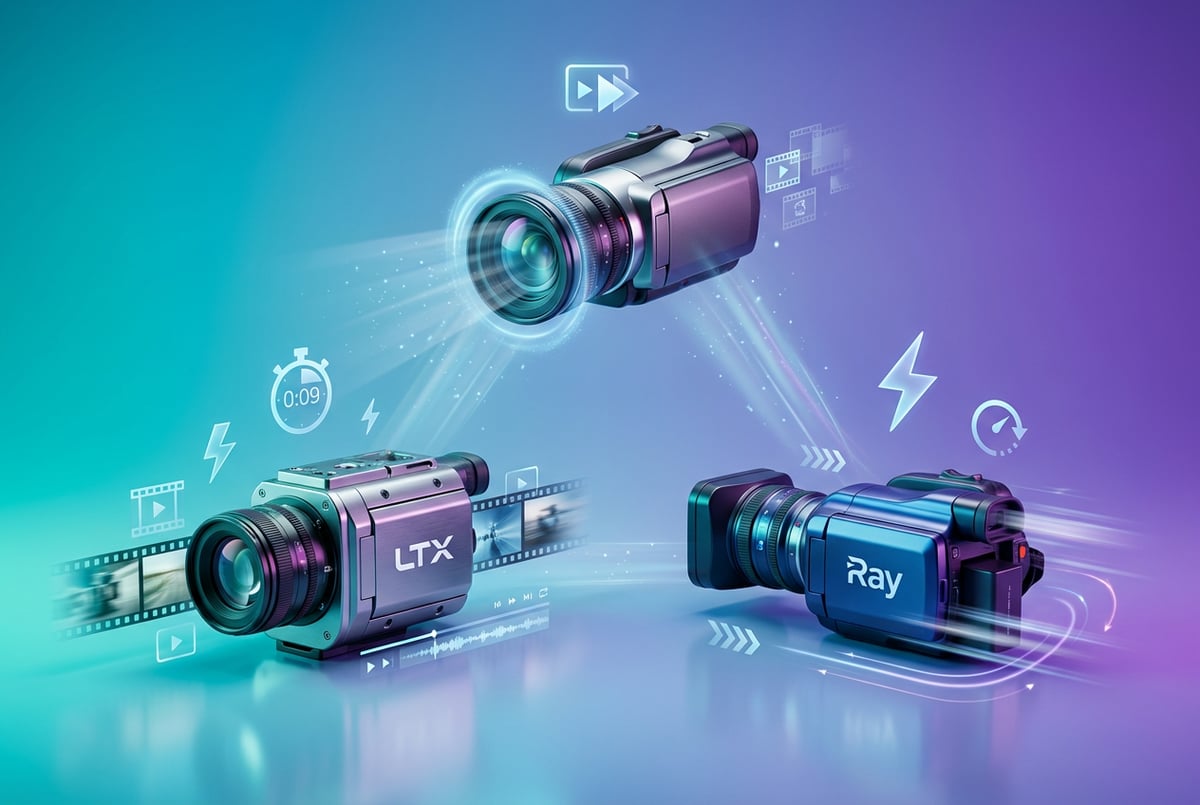
Two models stand out for speed-first workflows in 2026: Lightricks’ LTX-2 19b and Luma Labs’ Ray Flash 2. Both models prioritize fast inference without sacrificing visual quality, but they take different approaches to achieving speed. LTX-2 19b brings open-source transparency and synchronized audio generation, while Ray Flash 2 offers proprietary optimizations built specifically for professional creative environments.
This comparison examines both models from a practical workflow perspective. We’ll look at generation speed, output quality, pricing structures, and real-world use cases to help you choose the right model for your specific needs.
Why Speed Matters in AI Video Generation Workflows
Speed in AI video generation isn’t just about impatience. Fast generation enables entirely different creative workflows that slower models make impossible.
When a model generates video in under 10 seconds, you can iterate rapidly. You can test five different camera angles for the same scene in a minute. You can show a client three variations of an intro sequence during a call. You can A/B test video concepts for social media campaigns without committing hours to each version.
Other agents ship a demo. Remy ships an app.
Real backend. Real database. Real auth. Real plumbing. Remy has it all.

Fast models also enable real-time interaction. Some creative teams now use speed-optimized models during ideation sessions, generating visual concepts on the fly as teams discuss ideas. This transforms AI video generation from a post-production tool into a brainstorming aid.
For production teams creating high volumes of content, speed directly impacts economics. A marketing team creating 50 social media videos per week needs different tools than a studio producing one cinematic piece per month. Fast models make high-volume workflows viable where slower alternatives would create bottlenecks.
The tradeoff historically has been quality. Faster models often produced lower resolution outputs, visible artifacts, or inconsistent motion. Both LTX-2 19b and Ray Flash 2 claim to minimize these tradeoffs, offering production-ready quality at speeds that enable rapid iteration.
LTX-2 19b: Open Source Speed with Synchronized Audio
LTX-2 19b represents a significant milestone as the first open-source model combining native 4K video generation with synchronized audio in a single pass. Released by Lightricks in January 2026, the model contains 19 billion parameters split asymmetrically: 14 billion for video generation and 5 billion for audio.
The architecture uses a Diffusion Transformer (DiT) approach, which differs from traditional U-Net models by processing video as sequences of latent tokens. This architectural choice enables the model to scale efficiently and maintain consistency across longer sequences.
LTX-2 19b offers two performance modes. Fast Mode generates videos in under 10 seconds with good visual quality, making it suitable for rapid prototyping, previews, and high-volume batch processing. Pro Mode delivers maximum quality output with enhanced detail and better motion coherence, typically completing generation in 30-60 seconds.
The model supports resolutions from 1080p to 4K at frame rates of 25 or 50 FPS. Video duration ranges from 6 to 20 seconds per generation, which can be extended through sequential generation or video extension features.
A defining feature is synchronized audio-video generation. Rather than generating video first and adding audio as a separate step, LTX-2 creates both simultaneously. This produces natural synchronization between visual events and sounds, including dialogue with accurate lip sync, environmental ambience matching scene content, and music or sound effects aligned to motion.
The model is optimized for NVIDIA GPUs through NVFP8 quantization, which reduces model size by approximately 30% while improving performance up to 2x on compatible hardware. This makes the model practical to run on consumer-grade GPUs like the RTX 4070 Ti or better, though professional workflows benefit from higher-end cards.
Benchmark testing shows LTX-2 is approximately 18 times faster than comparable video generation models like Wan 2.2. This speed advantage comes from both architectural optimizations and efficient latent space processing.
Because LTX-2 is open source with full model weights and training code released under Apache 2.0 license, developers can fine-tune the model for specific use cases, integrate it into custom workflows, or modify the architecture for specialized applications. For companies under $10 million in annual recurring revenue, commercial use is completely free.
The training data comes from licensed sources including Getty Images and Shutterstock, addressing copyright concerns that affect some other AI video models. This makes the model safer for commercial applications where content provenance matters.
Ray Flash 2: Proprietary Speed for Professional Workflows
- ✕a coding agent
- ✕no-code
- ✕vibe coding
- ✕a faster Cursor
The one that tells the coding agents what to build.
Ray Flash 2 is Luma Labs’ speed-optimized video generation model, designed specifically to reduce the quality-speed-cost tradeoffs that typically force users to choose between fast generation and production-quality output.
The model uses an accelerated frame interpolation and text-conditioning architecture. Rather than generating every frame independently, the model intelligently interpolates between keyframes while maintaining scene consistency. This approach enables faster generation without the visual drift or inconsistency that can affect other rapid generation methods.
Ray Flash 2 generates videos up to 9 seconds long at resolutions up to 4K. The typical processing time is approximately 1 minute from prompt submission to completed video, making it nearly twice as fast as its predecessor Luma Ray 2.
The model supports several advanced features beyond basic text-to-video generation. Users can specify first and last frames as images, effectively creating image-to-video animations with controlled start and end states. The model can extend previously generated videos by passing their generation IDs, enabling longer sequences through sequential generation. Looped video support allows creating seamless video loops for backgrounds or repetitive content.
Recent updates with Ray3.14 have pushed performance further. The latest version achieves four times faster generation speeds and three times cheaper per-second pricing compared to earlier Ray models. Luma specifically optimized this version for professional creative environments, particularly animation and high-fidelity video workflows.
Ray Flash 2 excels at temporal stability and motion fidelity. The reasoning-based video generation approach maintains coherence across motion, lighting, characters, and camera behavior. This makes the model particularly effective for scenarios requiring consistent visual continuity across multiple shots or scenes.
The model is built for professional creative environments where detail adherence and consistency matter more than raw speed alone. While it prioritizes fast generation, the architecture preserves visual depth and prompt adherence that slower, higher-quality models in the Ray family maintain.
Unlike LTX-2, Ray Flash 2 is a proprietary model accessible only through Luma’s API or platform integrations. This means users cannot download model weights, fine-tune the architecture, or run it locally. Access requires using Luma’s cloud infrastructure and pricing structure.
Head-to-Head Comparison
When comparing LTX-2 19b and Ray Flash 2 directly, several key differences emerge across technical capabilities, performance characteristics, and practical workflow considerations.
Technical Architecture
LTX-2 19b uses a Diffusion Transformer (DiT) architecture with 19 billion parameters. This transformer-based approach processes video as sequences of latent tokens, enabling efficient scaling and strong temporal consistency. The asymmetric design allocates more parameters to video (14B) than audio (5B), reflecting the relative complexity of each task.
Ray Flash 2 employs accelerated frame interpolation with text-conditioning. The model generates keyframes and interpolates between them using motion prediction, which enables faster generation while maintaining visual continuity. The exact parameter count for Ray Flash 2 hasn’t been publicly disclosed by Luma Labs.
Generation Speed
LTX-2 19b in Fast Mode completes generation in under 10 seconds for most prompts. Pro Mode takes 30-60 seconds depending on resolution and duration settings. Benchmark testing shows the model is approximately 18 times faster than comparable models like Wan 2.2.
Remy is new. The platform isn't.
Remy is the latest expression of years of platform work. Not a hastily wrapped LLM.
Ray Flash 2 completes generation in approximately 1 minute per clip. With the Ray3.14 update, generation speed improved to four times faster than earlier Ray models. This makes Ray Flash 2 competitive with LTX-2’s Pro Mode for speed, though slower than LTX-2’s Fast Mode.
Output Resolution and Duration
LTX-2 19b supports resolutions from 1080p to native 4K at 25 or 50 FPS. Maximum video duration is 20 seconds per generation. Users can create longer videos through sequential generation or video extension features.
Ray Flash 2 generates up to 9-second clips at 4K resolution. The shorter maximum duration reflects the model’s optimization for quick iterations and rapid prototyping. Like LTX-2, longer sequences can be created by extending existing videos or chaining multiple generations.
Audio Capabilities
This represents one of the most significant differences between the models. LTX-2 19b generates synchronized audio and video in a single pass. The audio includes dialogue with lip sync, environmental sounds matching scene content, and music or sound effects aligned to visual events. This eliminates the need for separate audio production or manual synchronization.
Ray Flash 2 does not include native audio generation. Users must add audio separately through post-production or use additional tools to create soundtracks. For workflows requiring audio, this adds an extra step that can partially offset the model’s speed advantages.
Model Access and Deployment
LTX-2 19b is fully open source with complete model weights, inference code, and training code available under Apache 2.0 license. Users can download the model, run it locally on compatible hardware, fine-tune it for specific use cases, or modify the architecture. This provides maximum flexibility but requires technical expertise and appropriate hardware.
Ray Flash 2 is proprietary and accessible only through Luma’s API or integrated platforms. Users cannot download model weights or run the model locally. All generation happens on Luma’s infrastructure, which means less control but also eliminates the need for powerful local hardware or technical setup.
Pricing Structure
LTX-2 19b uses transparent per-second pricing. Fast Mode costs $0.04 per second of generated video at 1080p, scaling up to $0.08 per second for 4K. Pro Mode costs $0.08 per second at 1080p and $0.24 per second for 4K. For companies under $10 million in annual revenue, commercial use is free.
Ray Flash 2 pricing through Luma’s platform varies by subscription tier and usage volume. The Ray3.14 update reduced per-second pricing to three times cheaper than earlier Ray models, but exact public pricing details are less transparent than LTX-2’s straightforward rate card.
Quality and Consistency
Both models achieve production-quality output, but with different characteristics. LTX-2 19b excels at maintaining 4K resolution with high frame rates and natural audio synchronization. Independent benchmarks rank it in the top three AI video models globally by Artificial Analysis.
Ray Flash 2 focuses on temporal stability and motion fidelity, with particular strength in animation and high-fidelity workflows. The reasoning-based generation maintains scene coherence across motion, lighting, and camera behavior. Testing shows strong performance on realistic motion and prompt adherence.
Use Case Optimization
LTX-2 19b is optimized for use cases requiring synchronized audio-video content, including product demonstrations with narration, social media content with music, explainer videos with voiceover, and trailer or promo content. The open-source nature also makes it ideal for research applications and custom workflow integration.
Ray Flash 2 is built for professional creative environments, particularly animation, video-to-video workflows, and cinematic projects where temporal stability matters most. The proprietary optimization for these specific scenarios makes it competitive even when raw speed metrics favor other models.
Real-World Performance Analysis
Speed specifications tell only part of the story. Real-world performance depends on how models handle different types of content, their consistency across multiple generations, and how well they integrate into actual production workflows.
Content Type Performance
For static scenes with slow camera movements, both models perform well. LTX-2 19b maintains exceptional consistency in establishing shots, nature scenes, and atmospheric sequences where the environment needs to remain stable. Ray Flash 2 shows similar strength in these scenarios, with both models producing minimal visual drift or artifact introduction.
Fast-action sequences reveal differences. Ray Flash 2’s accelerated frame interpolation handles rapid movements effectively, maintaining coherence even in sports footage or action choreography. LTX-2 can struggle with extremely fast motion, particularly in Fast Mode where speed prioritization may compromise temporal consistency.
Character-focused content shows LTX-2’s audio synchronization advantage. For talking-head videos, interview content, or dialogue scenes, the integrated lip sync produces natural-looking results that would require manual post-production work with Ray Flash 2.
Crowd scenes and complex interactions challenge both models. Testing shows neither model perfectly handles large crowds with multiple interacting elements. Ray Flash 2’s trajectory prediction for human movement gives it a slight edge in coordinated group motion, while LTX-2 performs better when ambient audio matching crowd density is important.
Consistency Across Generations
One critical workflow consideration is whether a model produces consistent results when given similar prompts. Teams building content series need reliable output styling across multiple videos.
LTX-2 19b shows good consistency in Fast Mode for basic scenarios but can vary more in Pro Mode where additional quality processing introduces subtle differences. The open-source nature allows fine-tuning to improve consistency for specific style requirements.
Ray Flash 2 demonstrates strong consistency, likely due to Luma’s controlled cloud infrastructure and standardized processing pipeline. Teams report reliable style matching across batches of content, which matters for maintaining brand coherence.
Iteration Speed in Practice
Raw generation time doesn’t fully capture iteration speed. The complete cycle includes prompt writing, generation, review, revision, and regeneration.
For text-to-video workflows, LTX-2’s Fast Mode enables true rapid iteration. Teams can test multiple camera angles, lighting variations, or motion styles in minutes. The 10-second generation time makes real-time creative direction viable.
Ray Flash 2’s 1-minute generation time still enables fast iteration but requires more patience. During client presentations or creative reviews, this difference becomes noticeable. However, the model’s strong prompt adherence means fewer regenerations are often needed, partially offsetting the longer individual generation time.
For image-to-video workflows, both models support keyframe-based generation. Ray Flash 2’s explicit support for first and last frame specification provides more precise control over animation endpoints, while LTX-2’s multi-keyframe conditioning offers flexibility for complex motion sequences.
Quality vs Speed Tradeoffs
Every AI video model makes tradeoffs between generation speed and output quality. Understanding these tradeoffs helps choose the right model for specific scenarios.
Visual Quality Considerations
Built like a system. Not vibe-coded.
Remy manages the project — every layer architected, not stitched together at the last second.
LTX-2 19b in Fast Mode prioritizes speed while maintaining acceptable visual quality for most use cases. Testing shows minimal artifact introduction in simple scenes but occasional quality degradation in complex scenarios with multiple moving elements or intricate textures. Pro Mode addresses these limitations but at 3-6x longer generation times.
Ray Flash 2 maintains consistent visual quality across its single generation mode. The model doesn’t offer a quality vs speed toggle, instead optimizing for a balanced middle ground. This means you get reliable output but can’t trade additional time for higher fidelity when needed.
Motion Coherence
Motion coherence measures how naturally objects and characters move across frames. Both models handle this differently.
LTX-2’s transformer architecture maintains strong temporal consistency for medium-paced motion. The model excels at smooth camera movements and gradual scene changes. Rapid motion or complex physics interactions can challenge the model, particularly in Fast Mode where processing shortcuts may compromise motion prediction.
Ray Flash 2’s frame interpolation approach produces smooth motion even in complex scenarios. The model’s trajectory prediction handles human movement and object continuity effectively. Independent testing ranks Ray Flash 2 highly for motion fidelity in professional workflows.
Prompt Adherence
How well models follow textual prompts affects iteration efficiency. Poor prompt adherence requires more regenerations to achieve desired results.
LTX-2 19b shows strong prompt adherence for straightforward descriptions. The model’s text embedding pipeline processes semantic and phonetic details effectively, which particularly helps with audio generation. Complex prompts with multiple specific requirements may require iteration to get all elements correct.
Ray Flash 2 demonstrates excellent prompt adherence, with users reporting that the model reliably captures described actions, settings, and styles. This reduces the need for prompt engineering and minimizes regeneration cycles.
Audio Quality (LTX-2 Specific)
Since LTX-2 19b is the only model of these two offering native audio generation, its audio quality deserves specific attention.
The model generates audio including dialogue, environmental sounds, music, and sound effects. Quality is generally good for social media content and preliminary mockups. Professional audio production may still prefer dedicated audio tools for final output, but the integrated audio provides usable results that match visual timing naturally.
Lip sync accuracy is strong for clear speech in controlled settings. Accents, rapid speech, or background noise can challenge synchronization. Multi-language support works well, with the model’s multilingual text encoder handling various languages with good phonetic accuracy.
Use Case Scenarios: Which Model Fits Your Workflow
Different workflows benefit from different model strengths. Here’s how LTX-2 19b and Ray Flash 2 perform across common use cases.
Social Media Content Creation
For teams creating high volumes of social media videos, speed and audio integration matter most. LTX-2 19b’s Fast Mode with synchronized audio enables rapid content production. A social media manager can generate multiple video concepts for A/B testing in minutes, complete with background music and sound effects.
Ray Flash 2 works well for visually-driven social content where audio will be added separately or where platform audio (trending sounds, licensed music) will be used instead. The model’s strong prompt adherence helps match brand visual styles consistently.
Winner for this use case: LTX-2 19b due to speed and integrated audio, though Ray Flash 2 remains viable for visual-only workflows.
Client Presentations and Mockups
One coffee. One working app.
You bring the idea. Remy manages the project.
When presenting concepts to clients, iteration speed during meetings can be valuable. LTX-2’s Fast Mode enables real-time generation during calls, allowing immediate visualization of client feedback.
Ray Flash 2’s 1-minute generation time is still fast enough for presentation workflows, particularly when consistent quality matters more than instantaneous results. The model’s reliable output reduces the risk of showing clients inconsistent variations.
Winner for this use case: LTX-2 19b for interactive presentations, Ray Flash 2 for pre-prepared concept collections.
Animation and Motion Graphics
Professional animation workflows need temporal stability and motion fidelity more than raw speed. Ray Flash 2’s optimization for animation and high-fidelity workflows makes it strong in this category. The model maintains coherence across motion sequences and handles trajectory prediction for character movement effectively.
LTX-2 can handle animation use cases but isn’t specifically optimized for this scenario. The open-source nature allows fine-tuning for animation-specific requirements, which can improve performance for dedicated animation pipelines.
Winner for this use case: Ray Flash 2 for professional animation, with LTX-2 as an option for teams willing to invest in custom optimization.
Product Demonstrations
Product demo videos often combine visual product shots with explanatory narration. LTX-2’s synchronized audio generation makes it ideal for creating complete product demonstrations in a single generation pass. Teams can describe product features, benefits, and use cases in the text prompt and get video with matching narration.
Ray Flash 2 requires separate audio production, adding workflow steps. However, for product demos where professional voiceover talent will be used anyway, this may not be a significant disadvantage.
Winner for this use case: LTX-2 19b for integrated audio-visual demos, though professional productions may use Ray Flash 2 with custom audio.
Educational Content
Educational videos need clear visuals and good audio explanation. LTX-2’s ability to generate both simultaneously streamlines educational content production. Teachers and instructional designers can describe concepts verbally and get synchronized video explanation.
The model’s multilingual support also helps create educational content in multiple languages without separate audio production for each version.
Winner for this use case: LTX-2 19b for multilingual and audio-integrated educational content.
Marketing and Advertising
Marketing videos vary widely in requirements. Short-form ads for social platforms benefit from LTX-2’s speed and audio integration. Longer-form brand content or high-production commercials may benefit from Ray Flash 2’s consistency and professional workflow optimization.
For A/B testing ad concepts, LTX-2’s Fast Mode enables rapid generation of multiple variations. For final production where every frame matters, Ray Flash 2’s motion fidelity provides polished results.
Winner for this use case: Depends on specific requirements - LTX-2 for testing and iteration, Ray Flash 2 for final production quality.
Research and Development
Teams researching AI video generation or developing custom applications need model access and flexibility. LTX-2’s open-source nature with full model weights and training code makes it the clear choice. Researchers can modify the architecture, fine-tune on custom datasets, and integrate the model into experimental workflows.
Ray Flash 2’s proprietary nature limits research applications to API-based experiments without access to underlying model architecture.
Winner for this use case: LTX-2 19b as the only viable option for research requiring model access.
Pricing and Total Cost of Ownership
Understanding true costs requires looking beyond per-generation pricing to total workflow costs including infrastructure, integration effort, and ongoing operational expenses.
Direct Generation Costs
LTX-2 19b offers transparent pricing. Fast Mode at 1080p costs $0.04 per second, meaning a 10-second video costs $0.40. At 4K resolution, the same video in Fast Mode costs $0.80. Pro Mode doubles these costs, with 1080p at $0.08 per second and 4K at $0.24 per second.
For a team generating 100 videos per week at 10 seconds each in 1080p Fast Mode, monthly costs would be approximately $160 ($0.40 × 100 × 4 weeks). Upgrading to 4K Fast Mode doubles this to $320 per month.
Companies under $10 million in annual recurring revenue can use LTX-2 commercially for free, making it extremely cost-effective for startups and small businesses.
Ray Flash 2 pricing varies by Luma’s subscription tiers. While exact public pricing isn’t as transparent as LTX-2, the Ray3.14 update reduced per-second costs to three times cheaper than earlier Ray models. Teams report that high-volume generation can become expensive on Luma’s platform, though exact costs depend on subscription level and usage patterns.
Infrastructure Costs
LTX-2’s open-source nature allows local deployment but requires appropriate hardware. Running the model efficiently needs at least an RTX 4070 Ti GPU for 4K generation. A professional workstation with RTX 4090 provides optimal performance.
For teams without existing GPU infrastructure, cloud GPU rental adds costs. NVIDIA H100 GPU instances cost approximately $2-4 per hour on major cloud providers. For high-volume generation, dedicated hardware may become cost-effective compared to cloud rental.
Ray Flash 2 runs on Luma’s infrastructure, eliminating hardware costs but creating ongoing subscription expenses. For teams without existing GPU resources, this can be more economical than purchasing dedicated hardware, particularly for moderate usage volumes.
Integration and Development Costs
Both models offer API access for integration into custom workflows. LTX-2’s API is well-documented with examples in multiple programming languages. The open-source nature allows deeper customization but may require more development effort.
Ray Flash 2’s proprietary API is streamlined for standard use cases. Luma provides robust documentation and support for common integration scenarios. Custom modifications beyond the API capabilities aren’t possible, which can simplify integration but limits flexibility.
For teams using platforms like MindStudio, both models are accessible through unified interfaces that eliminate custom integration work. This dramatically reduces development costs and technical barriers for teams without dedicated AI engineering resources.
Opportunity Costs
Speed differences translate to productivity differences. If LTX-2’s Fast Mode saves 50 seconds per generation compared to Ray Flash 2, a team generating 50 videos daily saves over 40 minutes of waiting time. For creative professionals billing $100+ per hour, this represents significant value beyond direct generation costs.
Audio integration costs also matter. Teams using LTX-2 avoid separate audio production, voiceover recording, and synchronization work that Ray Flash 2 workflows require. This can save hours per project for audio-heavy content.
Cost Optimization Strategies
For LTX-2 users, optimizing costs involves balancing Fast vs Pro Mode usage. Using Fast Mode for initial iterations and switching to Pro Mode only for final outputs minimizes costs while maintaining quality where needed.
Remy doesn't write the code. It manages the agents who do.
Remy runs the project. The specialists do the work. You work with the PM, not the implementers.
Frame count and resolution directly affect costs. Generating at 1080p and upscaling with traditional tools may be cheaper than native 4K generation for some use cases.
For Ray Flash 2 users, subscription tier selection and usage monitoring prevent unexpected costs. Teams should track generation volumes and adjust subscriptions to match actual usage patterns.
Integration and Workflow Considerations
Model capabilities matter less if integration into existing workflows proves difficult. Both LTX-2 and Ray Flash 2 offer different integration paths suited to different team structures.
API Access and Documentation
LTX-2 provides comprehensive API documentation with examples in Python, JavaScript, and other common languages. The API supports text-to-video and image-to-video generation with extensive parameter control including resolution, frame rate, duration, and audio settings.
The open-source nature means developers can examine the complete codebase, understand exactly how the model processes inputs, and troubleshoot issues with full transparency. GitHub repositories include implementation examples, training scripts, and community contributions.
Ray Flash 2 offers clean API documentation through Luma’s developer portal. The API is designed for straightforward integration with standard endpoints for video generation, status checking, and result retrieval. While not open source, the API is well-maintained with good uptime and responsive support.
Platform Integrations
Both models integrate with various platforms and tools. LTX-2 works with ComfyUI, enabling local workflows with visual programming interfaces. NVIDIA has optimized ComfyUI performance by 40% for LTX-2, with 60% reduced VRAM usage.
Ray Flash 2 integrates with Luma’s platform and various third-party tools through API connections. The model is available through aggregation platforms that provide unified access to multiple AI video models.
Platforms like MindStudio offer instant access to both LTX-2 19b and Ray Flash 2 through a unified interface. This eliminates the need to manage separate API keys, learn different documentation systems, or maintain multiple integration codebases. For teams working with multiple AI models, unified platforms significantly reduce integration complexity.
Workflow Automation
Both models support workflow automation through their APIs. Teams can build automated pipelines that generate video from content calendars, create variations of existing concepts, or produce personalized videos at scale.
LTX-2’s local deployment option enables fully offline automated workflows for teams with security requirements or limited cloud access. The model can be integrated into on-premises systems without external API dependencies.
Ray Flash 2’s cloud-only access requires internet connectivity for all automated workflows. This provides reliability and performance consistency but creates dependencies on Luma’s infrastructure availability.
Batch Processing
High-volume content creation requires efficient batch processing. LTX-2 supports batch processing through its API with concurrent generation requests limited by available GPU resources. Teams with multiple GPUs can process several videos simultaneously.
Ray Flash 2 supports batch processing through Luma’s infrastructure. The platform handles queuing and resource allocation automatically, though throughput may be limited by subscription tier and platform capacity.
Version Control and Reproducibility
For production workflows, reproducing specific results reliably matters. LTX-2’s deterministic generation with fixed random seeds enables exact reproduction of previous outputs. This helps when iterating on specific clips or maintaining consistency across content series.
Ray Flash 2 also supports seed-based reproducibility, ensuring teams can regenerate specific outputs when needed. The proprietary cloud infrastructure provides consistent execution environments, reducing variability from hardware differences.
Remy doesn't build the plumbing. It inherits it.
Other agents wire up auth, databases, models, and integrations from scratch every time you ask them to build something.
Remy ships with all of it from MindStudio — so every cycle goes into the app you actually want.
How MindStudio Simplifies Access to Both Models
Managing multiple AI video models typically requires separate API keys, different documentation systems, varying pricing structures, and custom integration code for each model. This complexity creates barriers for teams without dedicated AI engineering resources.
MindStudio addresses this by providing instant access to both LTX-2 19b and Ray Flash 2 through a unified platform. Instead of managing individual model integrations, teams access multiple AI video generation models through a single interface.
The platform eliminates technical setup barriers. Users don’t need to download models, configure local GPUs, or manage API keys for multiple services. Both LTX-2 and Ray Flash 2 are available immediately through MindStudio’s AI Video Workbench, along with models from other providers like ByteDance, Google, OpenAI, and Runway.
For workflow automation, MindStudio supports creating intelligent agents that reason across multiple steps rather than just triggering simple tasks. Teams can build automated generation pipelines that select the appropriate model based on content requirements, generate videos, and schedule publication across platforms.
The platform automatically integrates with CivitAI LoRAs, allowing custom model variations without manual downloads or version matching. Users simply provide the LoRA URL and MindStudio handles integration with the appropriate base model.
Cost management becomes simpler through unified billing instead of tracking separate subscriptions and usage across multiple platforms. Teams see consolidated usage metrics and can compare actual costs across different models to optimize spending.
For teams creating content at scale, MindStudio enables automated production pipelines from ideation through generation to publishing. This end-to-end workflow support goes beyond simple API access to provide complete production infrastructure.
The low-code approach makes AI video generation accessible to professionals without programming expertise. Marketing teams, content creators, and product managers can leverage advanced models like LTX-2 and Ray Flash 2 without requiring engineering support for every workflow change.
Which Model Should You Choose?
The right choice between LTX-2 19b and Ray Flash 2 depends on specific workflow requirements, technical capabilities, and content priorities.
Choose LTX-2 19b if you need:
- Fastest possible generation speed for rapid iteration
- Synchronized audio-video content in a single generation pass
- Open-source flexibility for custom modifications or fine-tuning
- Local deployment capability for security or offline workflows
- Longer video durations up to 20 seconds
- Free commercial use (for companies under $10M ARR)
- Native 4K generation at 50 FPS
- Transparent, predictable per-second pricing
- Full model access for research or development
- Multilingual audio generation
LTX-2 19b is the better choice for teams prioritizing speed, audio integration, and flexibility. The open-source nature provides maximum control for technical teams willing to invest in custom optimization. The integrated audio generation eliminates separate production steps, streamlining workflows for audio-heavy content.
Choose Ray Flash 2 if you need:
- Professional animation and motion graphics workflows
- Exceptional temporal stability and motion fidelity
- Consistent output quality without mode selection
- Cloud infrastructure without local hardware requirements
- Strong prompt adherence with minimal iteration
- Professional creative environment optimization
- Proprietary optimization for specific use cases
- Managed infrastructure with guaranteed uptime
Other agents start typing. Remy starts asking.
Scoping, trade-offs, edge cases — the real work. Before a line of code.
Ray Flash 2 is the better choice for professional creative teams focusing on visual quality and motion consistency. The proprietary optimization for animation and high-fidelity workflows provides polish that benefits final production quality. Teams without GPU infrastructure benefit from cloud-only access.
Consider Using Both
Many workflows benefit from using different models for different stages. Teams might use LTX-2’s Fast Mode for initial concept exploration and rapid iteration, then switch to Ray Flash 2 for final production of complex motion sequences.
Platforms like MindStudio make multi-model workflows practical by providing unified access to both models. This eliminates the friction of managing multiple integrations and allows choosing the optimal model for each specific task.
Future Developments and Model Evolution
Both LTX-2 and Ray Flash 2 continue evolving. Understanding development trajectories helps plan for future workflow capabilities.
LTX-2’s open-source nature enables rapid community-driven improvements. Developers are creating custom LoRAs for specific styles, fine-tuning models for specialized use cases, and optimizing performance for various hardware configurations. Lightricks regularly releases updates improving quality, expanding capabilities, and addressing user feedback.
The model’s architecture supports future enhancements including longer video durations through improved temporal modeling, better physics simulation for realistic object interactions, enhanced camera control with multi-keyframe conditioning, and improved audio quality through model refinement.
Ray Flash 2 benefits from Luma’s continued investment in professional creative tools. The Ray3.14 update demonstrated significant performance improvements, and Luma’s roadmap includes further optimization for animation workflows, enhanced reasoning capabilities for complex prompts, and better integration with professional creative tools.
Both models will likely see resolution improvements, longer maximum durations, better prompt adherence, and faster generation speeds as the underlying technologies advance. The competitive landscape pushes both proprietary and open-source models toward continuous improvement.
Conclusion
LTX-2 19b and Ray Flash 2 represent two different approaches to speed-first AI video generation. LTX-2 prioritizes maximum speed with integrated audio generation and open-source flexibility, while Ray Flash 2 focuses on professional creative workflows with exceptional motion fidelity.
For teams needing fastest possible iteration, synchronized audio-video content, or open-source flexibility, LTX-2 19b provides clear advantages. The model’s Fast Mode generation under 10 seconds enables truly interactive creative workflows, and the integrated audio eliminates separate production steps.
For professional animation teams, motion graphics producers, or workflows where temporal stability matters most, Ray Flash 2’s proprietary optimization delivers polished results. The model’s consistent quality and strong prompt adherence reduce iteration cycles even with slightly longer generation times.
The practical reality for many teams is that different projects benefit from different models. Rather than committing exclusively to one approach, using unified platforms like MindStudio enables accessing both models through single interfaces, choosing the optimal tool for each specific task.
Speed in AI video generation isn’t just about faster rendering. It’s about enabling new creative workflows, reducing iteration friction, and making high-quality video production accessible to teams without massive production budgets. Both LTX-2 19b and Ray Flash 2 advance this goal, each excelling in different scenarios.
As AI video generation technology continues evolving rapidly, the models that succeed will be those enabling creators to focus on creative vision rather than technical constraints. Whether through open-source flexibility or proprietary optimization, both approaches contribute to making professional video production faster, more accessible, and more powerful than ever before.