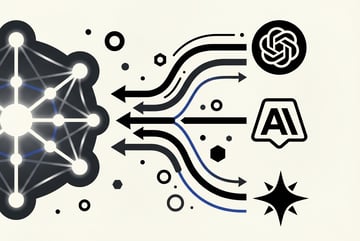
How to Build AI Agents Using Different LLM Providers
Tutorial on creating AI agents that leverage multiple large language model providers for optimal results across different tasks.

Why Building with Multiple LLM Providers Actually Matters
You’re probably using one LLM provider right now. Maybe OpenAI because it was first, or Claude because it’s good at reasoning, or Gemini because you’re already in the Google ecosystem.
That works fine until it doesn’t. Then you’re stuck when that provider has an outage, changes pricing, or a new model comes out that’s better for your specific task. Your entire AI application depends on one vendor’s uptime, pricing decisions, and roadmap.
The solution is building AI agents that can work across different LLM providers. Not as a backup plan, but as a core architecture decision. Different models are better at different things. GPT-4 Turbo excels at complex reasoning. Claude 3.5 Sonnet is strong at code generation. Gemini Pro handles long context windows efficiently. DeepSeek offers competitive performance at much lower cost.
This isn’t about being trendy. It’s about building systems that work reliably, cost less to run, and don’t lock you into one vendor’s ecosystem.
The Real Problem with Single-Provider AI Agents
When you build an AI agent around a single LLM provider, you inherit all their limitations. Here’s what that actually looks like in production.
Vendor Lock-In Creates Risk
Your application code becomes tightly coupled to one provider’s API structure. When OpenAI changes their API (which they do), you need to update your entire codebase. When they adjust pricing (which happened in 2024 and 2025), you either pay more or scramble to migrate.
Remy doesn't build the plumbing. It inherits it.
Other agents wire up auth, databases, models, and integrations from scratch every time you ask them to build something.
Remy ships with all of it from MindStudio — so every cycle goes into the app you actually want.

Migration isn’t simple. Different providers structure their APIs differently, even when they claim OpenAI compatibility. Response formats vary. Error handling differs. Rate limits work differently. Moving from one provider to another means rewriting significant portions of your application logic.
Reliability Becomes Single Point of Failure
Every LLM provider has outages. OpenAI went down in June 2024 and November 2024. Anthropic had issues in March 2025. Google Cloud AI services experienced disruptions in August 2025. When your only provider is down, your entire AI application stops working.
Companies report losing thousands of dollars per minute during provider outages. Customer service chatbots stop responding. Sales automation halts. Internal productivity tools become unavailable. You can’t do anything except wait for the provider to fix their systems.
Cost Optimization Hits a Wall
Different tasks have different requirements. Simple classification doesn’t need GPT-4’s power. Long document summarization benefits from models with larger context windows. Code generation works better with specialized models. But if you’re locked into one provider, you use their most expensive model for everything or accept lower quality for cost-sensitive tasks.
Token costs vary dramatically between providers. OpenAI charges $0.01 per 1K input tokens for GPT-4o. Anthropic’s Claude 3.5 Sonnet costs $0.003 per 1K tokens. Google’s Gemini 1.5 Flash is even cheaper. DeepSeek models cost 90% less than comparable Western models. When you can’t route tasks to the most cost-effective provider, you overspend by 30-60%.
Performance Requirements Vary by Task
No single LLM excels at everything. Benchmark data from early 2026 shows GPT-4 Turbo leads in general reasoning tasks. Claude 3.5 Sonnet performs better on coding challenges. Gemini 1.5 Pro handles multimodal inputs more effectively. DeepSeek-R1 matches or exceeds GPT-4 performance on mathematical reasoning at a fraction of the cost.
Different tasks need different capabilities. Customer service needs fast response times and conversational ability. Legal document analysis requires deep reasoning and accuracy. Code generation benefits from specialized training. When you’re limited to one provider’s models, you compromise on performance for at least some use cases.
Understanding LLM Provider Strengths in 2026
Each major LLM provider has distinct capabilities. Understanding these differences helps you route tasks to the right model.
OpenAI: General Purpose Excellence
OpenAI’s GPT-4 Turbo and GPT-4o remain strong general-purpose models. They excel at complex reasoning tasks, instruction following, and generating coherent long-form content. The models handle diverse prompts well and maintain consistency across different domains.
Strengths include broad knowledge coverage, strong reasoning capabilities, and excellent API documentation. The ecosystem around OpenAI is mature, with extensive tooling and community support.
Weaknesses are cost (among the most expensive per token), occasional rate limiting under heavy load, and context window limitations compared to newer models. Response times can be slower for complex queries.
Anthropic Claude: Safety and Reasoning
Claude 3.5 Sonnet leads in coding tasks and complex reasoning. The model reflects on its responses before generating output, which reduces errors but increases latency slightly. Claude models excel at understanding nuanced instructions and avoiding harmful outputs.
Strengths include superior code generation, strong reasoning on complex problems, better instruction following for detailed prompts, and robust safety features. Claude handles edge cases more gracefully than some alternatives.
- ✕a coding agent
- ✕no-code
- ✕vibe coding
- ✕a faster Cursor
The one that tells the coding agents what to build.
Weaknesses are higher cost than some competitors, longer response times due to reasoning approach, and less aggressive expansion of model variants.
Google Gemini: Multimodal and Context
Gemini 1.5 Pro handles up to 1 million token context windows, allowing analysis of extremely long documents or entire codebases in one request. The model performs well on multimodal tasks involving text, images, and video.
Strengths include massive context windows, strong multimodal capabilities, competitive pricing, and tight integration with Google Cloud services. Gemini Flash offers good performance at very low cost.
Weaknesses are less consistent performance on pure text tasks compared to GPT-4, and fewer specialized model variants for specific domains.
DeepSeek: Cost-Effective Performance
DeepSeek models from China offer competitive performance at dramatically lower prices. DeepSeek-R1 achieves results comparable to GPT-4 on mathematical reasoning and coding tasks while costing 90% less.
Strengths include extremely low cost, strong reasoning capabilities, good performance on technical tasks, and competitive benchmarks with Western models.
Weaknesses are data security concerns for some enterprises, potential regulatory restrictions, less established ecosystem, and fewer model variants.
Specialized Models for Specific Tasks
Beyond the major providers, specialized models excel at specific domains. Medical AI models understand healthcare terminology. Legal models handle contract analysis. Financial models interpret market data. Code-specific models like CodeLlama outperform general models on programming tasks.
These specialized options let you optimize for specific use cases rather than using general-purpose models for everything.
Architectural Approaches for Multi-Provider AI Agents
Building AI agents that work across multiple LLM providers requires thoughtful architecture. Here are the main approaches that work in production.
Unified Interface Layer
The unified interface pattern creates a single API that abstracts away provider differences. Your application code calls one interface, and the layer handles routing requests to different providers.
This approach normalizes inputs and outputs across providers. You send a request in a standard format, and the interface translates it to each provider’s specific API structure. Responses get converted back to your standard format before returning to your application.
Benefits include decoupling application logic from provider APIs, easy provider switching, and centralized configuration management. You update provider credentials or add new providers without touching application code.
Challenges are handling provider-specific features that don’t map cleanly to your interface, maintaining the abstraction layer as providers update APIs, and potential performance overhead from translation layers.
Smart Routing Architecture
Smart routing sends different types of requests to different providers based on task characteristics. Simple queries go to fast, cheap models. Complex reasoning tasks route to more capable models. Long document analysis uses models with large context windows.
This pattern includes routing rules based on prompt length, task type, required response time, cost constraints, and model capabilities. The router evaluates each request and selects the optimal provider.
Benefits include cost optimization by using cheaper models where appropriate, better performance by matching tasks to model strengths, and improved reliability through automatic failover to backup providers.
Challenges are defining effective routing rules, handling edge cases where classification is unclear, and monitoring to ensure routing decisions work as intended.
Fallback and Retry Patterns
Other agents ship a demo. Remy ships an app.
Real backend. Real database. Real auth. Real plumbing. Remy has it all.
Fallback patterns define alternative providers when the primary option fails. If OpenAI returns an error, the system automatically retries with Anthropic. If that fails, it tries Google.
This pattern implements retry logic with exponential backoff, provider health monitoring, and graceful degradation when all providers fail. Circuit breakers prevent repeatedly calling failing providers.
Benefits include high availability despite provider outages, automatic recovery from transient failures, and reduced manual intervention when problems occur.
Challenges are managing state across retry attempts, ensuring consistent responses when switching providers mid-conversation, and avoiding cascading costs from excessive retries.
Hybrid Approaches
Production systems often combine multiple patterns. A hybrid architecture might use smart routing for initial provider selection, unified interfaces for consistent API interaction, and fallback patterns for reliability.
You might route simple customer service queries to a cheap, fast model, complex technical support to Claude, and document analysis to Gemini. If any provider fails, the system falls back to alternatives while maintaining conversation context.
Implementation Strategies That Actually Work
Moving from architecture to implementation requires handling specific technical challenges. Here’s what works based on production experience.
Standardizing API Interactions
Different providers structure their APIs differently even when claiming OpenAI compatibility. Standardization requires creating a common request format that captures all necessary information without provider-specific details.
Your standard format should include the user prompt, system instructions, model parameters like temperature and max tokens, conversation history for context, and any tool definitions for function calling.
The interface layer translates this standard format to each provider’s specific structure. OpenAI uses the ChatCompletion API. Anthropic uses the Messages API with different parameter names. Google uses different field structures entirely.
Error handling needs standardization too. Different providers return errors in different formats with different status codes. Your interface should normalize these to consistent error types your application can handle uniformly.
Managing Context and State
AI agents maintain context across multiple interactions. When switching between providers, you need to preserve conversation history, user preferences, and task state.
Context management requires storing conversation history in a provider-agnostic format, tracking which provider handled each interaction, maintaining any provider-specific caching or optimization hints, and preserving tool execution results.
When switching providers mid-conversation, the new provider needs full context from previous interactions. This means replaying conversation history in a format the new provider understands.
State management for multi-step tasks gets more complex. If an agent starts a task with OpenAI but needs to complete it with Claude, the system must transfer not just conversation history but the current task state and any intermediate results.
Implementing Prompt Caching
Prompt caching reduces costs and latency by reusing processed prompts across requests. When multiple requests share common prefixes like system instructions or knowledge base content, caching prevents reprocessing the same tokens repeatedly.
Caching strategies depend on provider capabilities. Anthropic offers explicit prompt caching with specific API parameters. OpenAI caches implicitly based on usage patterns. Other providers have different approaches or no caching.
Effective caching requires organizing prompts so common elements appear at the start, tracking which providers support caching, maintaining cache affinity by routing similar requests to the same provider, and monitoring cache hit rates to measure effectiveness.
Plans first. Then code.
Remy writes the spec, manages the build, and ships the app.
Cache invalidation needs careful handling. When system instructions or knowledge base content changes, cached versions become stale. The system needs to detect changes and invalidate cached prompts appropriately.
Handling Function Calling and Tools
AI agents often need to call external functions or use tools. Function calling works differently across providers.
OpenAI uses the function calling API with specific schema formats. Anthropic uses tool use with Claude-specific structures. Google has its own function calling implementation. Each requires different parameter formatting and response handling.
Your interface layer needs to translate tool definitions into provider-specific formats, handle tool execution consistently regardless of provider, and normalize tool results before returning to the model.
Multi-step tool interactions get complicated when switching providers. If an agent starts a task with one provider, calls several tools, then needs to switch providers, all tool execution history must transfer correctly.
Cost Tracking and Monitoring
Multi-provider architectures require careful cost monitoring. You need to track token usage per provider, calculate costs based on different pricing models, attribute costs to specific tasks or users, and identify opportunities for optimization.
Different providers charge different rates for input and output tokens. Some offer caching discounts. Others have volume pricing. Context window usage affects costs differently across providers.
Effective monitoring tracks cost per request, identifies expensive patterns, compares actual costs against routing decisions, and alerts when costs exceed thresholds.
This data informs routing decisions. If certain task types consistently cost more with one provider, adjust routing rules to use more cost-effective alternatives.
Best Practices for Production Multi-Provider Systems
Production deployments reveal practices that separate working systems from fragile ones.
Start with Clear Routing Rules
Simple routing rules work better than complex ones. Start with basic criteria like task type, prompt length, and cost constraints. Avoid using AI to decide which AI to use unless you have clear evidence it improves results.
Define routing rules based on measurable characteristics. Route prompts under 1000 tokens to fast, cheap models. Send coding tasks to Claude. Direct long document analysis to Gemini. Simple rules are easier to debug and adjust.
Monitor routing decisions to ensure they work as intended. Track which providers handle which request types, measure performance and cost for each routing decision, and identify cases where routing logic makes poor choices.
Iterate based on data. If certain task types perform better with a different provider, update routing rules. If cost patterns change, adjust optimization strategies.
Implement Comprehensive Observability
You need visibility into provider performance, routing decisions, cost patterns, and error rates. Observability helps identify problems before they impact users.
Track request latency per provider, success and error rates, token usage and costs, cache hit rates, and fallback frequency. This data reveals performance patterns and optimization opportunities.
Distributed tracing shows request flow across providers. When a request fails or performs poorly, tracing reveals where problems occurred. Did the primary provider timeout? Did the fallback mechanism work? Did context transfer correctly?
Use structured logging with consistent formats across providers. Include request IDs, provider names, model versions, token counts, response times, and any errors. This makes debugging and analysis much easier.
Design for Graceful Degradation
Everyone else built a construction worker.
We built the contractor.
One file at a time.
UI, API, database, deploy.
When things go wrong, the system should degrade gracefully rather than failing completely. Prioritize availability over perfect responses.
Graceful degradation means using simpler models when advanced ones fail, returning partial results rather than errors, maintaining core functionality even when some features break, and communicating limitations clearly to users.
Circuit breakers prevent repeatedly calling failing providers. When a provider fails multiple times, the circuit breaker stops sending requests for a period. This prevents wasting time and money on requests likely to fail.
Fallback chains define alternative providers in order of preference. If the first choice fails, try the second. If that fails, try the third. The system works as long as at least one provider is available.
Test Across All Providers
Different providers handle the same prompt differently. Testing across all providers ensures consistent behavior.
Create test cases covering common scenarios, edge cases, error conditions, and boundary conditions like maximum context length. Run these tests against all providers you use.
Test provider switching mid-conversation. Does context transfer correctly? Do responses maintain consistency? Does state persist properly?
Test failover scenarios. What happens when the primary provider goes down? Does fallback work correctly? Does the system recover when the primary provider comes back?
Manage Credentials and Configuration Securely
Multiple providers mean multiple sets of API keys and configuration. Secure management is critical.
Store credentials in secure secret management systems, not in code or configuration files. Rotate keys regularly. Use different keys for different environments.
Configuration should be centralized and version controlled. When you update routing rules or add providers, the changes should be reviewable and auditable.
Monitor for compromised credentials. If a key starts making unusual requests or exceeds normal usage patterns, investigate immediately.
How MindStudio Simplifies Multi-Provider AI Agent Development
Building the infrastructure to work across multiple LLM providers takes significant engineering effort. You need to handle API differences, implement routing logic, manage credentials, track costs, and ensure reliability.
MindStudio solves these problems by providing a unified platform that connects to over 200 AI models across all major providers. The platform handles provider integration, routing, and management so you can focus on building your AI agent’s logic.
Instant Multi-Provider Access
MindStudio’s Service Router connects to OpenAI, Anthropic, Google, AWS Bedrock, Azure OpenAI, and dozens of other providers through a single interface. You don’t write provider-specific code or manage different API keys separately.
When you build an AI agent in MindStudio, you select which models to use from any provider. The platform handles authentication, API calls, response formatting, and error handling. Switching between providers is as simple as changing a configuration setting.
The visual workflow builder lets you design multi-step AI agents that use different models for different tasks. Your customer service agent might use GPT-4o for initial classification, Claude for complex reasoning, and Gemini Flash for simple responses. MindStudio orchestrates these interactions automatically.
Built-In Cost Management
MindStudio tracks token usage and costs across all providers in one dashboard. You see exactly how much each agent costs to run, which providers you’re using most, and where optimization opportunities exist.
The platform bills at cost with no markup. You pay provider rates directly without additional fees. This transparency helps you make informed decisions about provider selection and routing strategies.
Cost tracking integrates with your AI agent workflows. You can set budget limits, receive alerts when costs exceed thresholds, and analyze spending patterns over time.
Reliability Without Extra Engineering
MindStudio implements failover and retry logic automatically. If a provider fails, the platform tries alternatives you’ve configured. You don’t build circuit breakers, implement exponential backoff, or manage retry queues.
The platform monitors provider health and routes requests to available providers. During provider outages, your agents continue working by using backup options. When the primary provider recovers, traffic automatically shifts back.
Error handling is unified across providers. Provider-specific errors get normalized to consistent formats your agent logic can handle predictably.
No Code Required But Extensible When Needed
The visual builder works without writing code. You drag components to design workflows, select models from dropdown menus, and configure routing rules through forms.
When you need custom logic, MindStudio lets you inject JavaScript and Python functions. This flexibility means you’re not limited by the platform’s built-in capabilities.
Templates provide starting points for common use cases. Customer service agents, document analysis, content generation, and data processing templates include pre-built logic you can customize.
Enterprise Security and Compliance
MindStudio meets enterprise security requirements with SOC 2 compliance, GDPR compliance, custom access controls, and granular permissions. You control who can access which agents and what data they can use.
Data doesn’t persist with LLM providers beyond each request. The platform handles credentials securely and supports SSO integration for larger teams.
Deployment Flexibility
MindStudio supports multiple deployment types. Web apps run in browsers. Autonomous agents operate on schedules. Browser extensions integrate with existing tools. Email-triggered agents respond to messages. Webhook and API endpoints connect to other systems.
This flexibility means one agent can deploy in multiple contexts without rebuilding. Your document analysis agent works as a web app, API endpoint, and email responder using the same core logic.
Common Challenges and Solutions
Even with good tools, multi-provider AI agent development presents challenges. Here’s how to address common problems.
Inconsistent Responses Across Providers
The same prompt can produce different responses from different providers. This inconsistency complicates testing and can confuse users if they notice changes.
Solutions include standardizing system instructions across providers, using structured outputs to constrain response formats, testing responses from all providers during development, and documenting expected variation in your agent’s behavior.
Consider whether consistency matters for your use case. Sometimes different responses are acceptable or even desirable. A creative writing agent might benefit from provider variation. A data extraction agent needs consistency.
Context Length Differences
Providers support different maximum context lengths. GPT-4 Turbo handles 128K tokens. Claude supports 200K. Gemini Pro goes to 1M. When an agent hits context limits, behavior becomes unpredictable.
Solutions include routing long-context requests to providers with larger limits, implementing context summarization to reduce token usage, splitting large tasks into smaller chunks, and monitoring context usage to identify problematic patterns.
Seven tools to build an app. Or just Remy.
Editor, preview, AI agents, deploy — all in one tab. Nothing to install.
Design agents to work within the smallest common context window when possible. If you need longer context, route those specific requests to capable providers.
Function Calling Incompatibilities
Providers implement function calling differently. Tool definitions need translation between formats. Some providers support parallel function calls while others don’t.
Solutions include abstracting tool definitions to a provider-neutral format, handling tool execution consistently regardless of provider, testing tool interactions with all providers, and documenting which providers support which tool capabilities.
Some advanced function calling features only work with specific providers. If you need those features, route those tasks to supporting providers.
Performance Variability
Response times vary significantly between providers and models. GPT-4 Turbo is slower than GPT-3.5. Claude can be slower than GPT-4. Gemini Flash is very fast. This variability affects user experience.
Solutions include routing time-sensitive requests to faster models, using streaming responses to reduce perceived latency, implementing timeouts with automatic failover to faster alternatives, and caching common responses to avoid repeated model calls.
Monitor P95 and P99 latencies, not just averages. Tail latencies determine user experience. If 5% of requests take 30 seconds while the rest take 2 seconds, users will notice the slow ones.
Debugging Multi-Provider Systems
When something goes wrong, finding the root cause is harder with multiple providers. Was it the routing logic? Did the provider fail? Did context transfer incorrectly?
Solutions include implementing comprehensive logging with request tracing, using unique request IDs that track across providers, logging all provider interactions with full details, and building debugging tools that replay failed requests.
Structured logs make debugging much easier. Include provider name, model version, token counts, response times, any errors, and full request/response payloads (scrubbed of sensitive data).
Real-World Use Cases
Multi-provider AI agent architectures work across many applications. Here are patterns that demonstrate practical value.
Customer Service with Cost Optimization
A customer service agent handles thousands of requests daily. Most questions are simple and don’t need expensive models. Complex issues require sophisticated reasoning.
The agent routes simple questions like “What’s your return policy?” to fast, cheap models like GPT-3.5 or Gemini Flash. These handle straightforward queries for a fraction of the cost of premium models.
Complex technical support issues route to Claude or GPT-4. These models provide detailed troubleshooting steps and handle nuanced customer situations.
This approach reduces operational costs by 40-50% compared to using expensive models for everything while maintaining quality for complex cases.
Document Analysis with Context Windows
A legal document analysis agent processes contracts, agreements, and compliance documents. Many documents are large, exceeding smaller context windows.
The agent routes short documents to GPT-4 for thorough analysis. Medium-length documents go to Claude which handles up to 200K tokens. Very large documents use Gemini Pro’s 1M token context window.
This routing ensures the entire document fits in context without chunking, which could miss important relationships between sections.
Content Generation with Specialization
A content creation agent generates marketing copy, blog posts, social media content, and technical documentation. Different content types benefit from different models.
Marketing copy generation uses GPT-4 for creative, engaging language. Technical documentation uses Claude which excels at clear, structured explanations. Social media posts use fast models like Gemini Flash for quick generation of short content.
The agent routes based on content type and automatically adjusts its approach to match each format’s requirements.
Code Generation and Review
A development assistant helps with code generation, bug fixing, and code review. Different coding tasks need different capabilities.
Code generation for new features uses Claude which produces high-quality code with good structure. Bug fixing uses models good at understanding existing code context. Code review uses models strong at identifying potential issues and suggesting improvements.
When providers have outages, the assistant falls back to alternatives. This keeps development teams productive even when their preferred provider is down.
Data Extraction and Processing
A data processing agent extracts information from documents, emails, and forms. Accuracy is critical, but most extraction tasks are straightforward.
Simple form filling uses cheap models. Complex document understanding uses more capable models. When extraction confidence is low, the agent escalates to a more sophisticated model for verification.
This tiered approach balances cost and accuracy. Most tasks use inexpensive models. Only uncertain cases use premium models.
Looking Ahead: The Future of Multi-Provider AI Agents
The landscape of LLM providers and AI agent development continues changing rapidly. Several trends will affect how you build multi-provider systems.
Standardization Efforts
Industry groups are working on standards for AI agent communication. The Agent2Agent Protocol from Google aims to enable agents from different vendors to collaborate. Open Agent Specification provides common formats for defining agents. These standards will make multi-provider architectures more practical.
Standardization reduces the integration burden. When providers implement common protocols, you write less custom code to handle their specific APIs. Context transfer between providers becomes more reliable. Tool definitions become more portable.
Improved Provider APIs
Providers are improving their APIs based on production usage. Better error handling, more consistent response formats, enhanced caching capabilities, and clearer documentation make integration easier.
Providers also recognize that customers want flexibility. Many now offer OpenAI-compatible endpoints to ease switching. This compatibility reduces vendor lock-in and makes multi-provider architectures more practical.
Specialized Models Proliferate
More specialized models emerge for specific domains. Medical models, legal models, financial models, scientific models, and code models outperform general-purpose options in their domains.
Multi-provider architectures let you use these specialized models when appropriate. Your agent can route medical queries to medical models, legal questions to legal models, and general queries to general-purpose models.
Edge and Local Models
Some models now run on edge devices or local servers. This enables AI agents that work without cloud connectivity, reducing latency and improving privacy.
Multi-provider architectures can include local models as providers. Route privacy-sensitive requests to local models. Use cloud models for complex reasoning that benefits from larger models.
Cost Competition Continues
Competition between providers drives costs down. DeepSeek’s aggressive pricing forced Western providers to reduce their rates. This trend continues as more providers enter the market.
Multi-provider architectures benefit from this competition. You can switch to cheaper providers as they emerge without rebuilding your application. Regular cost reviews help you optimize spending as pricing changes.
Getting Started with Multi-Provider AI Agents
Building your first multi-provider AI agent doesn’t require a massive upfront investment. Start small and expand as you learn.
Begin with Two Providers
Start by supporting two providers instead of one. Pick a primary provider you’re already using and add one backup. This gives you fallback capability without overwhelming complexity.
Implement basic routing. Send all requests to your primary provider. If it fails, retry with the backup. This simple pattern improves reliability immediately.
Add Smart Routing Gradually
Once fallback works reliably, add routing rules. Start with one or two simple rules based on observable characteristics.
Route short requests to a cheaper model. Route long context to a provider with larger windows. Measure the results. Does it actually save money? Does quality suffer?
Add more rules based on what you learn. Don’t try to optimize everything at once. Iterate based on real usage data.
Instrument Everything
Add logging and monitoring from the start. Track which provider handles each request, how long it takes, how much it costs, and whether it succeeds.
This data reveals patterns you wouldn’t notice otherwise. You’ll see which tasks take longest, which cost most, and where failures occur most frequently.
Consider Using a Platform
Building multi-provider infrastructure yourself takes time and engineering resources. Platforms like MindStudio handle the complexity so you can focus on your agent’s logic.
A platform approach means faster development, less maintenance burden, built-in best practices, and immediate access to new providers as they become available.
If you’re building multiple AI agents or don’t have dedicated infrastructure engineering resources, a platform often makes more sense than building everything yourself.
Conclusion
Building AI agents that work across multiple LLM providers isn’t just a technical exercise. It’s a strategic decision that affects reliability, cost, and performance.
Single-provider architectures create dependencies that limit your options. When that provider has outages, raises prices, or doesn’t support features you need, you’re stuck. Multi-provider architectures give you flexibility to optimize for different tasks, reliability to survive provider outages, and leverage to negotiate better pricing.
The implementation challenges are real but manageable. You need to handle API differences, manage context across providers, implement routing logic, and monitor performance. But the benefits outweigh the complexity for any serious AI application.
Tools and platforms make multi-provider development practical. You don’t have to build everything from scratch. MindStudio provides the infrastructure to work across 200+ models while you focus on building valuable AI agents.
Start simple. Add a second provider for fallback. Implement basic routing. Monitor results. Iterate based on data. Your AI agents will become more reliable, cost less to run, and perform better as you expand your multi-provider capabilities.
The future of AI agent development is multi-provider by default. The question isn’t whether to support multiple providers but how to do it effectively. Build that capability into your architecture now and you’ll be prepared as the landscape continues to change.