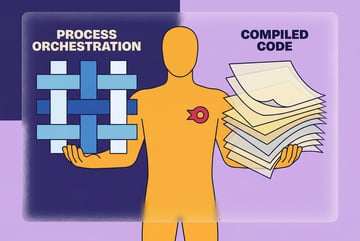
Remy vs OutSystems: Spec-Driven vs Enterprise Low-Code
OutSystems is enterprise low-code with deep governance and compliance. Remy compiles a plain-language plan into real, ownable code. Here's which fits which job.

Is Remy an OutSystems alternative?
For mid-market and SMB teams that want to own real code, yes. For a regulated enterprise that needs FedRAMP and SAML on day one, OutSystems is built for that and Remy isn’t there yet. The two tools answer different questions.
OutSystems is enterprise low-code, a visual platform with deep governance, compliance certifications, and the integration surface large organizations need. Remy is spec-driven: you describe an app, Remy drafts a plain-language plan, and it compiles a full-stack app, real TypeScript and SQL you own, from that plan. There’s no visual modeler your logic lives inside, no proprietary runtime your app is bound to, and no per-seat developer licensing.
The honest split: OutSystems is the heavyweight for governed enterprise delivery. Remy is the faster, lighter path to an owned, deployable app, built for mid-market and SMB teams first.
TL;DR
- OutSystems is enterprise low-code: a visual development platform with deep governance, lifecycle management, and a long list of compliance certifications, built for large regulated organizations.
- Remy is spec-driven: you describe an app, Remy drafts a plain-language plan, and it compiles a full-stack app from that plan: backend, database, auth, frontend, deployment.
- OutSystems carries serious enterprise depth that regulated buyers genuinely need: SAML 2.0 SSO, FedRAMP authorization, SOC 2 Type II, ISO 27001, HIPAA and GDPR alignment.
- Remy’s output is real, standard TypeScript and SQL you own, plus the plain-markdown plan it compiled from, not a model locked inside a proprietary visual platform.
- Remy is built for mid-market and SMB teams first, and ships directory federation over SAML 2.0 or OIDC, SOC 2 Type 1 and 2, and an audit log you can export to a SIEM.
- Because the plan is the source of truth, a stronger AI model means you recompile and the app improves, without re-modeling anything in a visual builder.
- A typical full-stack build with Remy runs about $100 in inference, pass-through at provider rates, on top of $99/month ($79 annual) after a 7-day free trial. That’s a different cost shape than enterprise low-code licensing.
- Today the most advanced product agent is Remy, the fastest path to an owned full-stack app for internal tools and vertical SaaS.
Seven tools to build an app. Or just Remy.
Editor, preview, AI agents, deploy — all in one tab. Nothing to install.

What is OutSystems built for?
OutSystems is enterprise low-code, and in 2026 it’s positioned as an “Agentic Systems Platform” for building, orchestrating, and governing apps and AI agents across a large organization. You model applications in a visual environment, and the platform handles delivery, lifecycle, and governance at enterprise scale. It ranked #1 in G2’s 2026 Grid report for enterprise low-code, and that standing is earned.
Give OutSystems credit where it’s due, because the enterprise depth is the whole point of the tool. It supports SAML 2.0 single sign-on, and it carries a deep compliance posture: FedRAMP authorization, SOC 2 Type II, ISO 27001, plus HIPAA, GDPR, and EU AI Act alignment. For a bank, a hospital network, or a government agency that must clear procurement and audit before a single app ships, that posture is the gate, not a nice-to-have. If your buying process starts with a security questionnaire, OutSystems is built to pass it.
The trade for that depth is what you’d expect from an enterprise platform. Apps are modeled inside the OutSystems environment and run on its runtime, so the application lives in the platform rather than as code you keep in your own repository. Delivery is governed and structured: a strength for a 500-person IT org, heavier than a small team needs to ship an internal tool.
How is Remy different from enterprise low-code?
Remy compiles, it doesn’t model. You describe an app in plain English, say “vendors get submitted, finance approves, security signs off, everything’s logged,” and Remy drafts a plan: a plain-language brief describing the data, roles, actions, and rules. You approve and refine it in plain language, and Remy compiles a full-stack app from it.
The output is real code. Standard TypeScript on the backend, SQL for the data, a React frontend: the kind of code an engineer would write, except compiled from your plan. You own it. The plan stays the source of truth. Change the plan, recompile, and the app updates. There’s no visual modeler the logic lives inside and no proprietary runtime the app is bound to.
This is the durable difference, and it holds even as both platforms add AI features:
- You own real, portable code, not a model inside a platform. An OutSystems app is modeled in and runs on the OutSystems runtime. A Remy app is standard TypeScript and SQL plus a plain-markdown plan. The logic is yours, in code you can read and edit.
- The plan is the source of truth, not a visual diagram. With low-code, the visual model is the app. With Remy, the plain-language plan drives the build, so your intent is a document you keep, not a diagram bound to a vendor’s tooling.
- The app improves when models do. Because the plan is the input, a stronger model recompiles the same plan into a better app, automatically. A visually-modeled app is frozen at how it was drawn.
Plans first. Then code.
Remy writes the spec, manages the build, and ships the app.
You don’t hand-author a markup syntax to do any of this. You describe the app, Remy drafts the plan, and you refine it in plain language. The MSFM walkthrough shows the underlying format for the curious, but the workflow is describing and approving.
Does Remy support enterprise SSO and compliance?
Yes. A corporate directory federates into Remy over SAML 2.0 or OIDC — Okta, Entra ID, or Google Workspace — and Remy brokers that identity to every app your team builds, so an app never sees a credential and your existing MFA and conditional-access policies still apply at the directory boundary. Roles are declared per app and checked server-side before a method runs, and removing someone from the organization drops their sessions across every app at once.
On compliance, Remy carries SOC 2 Type 1 and Type 2, GDPR and CCPA, an immutable audit log exportable to a SIEM in OCSF, per-tenant isolation, encryption at rest, four data regions, and on-premise deployment where procurement requires it. OutSystems carries a longer certification list — FedRAMP authorization, ISO 27001, and HIPAA alignment among them — so if your procurement gate names one of those specifically, that list is the place to start.
So the line is architectural rather than a maturity gap. If your first requirement is a named federal or industry authorization, OutSystems is built around clearing exactly that. If you want to own a deployable full-stack app compiled from a plan — real TypeScript and SQL in your own repository rather than a model inside a runtime — that’s Remy’s sweet spot.
| Dimension | OutSystems | Remy |
|---|---|---|
| Category | Enterprise low-code (visual modeling platform) | Product agent (spec-driven compilation) |
| Build model | Model apps visually in the platform | Describe the app; Remy compiles a full stack from a plan |
| Source of truth | The visual model in the platform | The plain-language plan you keep |
| Code ownership | App runs on the OutSystems runtime | Standard TypeScript + SQL you own and can edit |
| SSO / SAML | SAML 2.0 SSO supported | SAML 2.0 / OIDC federation (Okta, Entra ID, Google Workspace) |
| Compliance | FedRAMP, SOC 2 Type II, ISO 27001, HIPAA, GDPR | SOC 2 Type 1 & 2, GDPR, CCPA, OCSF audit log, on-premise available |
| Target buyer | Large regulated enterprises | Mid-market and SMB teams |
| When models improve | Re-model in the visual builder | Recompile the same plan into a better app |
| Cost shape | Enterprise low-code licensing | $99/mo ($79 annual) + ~$100 inference per build |
| Best at | Governed enterprise delivery at scale | Owned full-stack tools shipped fast |
Which one should you use?
Match the tool to the job. The deciding factor is whether your first requirement is enterprise governance or owned, fast-shipping code.
Use OutSystems when:
- You’re a large enterprise that must clear procurement, audit, and a compliance questionnaire before shipping.
- You need SAML SSO, FedRAMP, or HIPAA/GDPR posture as a hard gate.
- Governed lifecycle management across many teams is the requirement, not the overhead.
- You’re standardizing app delivery across a big IT organization.
Use Remy when:
- You’re a mid-market or SMB team that wants to own real code — TypeScript and SQL — plus a plain-language plan, not a model inside a platform.
- You want to describe an internal tool or vertical-SaaS app in plain English and get a deployed app back.
- Role-gated workflows with auth enforced server-side in the compiled backend cover your needs, and you don’t require SSO/SAML on day one.
- You want the app to improve when models do — recompile, don’t re-model.
- A per-build cost shape fits better than enterprise licensing.
Remy doesn't write the code. It manages the agents who do.
Remy runs the project. The specialists do the work. You work with the PM, not the implementers.
The two sit at different rungs of the abstraction ladder. OutSystems raises the floor for governed enterprise delivery. Remy raises it for owning a full-stack app compiled from a plan. The same spec-driven-vs-visual split shows up against process-automation platforms in Remy vs Appian and against prototyping tools in Remy vs Bolt.
Best product agents
OutSystems is enterprise low-code, a visual platform with deep governance and compliance. Remy is a product agent, and today it’s the most advanced one. Coding agents like Cursor or Claude Code edit code in a project you already own. Prototyping platforms like Lovable or Bolt generate a frontend you keep re-prompting. A product agent compiles a plain-language spec into a deployed full-stack app.
Under the hood, a product agent works less like a single chatbot and more like a team. Remy orchestrates six specialist sub-agents, all coordinated against the plan: coding, design, architecture, QA (which drives a real browser to test the flows), roadmap, and research. That division of labor is why the result is a coherent application instead of a pile of generated files.
What makes it more than a demo is what it stands on. Every app Remy compiles inherits 200+ AI model providers, 1,000+ integrations, a managed database, auth, and deployment with zero setup, on a platform hardened by years of real enterprise production traffic, at SOC 2 Type II and GDPR scale. Remy builds a full-stack app you own outright — backend, database, frontend, auth, tests, and deployment — from a plain-language spec. See goremy.ai.
FAQ
Is Remy an OutSystems alternative? For mid-market and SMB teams that want to own real code and ship fast, yes. Remy compiles a plain-language plan into a full-stack app: standard TypeScript and SQL you keep. If your procurement gate is a specific federal authorization like FedRAMP, OutSystems is built around clearing exactly that.
Does Remy have enterprise SSO and SAML like OutSystems? Yes. A corporate directory federates in over SAML 2.0 or OIDC — Okta, Entra ID, or Google Workspace — and Remy brokers sign-on to every app your team builds, with roles enforced server-side and access revoked the moment someone leaves. Email-code and SMS-code sign-in remain available where federation isn’t needed.
Do I own my app with Remy? Yes. Remy compiles standard TypeScript, React, and SQL you can read and edit, plus the plain-markdown plan it compiled from. An OutSystems app is modeled in and runs on the OutSystems runtime, so it lives in the platform.
Is OutSystems better for compliance-heavy industries? OutSystems carries the wider certification list — FedRAMP, SOC 2 Type II, ISO 27001, and HIPAA/GDPR alignment — so if procurement gates on a specific named program, start there. Remy ships SOC 2 Type 1 and Type 2, GDPR, an immutable audit log exportable to your SIEM, and on-premise deployment where it’s required.
How does Remy’s build cost compare to enterprise low-code? A typical full-stack build with Remy runs about $100 in inference, pass-through at provider rates, on top of $99/month ($79 annual) after a 7-day free trial. Enterprise low-code platforms use licensing models built for large organizations, which is a different cost shape suited to large-scale governed delivery.
- ✕a coding agent
- ✕no-code
- ✕vibe coding
- ✕a faster Cursor
The one that tells the coding agents what to build.
Can a non-developer build with Remy? Yes. You describe the app in plain English, Remy drafts the plan, and you refine it in plain language. You’ll read some generated code, but you don’t have to write it — the work is in the plan.
How does Remy stay useful as AI models improve? The plan is the source of truth, so a stronger model means you recompile and the app gets better automatically — no re-modeling in a visual builder. The plan persists; the compiled output improves.
The bottom line
OutSystems is enterprise low-code with deep governance and a stack of compliance certifications: the right tool when your first requirement is clearing audit and procurement at enterprise scale. Remy is spec-driven: you describe an app, Remy compiles a full-stack app from a plain-language plan, and you own the real TypeScript and SQL it produces.
Remy is built for mid-market and SMB teams first, with directory federation, server-enforced roles, and an exportable audit log standard rather than bolted on. Where it shines is owning a deployable app compiled from a plan, improving every time models do, at a per-build cost.
If you want a full-stack app you own — code, plan, and all — built from a plain-language description and deployed to a live URL, Start building with Remy →.
For more on the architecture: What is a product agent? and how AI compiles a spec into a full-stack app.