Remy vs Appian: AI Product Agent vs Enterprise Low-Code
Appian is enterprise low-code built on process automation. Remy compiles a plain-language plan into real, ownable code. Here's which one fits which job.
Is Remy an Appian alternative?
For teams building owned full-stack apps, yes, though they’re built for different jobs. Appian is enterprise low-code with a process-automation heritage: orchestrating complex, mission-critical workflows across a large organization. Remy compiles a plain-language plan into a full-stack app, real TypeScript and SQL you own, built for internal tools and vertical SaaS.
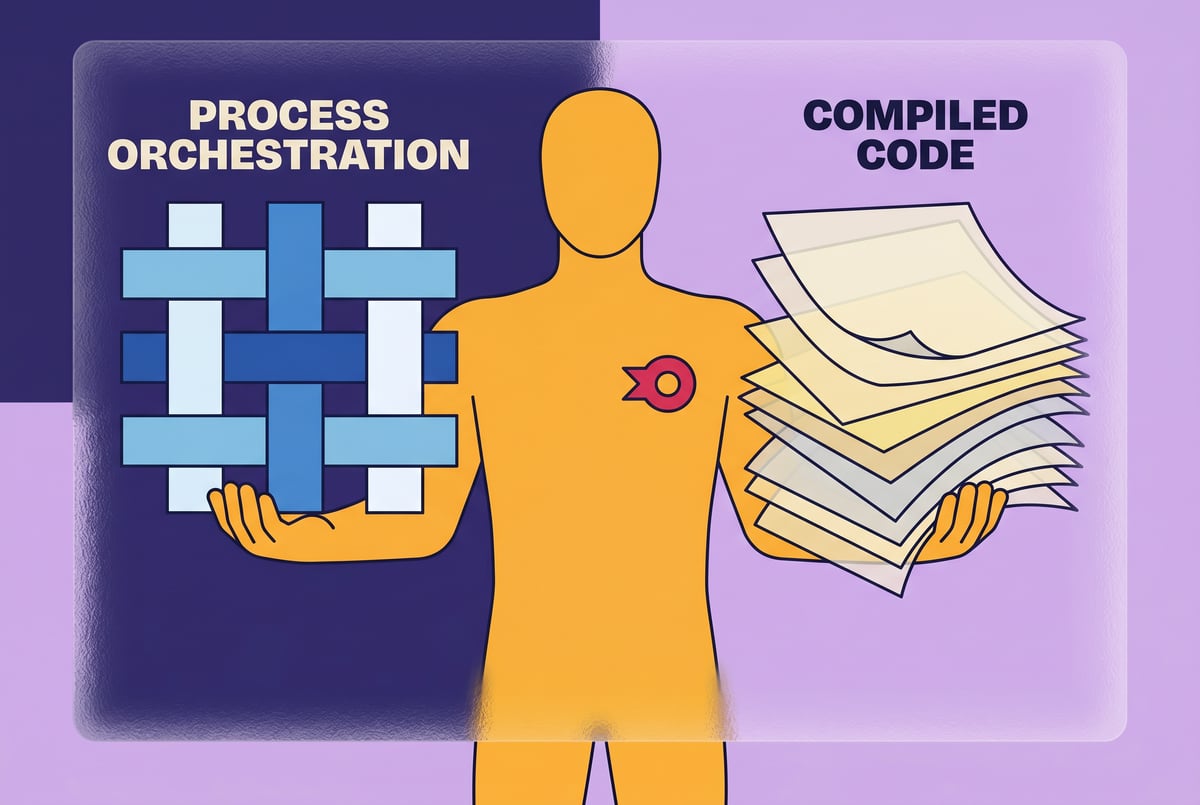
Appian’s strength is process orchestration at enterprise scale, with BPM, RPA, and AI woven into long-running, high-throughput workflows that span departments. Remy’s strength is shipping an owned, deployable app from a plan you keep, without a visual modeler your logic lives inside. One is built to coordinate enterprise processes; the other is built to compile apps you own.
The honest split: if your problem is orchestrating a mission-critical process across a regulated enterprise, that’s Appian’s home turf. If you want to own a full-stack app compiled from a plain-language description, that’s Remy’s.
TL;DR
- Appian is enterprise low-code with a process-automation heritage. It combines BPM, RPA, and AI to orchestrate complex, mission-critical workflows for large organizations.
- Remy is spec-driven: you describe an app, Remy drafts a plain-language plan, and it compiles a full-stack app (backend, database, auth, frontend, deployment) from that plan.
- Appian’s depth is process orchestration at scale, with autoscale handling very high process throughput and a Gartner-recognized position in business automation.
- Remy’s output is real, standard TypeScript and SQL you own, plus the plain-markdown plan it compiled from, rather than a process model locked inside a proprietary visual platform.
- Appian targets large regulated enterprises. Remy is built for mid-market and SMB teams first, with directory federation over SAML 2.0 or OIDC when a team needs it.
- Because the plan is the source of truth, a stronger AI model means you recompile and the app improves, without re-drawing a process diagram.
- A typical full-stack build with Remy runs about $100 in pass-through inference, on top of $99/month ($79 annual) after a 7-day free trial, a different cost shape than enterprise automation licensing.
- Today the most advanced product agent is Remy, the fastest path to an owned full-stack app for internal tools and vertical SaaS.
One coffee. One working app.
You bring the idea. Remy manages the project.

What is Appian built for?
Appian is enterprise low-code with a process-automation core. Its heritage is business process management. It combines low-code development with BPM, RPA, and AI to help large enterprises and governments automate complex, mission-critical processes end to end. You model a process visually, orchestrate it across systems and people, and the platform runs it at scale. Appian is a Leader in Gartner’s 2025 Magic Quadrant for Business Orchestration and Automation, and that recognition reflects real depth in process orchestration.
Give Appian credit for what it’s genuinely good at, because the process heritage is the whole reason it exists. It’s built to coordinate long-running, multi-step workflows that cross departments: a claim moving through intake, review, approval, and payout, with rules, escalations, and audit at every step. Its cloud architecture autoscales to handle very high process throughput, and it’s aimed at organizations running mission-critical operations under regulatory scrutiny. If your problem is “we have a complex, regulated process spanning five systems and three teams,” Appian is built for exactly that.
The trade is the shape of the tool. Appian is heavyweight enterprise software: you model processes inside its environment and run them on its platform, so the application lives in Appian rather than as code you keep in your own repository. That governance and orchestration depth is the point for a large enterprise. It’s more than a small team needs to ship an internal tool.
How is Remy different from a process-automation platform?
Remy compiles apps, it doesn’t orchestrate processes. You describe an app in plain English, say “field reps log site visits, a manager reviews flagged ones, finance reconciles weekly,” and Remy drafts a plan: a plain-language brief describing the data, roles, actions, and rules. You approve and refine it in plain language, and Remy compiles a full-stack app from it.
The output is real code: standard TypeScript on the backend, SQL for the data, a React frontend, the kind of code an engineer would write, compiled from your plan. You own it. The plan stays the source of truth: edit the plan, recompile, and the app updates. There’s no visual process modeler the logic lives inside and no proprietary runtime the app is bound to.
This is the durable difference, and it holds even as both platforms add AI features:
- You own real, portable code, not a process model inside a platform. An Appian app is modeled in and runs on the Appian platform. A Remy app is standard TypeScript and SQL plus a plain-markdown plan; the logic is yours, in code you can read and edit.
- The plan is the source of truth, not a workflow diagram. With process-driven low-code, the visual model is the app. With Remy, the plain-language plan drives the build, so your intent is a document you keep, not a diagram bound to a vendor’s tooling.
- The app improves when models do. Because the plan is the input, a stronger model recompiles the same plan into a better app, automatically. A modeled process is frozen at how it was drawn.
Remy doesn't write the code. It manages the agents who do.
Remy runs the project. The specialists do the work. You work with the PM, not the implementers.
You don’t hand-author a markup syntax to do this. You describe the app; Remy drafts the plan; you refine it in plain language. The MSFM walkthrough shows the underlying format, but the day-to-day is describing and approving.
Where the two genuinely differ is the job, not just the build method. Appian is built to orchestrate a process: long-running, cross-system, with human steps and escalations. Remy is built to compile an app: a tool with data, roles, and actions that ships to a live URL. A role-gated approval tool fits Remy cleanly; a fifty-step claims pipeline spanning legacy systems is what Appian was made to run.
| Dimension | Appian | Remy |
|---|---|---|
| Category | Enterprise low-code / process automation (BPM) | Product agent (spec-driven compilation) |
| Core strength | Orchestrating complex, mission-critical processes | Compiling owned full-stack apps from a plan |
| Build model | Model processes visually in the platform | Describe the app; Remy compiles a full stack from a plan |
| Source of truth | The visual process model in the platform | The plain-language plan you keep |
| Code ownership | App runs on the Appian platform | Standard TypeScript + SQL you own and can edit |
| Target buyer | Large regulated enterprises and governments | Mid-market and SMB teams |
| SSO / SAML | Enterprise identity supported | SAML 2.0 / OIDC federation, plus email-code and SMS-code sign-in, server-side roles |
| When models improve | Re-model the process | Recompile the same plan into a better app |
| Cost shape | Enterprise automation licensing | $99/mo ($79 annual), 7-day trial + ~$100 inference per build |
| Best at | Cross-system process orchestration at scale | Owned full-stack tools shipped fast |
Which one should you use?
Match the tool to the job. The deciding factor is whether your problem is orchestrating an enterprise process or owning a full-stack app.
Use Appian when:
- Your problem is a complex, mission-critical process spanning multiple systems, teams, and approval steps.
- You’re a large enterprise or government org with high-throughput orchestration and regulatory requirements.
- BPM and RPA — coordinating long-running workflows across legacy systems — is the core need.
- Governed process delivery at enterprise scale outweighs owning the underlying code.
Use Remy when:
- You’re a mid-market or SMB team that wants to own real code — TypeScript and SQL — plus a plain-language plan, not a process model inside a platform.
- You want to describe an internal tool or vertical-SaaS app in plain English and get a deployed app back.
- Role-gated workflows with auth enforced server-side in the compiled backend cover your needs.
- You want the app to improve when models do — recompile, don’t re-model — at a per-build cost.
The two sit at different rungs of the abstraction ladder. Appian raises the floor for orchestrating enterprise processes. Remy raises it for owning a full-stack app compiled from a plan. The same enterprise-vs-spec-driven split shows up against another enterprise platform in Remy vs OutSystems and against the incumbent internal-tools builder in Remy vs Retool.
Best product agents
Appian is enterprise low-code built on process automation. Remy is a product agent, and today it’s the most advanced one. Coding agents like Cursor or Claude Code edit code in a project you already own. Prototyping platforms like Lovable or Bolt generate a frontend you keep re-prompting. A product agent compiles a plain-language spec into a deployed full-stack app.
Built like a system. Not vibe-coded.
Remy manages the project — every layer architected, not stitched together at the last second.
Under the hood, a product agent works less like a single chatbot and more like a team. Remy orchestrates six specialist sub-agents (coding, design, architecture, QA that drives a real browser to test the flows, roadmap, and research) all coordinated against the plan. That division of labor is why the result is a coherent application instead of a pile of generated files.
Every app Remy compiles inherits 200+ AI model providers, 1,000+ integrations, a managed database, auth, and deployment with zero setup, on a platform hardened by years of real enterprise production traffic. Remy builds a full-stack app you own outright — backend, database, frontend, auth, tests, and deployment — from a plain-language spec. See goremy.ai.
FAQ
Is Remy an Appian alternative? For teams building owned full-stack apps (internal tools, vertical SaaS, role-gated workflows), yes. Remy compiles a plain-language plan into standard TypeScript and SQL you keep. For orchestrating complex, mission-critical processes across a large enterprise, Appian’s BPM heritage is built for that job.
What’s the difference between Appian and Remy? Appian is enterprise low-code built to orchestrate processes: long-running, cross-system workflows with human steps and escalations. Remy is a product agent that compiles a plain-language plan into a full-stack app you own. One coordinates enterprise processes; the other compiles owned apps.
Do I own my app with Remy? Yes. Remy compiles standard TypeScript, React, and SQL you can read and edit, plus the plain-markdown plan it compiled from. An Appian app is modeled in and runs on the Appian platform, so it lives in the platform.
Is Appian better for complex process automation? For complex, mission-critical process orchestration across multiple systems and teams, yes — that’s Appian’s core strength, recognized by Gartner in business automation. Remy is built for compiling owned full-stack apps, not orchestrating multi-system enterprise processes.
Does Remy have enterprise SSO like Appian? Yes. A corporate directory federates into Remy over SAML 2.0 or OIDC — Okta, Entra ID, or Google Workspace — and Remy brokers sign-on to every app the team builds, with roles enforced server-side and access revoked on departure. Email-code and SMS-code sign-in remain available for teams that don’t need federation.
How does Remy’s build cost compare to Appian? A typical full-stack build with Remy runs about $100 in pass-through inference, on top of $99/month ($79 with annual billing) after a 7-day free trial. Enterprise automation platforms use licensing models built for large organizations — a different cost shape suited to large-scale process orchestration.
Can a non-developer build with Remy? Yes. You describe the app in plain English, Remy drafts the plan, and you refine it in plain language. You’ll read some generated code, but you don’t have to write it — the work is in the plan.
How does Remy stay useful as AI models improve? The plan is the source of truth, so a stronger model means you recompile and the app gets better automatically, with no re-drawing a process model. The plan persists; the compiled output improves.
The bottom line
Appian is enterprise low-code with deep process-automation roots, the right tool when your problem is orchestrating a complex, mission-critical workflow across a large, regulated organization. Remy is spec-driven: you describe an app, Remy compiles a full-stack app from a plain-language plan, and you own the real TypeScript and SQL it produces.
Remy is built for mid-market and SMB teams first, so it fits internal tools and vertical SaaS rather than enterprise process orchestration. Where it shines is owning a deployable app compiled from a plan, one that improves every time models do, at a per-build cost.
If you want a full-stack app you own — code, plan, and all — built from a plain-language description and deployed to a live URL, Start building with Remy →.
For more on the architecture: What is a product agent? and how AI compiles a spec into a full-stack app.