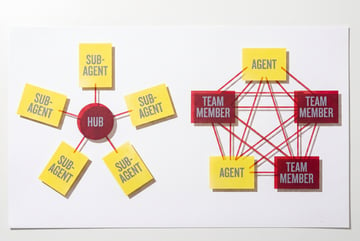
What Is the Planner-Generator-Evaluator Pattern? The GAN-Inspired AI Coding Architecture
Inspired by generative adversarial networks, the planner-generator-evaluator pattern uses three agents to build more reliable software than a single agent can.

Three Agents Are Better Than One
Single AI agents make mistakes. They hallucinate function signatures, write code that doesn’t match the spec, or produce something that technically runs but fails edge cases. When you ask one model to plan, generate, and evaluate all at once, you’re compressing tasks that benefit from separation into a single pass.
The planner-generator-evaluator pattern fixes this. Inspired by the competitive feedback loop of generative adversarial networks, it splits the job into three distinct roles — each focused on one thing. The result is a multi-agent architecture that produces more reliable software than any single agent can, and it’s become one of the more practical patterns in production AI coding systems.
The GAN Analogy (and Where It Breaks Down)
To understand why this pattern works, it helps to understand what GANs do.
Ian Goodfellow introduced generative adversarial networks in 2014. The core idea: two neural networks compete. A generator tries to produce fake data convincing enough to fool a discriminator. The discriminator tries to tell real from fake. Each gets better because the other keeps pushing it. Over training runs, the generator produces increasingly realistic outputs because it’s constantly tested against an adversarial critic.
That adversarial pressure is the key insight. Without it, a generator optimizes for whatever it was trained on — and stops there. With it, the generator must keep improving because the evaluator keeps finding flaws.
One coffee. One working app.
You bring the idea. Remy manages the project.

The planner-generator-evaluator pattern borrows that structure but applies it to task completion rather than training. There’s no backpropagation happening. Instead, you have three agents running sequentially (or in a loop), each with a different cognitive job:
- Planner — Figures out what needs to be built
- Generator — Builds it
- Evaluator — Judges whether what was built matches what was planned
The difference from a pure GAN: the evaluator isn’t adversarial in a competitive sense. It’s more like a senior engineer reviewing a pull request. It produces structured feedback the generator can act on, not just a pass/fail signal.
The Three Roles in Detail
The Planner
The planner’s job is decomposition. It takes a high-level request — “build a REST API endpoint that validates user input and writes to a database” — and breaks it into a concrete specification.
A good planner output might include:
- The expected inputs and their types
- The expected outputs or side effects
- Edge cases to handle
- Constraints (language, libraries, performance requirements)
- A step-by-step implementation outline
The planner shouldn’t write code. Its output is a blueprint. By separating planning from generation, you prevent the generator from getting lost in implementation details before it’s clear what it’s actually building.
In practice, the planner agent often uses a model with strong reasoning capabilities — Claude or GPT-4o work well here because they handle ambiguity and can ask clarifying questions before committing to a spec.
The Generator
The generator takes the planner’s spec and produces the actual code. Its context is narrower than a single-agent approach: it doesn’t need to reason about the original request, just execute a clear blueprint.
This focus matters. When a model knows exactly what it needs to produce, it does better work. Ambiguity is expensive at generation time — it leads to hedge code, unnecessary abstractions, or wrong assumptions about what the caller wants.
The generator also doesn’t need to be the most powerful model in the stack. A faster, cheaper model that’s good at code generation (like Claude Haiku or GPT-4o-mini) can handle generation if the spec is tight enough. This is one of the cost optimization benefits of the pattern.
The Evaluator
The evaluator is the most underrated component. It reads both the spec from the planner and the code from the generator, then produces a structured critique.
A useful evaluator does more than check syntax. It asks:
- Does the code implement what the spec requires?
- Are the edge cases handled?
- Are there security issues (injection vulnerabilities, improper error handling)?
- Does the code follow the specified constraints?
- What’s missing or incorrect?
The evaluator’s output feeds back to the generator (or planner, in some architectures). If the code passes, the loop terminates. If not, the generator gets another pass with the evaluator’s feedback as additional context.
This feedback loop is the mechanism that drives quality improvement. One iteration often catches obvious problems. Two or three iterations can catch subtle logic errors. Most implementations cap iterations at three to five to avoid infinite loops — and add a fallback if consensus isn’t reached.
How the Loop Actually Works
Here’s a concrete walkthrough of the pattern in action.
Seven tools to build an app. Or just Remy.
Editor, preview, AI agents, deploy — all in one tab. Nothing to install.
Step 1 — User submits a request “Write a Python function that parses a CSV file, validates that all rows have exactly four columns, and returns a list of dictionaries.”
Step 2 — Planner generates a spec
Function name: parse_csv
Input: file_path (str)
Output: list of dicts with keys from header row
Validation rules:
  - File must exist and be readable
  - Each row must have exactly 4 columns
  - Return empty list if file is empty
  - Raise ValueError on malformed rows with row number in message
Edge cases:
  - Handle BOM encoding
  - Handle trailing newlines
  - Skip blank lines
Step 3 — Generator writes code The generator produces a function based on the spec. Maybe it handles most cases but misses BOM encoding.
Step 4 — Evaluator reviews The evaluator compares output to spec:
Issue found: BOM encoding not handled (specified in edge cases)
Issue found: Blank line detection incomplete — checks only for \n, not \r\n
Recommendation: Add encoding='utf-8-sig' to open(), update blank line check
Step 5 — Generator revises The generator gets its original code plus the evaluator’s feedback and produces a revised version.
Step 6 — Evaluator re-checks If the revised code satisfies the spec, the loop terminates and the output is returned. If not, the loop repeats.
This isn’t magic. It’s structured iteration — the same thing that happens in a good human code review process, just automated.
Why Single Agents Fall Short
A single agent asked to plan, generate, and evaluate at once faces what researchers sometimes call the “context contamination” problem. The more tasks you compress into a single prompt, the harder it is for a model to give full attention to any of them.
When the same model that wrote the code reviews it, it tends to overlook its own mistakes. This is a cognitive bias in humans too — authors miss errors in their own writing that a fresh reader catches immediately. In language models, the effect is even more pronounced because the model’s generation process is partly autocomplete: it continues patterns, which makes it likely to reproduce the same reasoning error in both the generation and evaluation steps.
The planner-generator-evaluator pattern addresses this by separating concerns. The planner doesn’t know it’ll be evaluating later. The evaluator reads code as if it’s seeing it fresh, because it wasn’t involved in generating it.
You can reinforce this with prompt engineering — explicitly tell the evaluator not to assume the generator was correct, and give it the spec as its ground truth rather than the code.
Designing for Production
Choosing Models for Each Role
Different roles have different requirements. Here’s a rough heuristic:
- Planner: Needs strong reasoning and domain knowledge. Use your most capable model (Claude Sonnet, GPT-4o, or Gemini 1.5 Pro).
- Generator: Needs code fluency. A coding-specialized model or a fast frontier model works well.
- Evaluator: Needs strong critical reasoning and the ability to cross-reference against specs. Use your most capable model — the same as the planner, or a dedicated critique-tuned model.
Remy is new. The platform isn't.
Remy is the latest expression of years of platform work. Not a hastily wrapped LLM.
Some teams use the same model for planner and evaluator to reduce integration complexity. That’s fine. The key separation is planner/evaluator from generator, not between planner and evaluator.
Handling Loop Termination
You need a termination condition. Options include:
- Evaluator returns “pass” — cleanest, but requires the evaluator to be reliable
- Max iterations reached — fallback when evaluator keeps finding issues; return best iteration or escalate
- Confidence score threshold — if the evaluator rates the solution above a threshold (e.g., 8/10), accept it
Build in logging for each iteration. When the system fails to converge, you want to know whether the planner wrote a bad spec, the generator kept making the same mistake, or the evaluator was flagging false positives.
When to Loop Back to the Planner
Most implementations loop only between generator and evaluator. But sometimes the evaluator discovers that the spec itself was wrong — the planner misunderstood the requirement. In those cases, you need a path back to the planner.
This creates a more complex graph: planner → generator → evaluator → (generator | planner). It’s harder to implement but produces better results for ambiguous or under-specified inputs.
Memory and Context Management
By the third or fourth iteration, the generator’s context window can fill up with spec, previous code versions, and evaluator feedback. Long contexts degrade performance. Options:
- Summarize previous feedback rather than including full history
- Pass only the evaluator’s diff (what changed, what still needs fixing) rather than the full critique each time
- Use a separate context for each generator call, with only the spec and most recent feedback
Real-World Applications Beyond Coding
The planner-generator-evaluator pattern isn’t limited to software development. The same structure applies anywhere you need structured output that can be checked against a spec:
Content generation — Planner defines structure, tone, key claims, and length; generator writes the draft; evaluator checks for accuracy, tone consistency, and missing elements.
Data pipeline construction — Planner specifies the transformation steps; generator writes the pipeline code; evaluator validates that output schema matches the expected schema.
Test suite generation — Planner identifies what needs to be tested; generator writes the tests; evaluator checks for coverage gaps and false test cases.
Infrastructure as code — Planner defines the architecture; generator writes the Terraform or CloudFormation; evaluator checks for security misconfigurations and missing dependencies.
The pattern is most valuable when: (1) the output can be clearly specified, (2) evaluation is cheaper than generation, and (3) mistakes have real costs.
Building This Pattern in MindStudio
If you want to implement the planner-generator-evaluator pattern without building the agent orchestration from scratch, MindStudio’s visual workflow builder handles the multi-agent coordination layer directly.
Each of the three roles maps to a separate AI step in a workflow. You configure the planner step with Claude (or whichever model fits), define its system prompt and input, and pipe its output into the generator step. The generator feeds the evaluator. You can build the feedback loop using conditional branching — if the evaluator returns a pass, end the workflow and return the output; if it returns issues, route back to the generator with the critique attached.
Other agents start typing. Remy starts asking.
Scoping, trade-offs, edge cases — the real work. Before a line of code.
MindStudio supports multi-agent workflow orchestration with over 200 models out of the box — including Claude, GPT-4o, and Gemini — so you can assign different models to planner, generator, and evaluator without separate API keys or infrastructure setup. The average workflow like this takes under an hour to build.
You can also expose the finished workflow as an API endpoint, making it easy to call from an existing IDE plugin, CI/CD pipeline, or internal developer tool. Try it free at mindstudio.ai.
Frequently Asked Questions
What is the planner-generator-evaluator pattern?
It’s a multi-agent architecture that divides an AI coding (or content generation) task into three specialized roles: a planner that creates a structured spec, a generator that produces the output based on that spec, and an evaluator that reviews the output against the spec. The evaluator’s feedback loops back to the generator, which iterates until the output meets the spec or a maximum iteration count is reached.
How is this different from just asking an AI to review its own code?
When you ask a single model to write code and then review it in the same context window, the model’s review is influenced by its own generation process — it tends to miss the same errors it introduced. The planner-generator-evaluator pattern addresses this by using separate agent instances (or separate calls with distinct contexts) for each role, reducing this self-confirmation bias.
Does each agent need to be a different AI model?
No. You can run all three roles with the same underlying model (like Claude). What matters more than model diversity is prompt separation — each agent should have a distinct system prompt that defines its specific job, and ideally, agents shouldn’t share full context histories to avoid contamination.
How many iterations does the evaluator loop typically require?
In practice, most correctly specified implementations converge within two to three iterations for well-scoped tasks. Setting a cap of three to five iterations covers most cases. If the loop hits the cap without converging, that’s often a signal that the spec was ambiguous or the task was too large to decompose effectively.
Can this pattern work for tasks other than code generation?
Yes. The pattern applies to any task where the output can be checked against a structured specification: writing, data transformation, infrastructure configuration, test generation, document creation. The key requirement is that evaluation is tractable — you need to be able to define what “correct” looks like clearly enough for an agent to assess it.
What’s the relationship between this pattern and GAN architecture?
The conceptual link is adversarial feedback: just as a GAN’s discriminator pushes the generator to improve its outputs, the evaluator in this pattern provides critical feedback that drives the generator to revise. The analogy is imperfect — there’s no training signal or gradient update — but the structural insight is the same: quality improves when generation and evaluation are separated into distinct processes rather than collapsed into one.
Key Takeaways
- The planner-generator-evaluator pattern splits AI code generation into three roles: planning (spec creation), generation (code writing), and evaluation (quality review).
- The evaluator’s structured feedback creates an iterative loop that catches errors a single-pass agent would miss.
- Each role benefits from distinct prompt contexts — agents shouldn’t carry each other’s full history.
- The pattern applies beyond code: content, data pipelines, infrastructure config, and test suites all benefit from the same separation of concerns.
- You can implement the full pattern as a visual workflow in MindStudio, with different models assigned to each role and conditional logic handling the feedback loop.
Everyone else built a construction worker.
We built the contractor.
One file at a time.
UI, API, database, deploy.
Building more reliable AI outputs often comes down to better process design, not just better models. The planner-generator-evaluator pattern is one of the clearest examples of that — and it’s worth trying on any task where single-agent quality has been a problem.