
AI Memory & Knowledge Bases
Persistent memory and knowledge bases for AI agents — Karpathy's LLM wiki, OpenBrain, second brain setups, self-evolving Claude Code memory, three-layer memory architectures, RAG patterns, vector databases, embeddings strategy.
Google's Wiki Skill: How AI Agents Get Persistent Memory
Google Research's Wiki Skill gives AI agents lasting, evolving knowledge instead of relearning tasks. Here's how the architecture works.

Claude's Memory Update: Co-work and Chat Now Share Context
Anthropic unified Claude's memory across Co-work and standard chat and redesigned the projects UI. Here's what actually changed and why it matters.

What Is EVE Preview 4.5B? Tencent's OCR-Free Document Retriever
Tencent's EVE Preview 4.5B retrieves document pages as images using ColBERT-style late interaction, skipping OCR entirely for tables and charts.

How to Run EVE Preview 4.5B Locally for Document Retrieval
A hands-on guide to installing Tencent's EVE Preview 4.5B visual retriever, testing it on invoices and citations, and building a full RAG pipeline.
Obsidian Skills: Giving AI Agents Access to Your Markdown Notes
Obsidian Skills lets AI agents like Claude Code and Codex read and use your Obsidian markdown notes as a searchable knowledge base.
Managing Context in Long-Running AI Agent Sessions
How progressive context shaping and current-state files help AI coding agents stay on track across multi-hour, multi-session runs.

How to Give Your Whole Team Shared Claude Memory and Context
A practical guide to shared Claude memory and context for teams, using Notion, Composio, and supermemory.ai without sharing API keys.
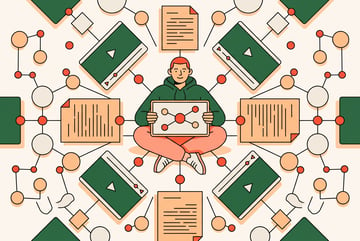
Turn Any YouTube Channel Into a Searchable AI Knowledge Base with OKF
How Google's Open Knowledge Format turns YouTube transcripts into a linked, queryable knowledge base your AI agents can search and cite.

GenSpark Second Brain Note: A MagSafe AI Recorder That Acts for You
GenSpark's Second Brain Note is a MagSafe recording card that feeds meetings and conversations into an AI memory system that drafts and acts.

Stop AI Hallucinations With a Context Management Framework for Your AI OS
A practical framework for organizing personal AI systems to prevent hallucinations by fixing four context failure modes: poisoning, bloat, confusion, and clash.

What Is an Enterprise RAG Knowledge Base? How Cerebras Built One That Actually Works
Most AI knowledge bases are hype. Cerebras built a RAG system answering 15,000 questions daily from Slack, GitHub, and Confluence. Here's how it works.

How to Build an AI Second Brain with Obsidian and Claude: The LLM Wiki Method
Learn how to build a self-updating AI knowledge base using Obsidian and Claude. Automate data ingestion, cross-linking, and daily briefings from one vault.

How to Build an AI Second Brain with Obsidian and Claude Code: The LLM Wiki Method
Learn how to build an AI-maintained knowledge base using Obsidian and Claude Code, inspired by Andrej Karpathy's LLM Wiki architecture.
How to Build a Semantic Memory System for AI Agents Without Hermes Agent
Hermes Agent proved memory matters, but you can build better recall inside Claude Code. Learn storage, injection, and semantic search using local vector DBs.
How to Build a Production AI Agent with Context Retrieval and Long-Term Memory
Learn how to architect production AI agents with database-backed context retrieval and semantic memory that scales to millions of users.

How to Build an AI Operating System for Your Business Using Claude Code
Learn how to design a personal AI OS with Claude Code—mapping workflows, automating tasks, and building a 30-day productivity plan from scratch.
How to Build an AI Second Brain Knowledge Base Using Claude Code
Learn how to build a personal AI knowledge base that stores, organizes, and retrieves your information using Claude Code and structured memory systems.
How to Build an LLM Wiki Knowledge Base with Obsidian and Claude Code
Learn how to build a self-growing knowledge base from YouTube transcripts, PDFs, and URLs using Karpathy's LLM wiki architecture and Claude Code.

How to Build an AI Operating System for Your Business Using LLM Wikis
Learn how to ingest YouTube videos, meeting transcripts, and documents into an LLM wiki that makes every AI agent smarter and more context-aware.

How to Build an OKF Knowledge Bundle and Share It with Any AI Agent
OKF bundles let you package structured knowledge and share it across agents. Here's how to build one, add metadata, and deploy it to your second brain.

What Is the Open Knowledge Format (OKF)? Google's Standard for AI Knowledge Bases
OKF is Google's open standard for building shareable LLM knowledge bases. Learn how it works, why it matters, and how to adopt it for your agents.

How to Build a Brand Context Folder for AI Agents: Voice Profile, Visual Identity, and Positioning
Stop getting generic AI outputs. Build a brand context folder with voice profile, design tokens, and positioning files that every agent session inherits.

How to Build an OKF Knowledge Bundle: Share Your AI Knowledge Base with Any Agent
Google's Open Knowledge Format lets you package knowledge bases as shareable bundles. Learn how to build one and import it into your second brain.
What Is the Open Knowledge Format (OKF)? Google's Standard for Shareable AI Knowledge Bases
OKF is Google's open standard for LLM wikis—a minimal layer on top of Karpathy's knowledge base pattern that makes wikis shareable across AI agents.