The Next Level of Abstraction: Why Software Is Moving Beyond Code
Every generation of programming moves up in abstraction. Here's why the next level looks like structured prose rather than syntax.

Programming Has Always Been a War Against Complexity
Every generation of developers has faced the same problem: the machine speaks one language, humans think in another. The history of software is really a history of closing that gap — building layers of abstraction so that more intent can be expressed with less ceremony.
Spec-driven development is the next step in that progression. Not because it’s a clever new tool, but because the underlying conditions have finally changed enough to make a new layer of abstraction possible. Understanding why requires looking at where we’ve been.
The Pattern That Keeps Repeating
Early computers were programmed by physically wiring circuits or flipping switches. Then came punch cards. Then assembly language, which let you write instructions in human-readable mnemonics instead of raw binary. Then higher-level languages like FORTRAN and COBOL, which let you describe mathematical operations and business logic instead of register manipulations.
Each step followed the same pattern:
- The previous layer didn’t disappear — it just became invisible
- The new layer let developers express more intent with less syntax
- Productivity went up, but so did what was possible
- Developers who stayed at the new level built things the previous generation couldn’t imagine
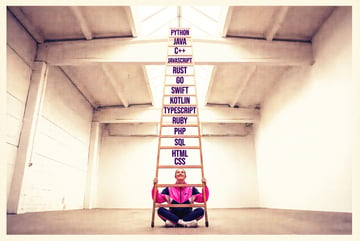
C abstracted away assembly. C++ abstracted away manual memory management. Java abstracted away operating system specifics. Python abstracted away type declarations. TypeScript put useful constraints back in so that large teams could reason about code without constantly breaking things.
Remy doesn't build the plumbing. It inherits it.
Other agents wire up auth, databases, models, and integrations from scratch every time you ask them to build something.
Remy ships with all of it from MindStudio — so every cycle goes into the app you actually want.

Each level up the stack required understanding what you were asking the machine to do, even if you weren’t specifying how. The “how” became the compiler’s job.
For a deeper look at how each of these layers built on the last, the abstraction ladder from assembly to TypeScript to spec traces the full arc.
Why Code Became the Bottleneck
For most of software history, code was the only reliable way to express precise intent to a computer. Natural language was too ambiguous. Visual tools were too limited. Diagrams were great for communication but useless for execution.
So code became the source of truth. If you wanted a computer to do something, you had to express it in a formal language the machine could parse. That constraint shaped everything: how teams were organized, what skills were valued, how products were built, who could build them.
The problem with code as source of truth isn’t that code is bad. It’s that code optimizes for machine execution at the expense of human readability. A TypeScript file is precise enough for a computer to run but opaque enough that most stakeholders — product managers, designers, domain experts, users — can’t meaningfully engage with it.
This creates a translation problem. Someone understands what the software should do. Someone else writes code that (hopefully) does that thing. The gap between intent and implementation is where most bugs, delays, and failed projects live.
Why the source of truth in software development is changing goes deep on this problem — and why it’s not just a workflow issue. It’s structural.
The Condition That Makes a New Layer Possible
Previous attempts to raise the abstraction level — no-code builders, visual programming tools, domain-specific languages — all hit the same wall: they couldn’t handle complexity. You could drag and drop simple things, but anything real required dropping back into code.
What’s different now is that large language models can translate between human-readable descriptions and working code with enough reliability to make a new layer viable. Not perfect — but reliable enough.
This isn’t about AI writing code so you don’t have to. That framing misses the point. The point is that the source of truth can now be something humans actually write and read, with the code treated as compiled output rather than the primary artifact.
That shift has profound implications. When code is the source of truth, changes cascade in unpredictable ways. When a spec is the source of truth, changes are made at the level of intent, and the code is re-derived from there.
What the New Abstraction Actually Looks Like
The new layer isn’t natural language in the loose, conversational sense. Pure natural language is too ambiguous for engineering work.
Spec-driven development looks like annotated prose — a markdown document with two layers. The readable text describes what the application does in terms any smart reader can follow. The annotations carry precision: data types, validation rules, edge cases, system boundaries, expected behaviors.
A spec for a simple CRM might include sections like:
- What the app does (contact management, pipeline tracking, activity logging)
- Who uses it and what they need
- What data exists and how it’s structured
- What operations are possible and under what conditions
- What the edge cases are and how they’re handled
Other agents start typing. Remy starts asking.
Scoping, trade-offs, edge cases — the real work. Before a line of code.
This isn’t a design doc or a product brief. It’s something more precise than that — a document that serves both human communication and machine execution. The same document that a PM reads to understand what’s being built is the document that gets compiled into a working backend, database, auth system, and frontend.
The spec is the program. The code is the compiled output.
This Isn’t the Same as Vibe Coding
It’s worth being specific about what spec-driven development is not.
Vibe coding typically means throwing prompts at an AI and iterating until something works. It’s conversational and reactive. The output might look impressive, but there’s no durable source of truth. The “spec” is a chat log. When something breaks — or when you want to add a feature — you’re back to prompting from scratch with no stable foundation.
Spec-driven development is different in a few key ways:
- The spec is a document, not a conversation. It persists, grows, and stays in sync with the code.
- Annotations carry precision. You’re not describing vibes. You’re specifying data types, validation logic, access rules, and behavior under edge cases.
- The relationship between spec and code is explicit. The code is derived from the spec. When the spec changes, the code changes. Not the other way around.
- Iteration is structured. Adding a feature means updating the spec. Fixing a bug might mean correcting the spec’s description of a rule, then recompiling.
This distinction matters a lot in practice. One of the main reasons AI-generated apps fail in production is exactly the lack of a stable source of truth. When the source of truth is a chat log, every iteration risks breaking things that worked before. When the source of truth is a spec, changes are bounded and traceable.
The Skills That Matter at This Level
Raising the abstraction level doesn’t make skill irrelevant — it changes which skills matter.
When you moved from assembly to C, the skill of manually managing registers became less important. The skill of understanding program structure became more important. When you moved from C to TypeScript, the skill of managing raw pointers became less important. The skill of designing type-safe interfaces became more important.
At the spec layer, the skills that matter include:
- Specification precision — the ability to describe behavior unambiguously. This is harder than it sounds. Most people, when asked to describe what software should do, are much vaguer than they think. Specification precision is arguably the most underrated skill in AI development right now.
- System thinking — understanding how components interact, what the data model implies, where edge cases live
- Domain knowledge — knowing what the software actually needs to do for real users in real situations
What matters less at this level: the ability to write syntactically correct TypeScript, memorize framework APIs, or wire up boilerplate.
How AI is changing what it means to be a developer explores this shift in more depth — specifically what stays valuable and what becomes less relevant as the abstraction level rises.
The Question of Who Can Build
One meaningful consequence of a higher abstraction level is that the population of people who can participate in building software expands.
- ✕a coding agent
- ✕no-code
- ✕vibe coding
- ✕a faster Cursor
The one that tells the coding agents what to build.
This doesn’t mean coding skills don’t matter. They still do — especially when you need to extend, debug, or deeply customize what gets compiled. But the threshold for building something real drops.
A domain expert — someone who deeply understands a business problem, a workflow, a set of user needs — can contribute meaningfully at the spec level without being able to write TypeScript. That’s new. Domain expert building is the term for this: people who understand the problem contributing directly to the solution, rather than translating their knowledge through a developer who may understand neither the domain nor the users as well.
This matters economically too. If building software requires fewer people with narrow technical skills and more people with deep domain understanding, it changes the economics of knowledge work significantly.
How Remy Makes This Concrete
Understanding the abstraction argument is useful. Seeing it work is more useful.
Remy is a spec-driven development tool that builds full-stack applications: real backends, typed SQL databases, auth with sessions and verification codes, git-backed deployment. Not a prototype. Not a static frontend. A production-ready application.
The workflow looks like this:
- You write a spec — a markdown document describing what the application does, what data it manages, who uses it, and what the rules are.
- Remy compiles that spec into a full-stack app: TypeScript backend, frontend (Vite + React by default, but any framework works), SQLite database with automatic schema migrations, auth system.
- The app deploys on push to main and is live on a real URL.
- When you want to change something, you update the spec. Remy recompiles. The code follows the spec.
When the compiled code has issues, you don’t rewrite the app. You fix the spec — or fix the code directly and let the spec catch up. As underlying models get better, the compiled output improves without you touching anything.
This is what it means for the spec to be the source of truth. You can check out what’s possible with 10 apps you can build with a spec and an AI compiler if you want concrete examples.
If you want to try it yourself, Remy is available at goremy.ai.
What This Means for the Field
A few implications worth naming directly:
Code doesn’t go away. The same way assembly didn’t disappear when C arrived, TypeScript won’t disappear when specs become the primary way to express programs. It’ll just move down the stack. Knowing TypeScript will remain useful, especially for working with the compiled layer, debugging edge cases, or building extensions. But it won’t be the primary activity for most software development.
The tools will catch up. Right now, spec-driven development is early. The tooling is nascent, the conventions aren’t settled, and the compilers make mistakes. But every abstraction layer looked like this at the start. FORTRAN was mocked when it shipped. TypeScript was considered unnecessary overhead for years. The pattern of early skepticism followed by rapid adoption is consistent.
The locus of skill shifts upward. The developers and builders who thrive at this level will be the ones who can think clearly about systems, describe behavior precisely, and understand domain problems deeply. The AI skills most in demand in 2026 increasingly reflect this shift — away from syntax fluency and toward system thinking and specification quality.
Software development becomes more accessible — but not easier. This is important. Lowering the barrier to building doesn’t mean building good software is simple. The hard parts of software — understanding what to build, for whom, under what constraints, with what tradeoffs — don’t get automated away. What gets easier is the translation from intent to working code. The intent still has to come from somewhere.
FAQ
What is spec-driven development?
Spec-driven development is an approach where the source of truth for a software project is a structured specification document rather than the code itself. The spec describes what the application does — its data model, behaviors, rules, and edge cases — in annotated prose. From that spec, code is compiled by an AI agent. Changes to the application are made at the spec level, and the code is re-derived from there. The full explanation of spec-driven development covers the concept in detail.
Is this the same as no-code or low-code?
No. No-code and low-code tools typically use visual interfaces — drag-and-drop builders, form-based editors — to produce output that’s often limited in scope and flexibility. Spec-driven development produces real code: TypeScript, real databases, real auth systems. The difference is that you don’t work at the code level directly. You work at the spec level, and code is the compiled output. You can still read, edit, and extend the underlying code when needed.
How is this different from just prompting an AI to write code?
Prompting an AI to write code — sometimes called vibe coding — is conversational and doesn’t produce a persistent source of truth. The “spec” is effectively a chat log. Spec-driven development uses a structured document with explicit annotations. That document stays in sync with the code, grows with the project, and provides a stable foundation for iteration. If something needs to change, you update the spec, not just issue a new prompt.
Do developers still need to know how to code?
It depends on what you’re building and how deep you need to go. At the spec level, syntactic fluency matters less. But understanding how code works — what a database schema implies, how auth flows work, what side effects look like — remains valuable. Developers who can work at both the spec level and the code level will have the most flexibility. What changes is that writing code from scratch stops being the primary activity for most software work.
What happens when the compiled code is wrong?
The spec is the source of truth, so when compiled code has issues, the fix typically happens at one of two levels: correcting the spec’s description of the intended behavior, or directly editing the compiled code when the spec was correct but the compilation was off. As models improve, compilation quality improves automatically without requiring changes to the spec. This is one of the structural advantages of treating code as a compiled artifact rather than a hand-maintained primary source.
Other agents ship a demo. Remy ships an app.
Real backend. Real database. Real auth. Real plumbing. Remy has it all.
Who can work at the spec level — only developers?
Not necessarily. The spec format is human-readable, which means domain experts, product managers, and others who understand the problem deeply can contribute meaningfully. Annotations add precision, so there’s still a skill to writing good specs — but it’s a different skill from knowing how to write TypeScript. This is part of why domain expert building is becoming a real category, not just a marketing claim.
Key Takeaways
- Programming has always moved up in abstraction. Each layer let developers express more intent with less ceremony — and each layer made previously impossible things possible.
- Code has been the source of truth because it was the only reliable way to express precise intent to a machine. That constraint is now changing.
- Spec-driven development treats the spec as the source of truth and code as the compiled output — the same relationship TypeScript has with JavaScript, or C has with assembly.
- This isn’t vibe coding. A spec is a structured document with real precision. It persists, grows with the project, and keeps code and intent in sync.
- The skills that matter at this level are specification precision, system thinking, and domain knowledge — not syntax fluency.
- Code doesn’t disappear. It moves down the stack, the same way assembly moved down when C arrived.
If you want to see what building at the spec level actually looks like, try Remy at goremy.ai.