The Abstraction Ladder: From Assembly to TypeScript to Spec
Every generation of programming moves up in abstraction. Here's how annotated specs fit into that history and why the shift is happening now.
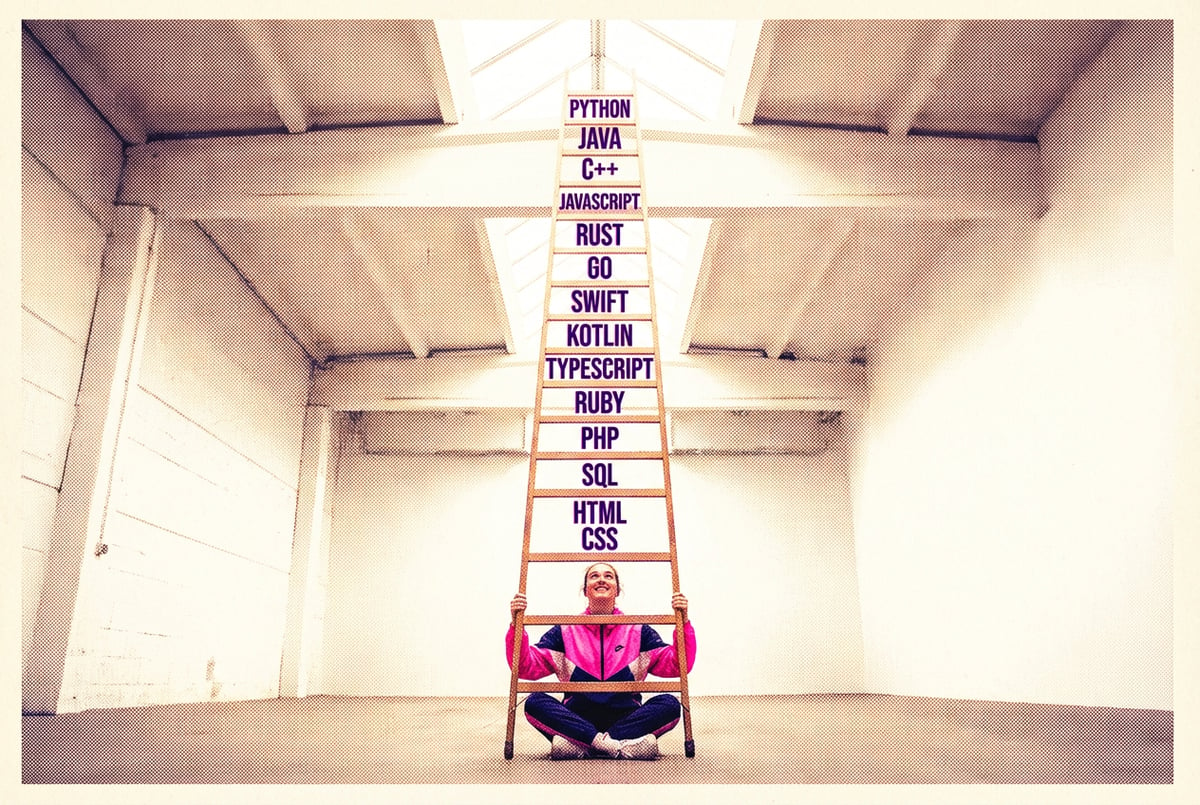
Programming Has Always Been About Saying More With Less
Every generation of programmers believes they’re working at the “real” level of software. The assembly programmer scoffs at C. The C programmer scoffs at Python. The Python developer scoffs at no-code tools. And yet, the abstraction ladder keeps climbing — and each rung produces more software than the one before it.
Spec-Driven Development is the next rung. It’s not a shortcut or a dumbed-down interface. It’s a new level at which programming happens — one where annotated prose describes an application, and a compiler produces the full stack underneath. To understand why this matters, and why it’s happening now rather than a decade ago or a decade from now, it helps to look at how we got here.
This article traces the full arc: from toggling bits in machine language to writing TypeScript, and then to what comes next.
The Bottom of the Ladder: Speaking Directly to Hardware
In the beginning, programming meant talking directly to the machine. Early computers were programmed with physical switches and punch cards — sequences of 1s and 0s loaded into memory, with no translation layer at all.
Assembly language was the first real abstraction. Instead of binary opcodes, you wrote human-readable mnemonics: MOV, ADD, JMP. An assembler translated those into machine code. The mapping was nearly one-to-one — each instruction corresponded to a processor operation — but even this small layer changed everything. It meant programmers could think in operations rather than bit patterns.
The gains were modest by today’s standards. But the principle was established: you could express intent at a higher level, let a program do the translation, and lose almost nothing in the process.
Assembly is still running underneath your smartphone. Nobody writes it by hand anymore unless they’re doing embedded systems work or performance-critical kernel code. But the code it generates runs billions of times a second. The lower layer didn’t disappear — it just stopped being where the work happens.
The Middle Rungs: C, Objects, and Managed Memory
The next major leap was C, developed at Bell Labs in the early 1970s. C let you write programs that were portable across different hardware architectures. You described logic in terms humans could read — loops, conditionals, functions — and the compiler handled the architecture-specific machine code.
This was a genuine abstraction jump. A C program could compile to x86 or MIPS or ARM. The programmer no longer needed to know the exact instruction set of the target machine. Intent was separated from implementation.
Then came object-oriented languages — C++, Smalltalk, Java. These added a new layer: not just “what operations do I run?” but “what entities exist in my system, and how do they relate?” Classes, inheritance, encapsulation — these were ways of organizing programs that mapped closer to how humans think about problems.
Java went a step further by introducing garbage collection. Programmers no longer managed memory manually. The runtime handled it. You described your objects and their relationships; the JVM handled when to allocate and free memory. Entire categories of bugs — dangling pointers, memory leaks of the classic variety — moved from programmer responsibility to runtime responsibility.
Each rung made the programmer responsible for less mechanical work and more meaningful work.
Scripting, the Web, and Dynamic Languages
The internet created a new pressure: shipping fast. Python, Ruby, PHP, and JavaScript prioritized developer velocity over raw performance. They were dynamically typed, interpreted, and came with large standard libraries. You could write a web server in 20 lines of Python. The same task in C++ took 500.
These languages traded performance headroom for expressiveness. And for most web applications, that trade was worth it. Databases are almost always the bottleneck, not the application layer. Being able to move faster in Python and lose 20% of raw CPU performance rarely mattered in practice.
JavaScript took an unusual path: it became the only language that ran natively in the browser. This made it the most-used programming language on earth almost by accident. Every web frontend had to speak JavaScript. The language grew from a scripting language for simple form validation into the foundation for complex, stateful single-page applications.
This created a problem. JavaScript is dynamically typed. When your codebase grows to hundreds of thousands of lines, dynamic typing becomes a source of bugs that are hard to catch before runtime. Refactoring becomes dangerous. The language that was designed for quick scripts was now holding up production systems at scale.
Plans first. Then code.
Remy writes the spec, manages the build, and ships the app.

TypeScript: The Rung We’re Currently Standing On
TypeScript is Microsoft’s answer to JavaScript’s type problem. It adds a static type system on top of JavaScript. You annotate your variables, function parameters, and return values with types. A compiler checks those types before your code runs, catching a class of errors that would otherwise surface in production.
TypeScript compiles to JavaScript. The output — the runtime artifact — is plain JavaScript. TypeScript itself is only ever a source format. Using TypeScript for full-stack web development has become standard for exactly this reason: it lets large teams work on large codebases with more confidence.
This is worth pausing on, because it’s directly analogous to what’s happening now with specs. TypeScript didn’t replace JavaScript — it raised the level at which you express your intent. The compiled output is still JavaScript. The source of truth shifted upward.
TypeScript also made it easier for tools to understand code. IDEs can autocomplete with confidence. Refactoring tools can rename a function across an entire codebase reliably. Static analysis can catch dead code. The type annotations aren’t just for humans — they’re for the toolchain.
That’s a preview of what happens when the source format carries more structured information.
What Forces Drive Abstraction Upward?
It’s worth asking why abstraction keeps increasing. It’s not inevitable — it requires the right conditions. Looking at the historical pattern, three forces appear consistently:
1. Hardware gets faster and cheaper. Each abstraction layer adds overhead. The transition from assembly to C was resisted partly because C programs were “slower.” But as CPUs became faster, the performance gap narrowed to irrelevance for most use cases. When hardware is cheap, you can afford the overhead of a higher-level language and gain the productivity benefits.
2. Software systems get bigger and more complex. As systems grew, the cognitive load of managing them at a low level became the bottleneck. Memory management in C is powerful but error-prone. Object-oriented design was partly a response to programs getting too large to reason about as flat sequences of instructions. Type systems were a response to dynamic codebases getting too large to change safely.
3. The pool of people who need to build software expands. Every new abstraction layer makes programming accessible to more people. C was more accessible than assembly. Python was more accessible than C. Each transition brought in a new wave of builders — people who had the domain knowledge to build valuable software but couldn’t work at the prior level.
All three forces are active right now, and each one is pushing toward the same outcome: a higher-level abstraction for software development.
Why Now? The Conditions That Make Spec-Driven Development Possible
The abstraction ladder didn’t jump from TypeScript to specs arbitrarily. The same three forces are operating, and they’ve converged at an unusual intensity.
Hardware isn’t just cheaper — inference is now available as a commodity. Large language models can parse and reason about natural language with enough reliability to use as a compilation target. That wasn’t true five years ago. The “compiler” for converting human-readable specs to working code now exists and is getting better every quarter.
Software complexity has reached a point where even TypeScript isn’t expressive enough for non-developers. The question is no longer “can we build this?” but “who gets to build this?” The demand for software far exceeds the supply of engineers who can write it. Domain experts who aren’t coders — doctors building clinical tools, operations managers building workflow software, researchers building data pipelines — know exactly what they need but can’t express it in TypeScript.
AI coding agents have made the compilation step real. AI coding agents can now take a structured description of a system and produce working backend code, database schemas, API routes, and frontend components. The key word is “structured.” Unstructured prompts produce inconsistent output. But a spec — a document with real precision baked in — gives an agent enough to work with reliably.
This last point is critical. The shift from typing code to writing specs isn’t about removing structure. It’s about moving structure to a higher level. The spec carries the precision that the compiler needs.
What a Spec Actually Is (And Why It’s Not Just a Prompt)
This is where a lot of people get confused. “Describing your app in English and having AI build it” sounds like vibe coding — throwing casual prompts at a model and seeing what comes out. A spec is something different.
Spec-Driven Development treats the spec as the source of truth for the application. The spec is a structured document — typically Markdown — with two layers:
- Readable prose that describes what the app does, who uses it, and how it behaves
- Annotations that carry precision: data types, validation rules, edge cases, relationships between entities, code hints
The annotations are what make the spec compilable. A spec that says “users can log in” is ambiguous. A spec that says “users authenticate via email and a 6-digit verification code; sessions expire after 30 days; failed attempts are rate-limited to 5 per hour” gives a compiler something real to work with.
Specification precision — the skill of writing specs with enough clarity and structure to compile reliably — is genuinely different from casual prompting. It’s closer to writing a type-annotated function signature than writing a wish list.
The spec is also persistent. Unlike a chat log of prompts, it’s a document you can version, edit, review, and reason about. It grows with the project. When requirements change, you update the spec and recompile. You’re not renegotiating with a chatbot — you’re editing the source and rebuilding the output.
Andrej Karpathy’s framing — treating LLMs as compilers that translate high-level intent into executable code — captures this well. The spec is the high-level language. The code is the compiled artifact.
The Compiled Output Is Still Real Code
One of the most common objections to spec-driven development is: “But what about the code? Is it real?”
Other agents ship a demo. Remy ships an app.
Real backend. Real database. Real auth. Real plumbing. Remy has it all.
Yes. The output is real TypeScript running on a real backend, with a real SQL database and real auth. It’s not a prototype backed by a serverless function and localStorage. The difference between a frontend and a full-stack app matters here — and a spec-compiled app is genuinely full-stack.
You can read the code. You can extend it. You can add npm packages. You can drop down into TypeScript when you need to do something the spec doesn’t handle. The code being generated doesn’t lock you out of it — it’s just not where you work by default, the same way you don’t hand-write assembly just because it’s running underneath your Python script.
This is also why most AI-generated apps fail in production when they start from prompts rather than specs. A prompt-generated app doesn’t have a persistent source of truth. When you come back to it, you’re starting over. The spec changes that — it’s the document you update, and the code follows.
The New Role of the Developer
Every abstraction shift raises the same fear: “Are developers being replaced?”
They weren’t when C replaced assembly programmers. They weren’t when Python replaced C for data work. In each case, the number of people working in software grew dramatically, and the work shifted from low-level mechanical tasks to higher-level design and reasoning.
The honest question isn’t whether software engineering is dead — it’s what changes about the work. The answer, historically, is that the mechanical part gets automated and the thinking part gets more valuable.
With spec-driven development, the mechanical part is wiring up routes, writing CRUD handlers, setting up auth middleware, and configuring database schemas. These things are compilable from intent. What isn’t compilable is knowing what to build and why — understanding the user’s problem, making tradeoffs, knowing what edge cases matter.
That knowledge lives in the spec. Writing a good spec requires the kind of precision that comes from understanding the problem deeply. It rewards domain knowledge, not syntax familiarity.
How Remy Fits Into This History
Remy is a spec compiler. You write an annotated Markdown spec describing your application. Remy compiles that into a full-stack app: TypeScript backend, SQLite database with migrations, real auth with email verification and sessions, a Vite + React frontend, tests, and deployment.
The spec is the program. The code is the output.
This positions Remy not as a tool on top of the existing stack — it’s not a code editor add-on or a smarter autocomplete — but as the next rung on the abstraction ladder. You work at the spec level. The TypeScript is still there, still readable, still extensible. But it’s compiled output, not the source of truth.
The infrastructure underneath Remy is built on years of production work — hundreds of AI models, thousands of integrations, managed databases, and deployment pipelines — which means you’re not building on a demo platform. But the approach is entirely new: start from a spec, compile to a real app.
If you want to see what this looks like in practice, check out how to write a software spec — and then try compiling one at goremy.ai.
FAQ
What is spec-driven development?
One coffee. One working app.
You bring the idea. Remy manages the project.
Spec-driven development is an approach where the source of truth for an application is a structured specification document — typically annotated Markdown — rather than code. The spec describes what the app does, who uses it, and how it behaves, with annotations carrying the precision that lets an AI compiler generate the full code stack. The code is a derived artifact from the spec, not the starting point.
How is a spec different from a prompt?
A prompt is a one-time instruction to an AI model. A spec is a persistent document that evolves with the project. Prompts produce inconsistent output because there’s no structured source of truth for the AI to reference. A spec carries real precision — data types, validation rules, edge cases — and stays in sync with the codebase as the project grows. Writing a good spec is a skill closer to writing type-annotated code than writing a chatbot message.
Is spec-driven development the same as no-code or low-code?
No. No-code tools typically produce constrained outputs — forms, simple workflows, visual interfaces with limited backend logic. The differences between no-code, low-code, and code-first platforms matter here. Spec-driven development produces real code: TypeScript backends, SQL databases, auth systems. The spec format has genuine precision. You can extend the output code, add npm packages, and deploy to production. It’s a higher-level programming language, not a drag-and-drop interface.
Why is this shift happening now and not earlier?
Three conditions converged: AI inference became cheap and reliable enough to use as a compilation layer; software complexity grew to the point where TypeScript alone couldn’t serve the full range of people who need to build software; and AI coding agents matured enough to produce consistent full-stack output from structured input. Each condition was a prerequisite. Five years ago, the AI layer wasn’t reliable enough. The spec-to-code path is only now practical at production quality.
Do I lose control over the code when I use a spec?
No. The generated code is real TypeScript — readable, editable, extensible. You can add any npm package, modify any file, and extend the app in ways the spec doesn’t cover. The spec is the starting point and the source of truth for recompilation, but it doesn’t lock you into a walled garden. If the generated code has issues, you can fix them directly or update the spec and recompile.
What happens to the spec when the app changes?
The spec updates too. It’s not a one-time description that becomes stale — it’s the document you maintain as the project evolves. When you add a feature, you add it to the spec first. When requirements change, the spec changes. The code follows. This is the same relationship TypeScript has with JavaScript: the source format changes, the compiled output regenerates.
Key Takeaways
- Programming has always moved up in abstraction — from punch cards to assembly to C to TypeScript — with each step producing more software and reaching more builders.
- Every abstraction shift was driven by the same three forces: cheaper hardware, growing software complexity, and an expanding need for people to build software.
- All three forces are operating now, converging toward a new level of abstraction: the annotated spec.
- A spec is not a prompt. It’s a persistent, structured document with the precision required to compile reliably into a full-stack application.
- The code generated from a spec is real — real TypeScript, real databases, real auth. The spec is the source of truth; the code is the compiled output.
- The skill that matters at this level isn’t syntax fluency — it’s knowing how to specify what you want with enough precision that a compiler can act on it.
Other agents start typing. Remy starts asking.
Scoping, trade-offs, edge cases — the real work. Before a line of code.
The next rung is here. You can start climbing it at goremy.ai.