Andrej Karpathy Joins Anthropic: What the Karpathy Loop Means for AI Builders
Karpathy's Auto Research project uses AI agents to run recursive self-improvement loops. Here's what his move to Anthropic signals for the future of AI.

Karpathy at Anthropic: A Signal Worth Paying Attention To
Andrej Karpathy joining Anthropic is one of those moments that makes the broader AI community stop and recalibrate. Not because individual moves always matter — they often don’t — but because of what Karpathy represents: someone who has spent years thinking rigorously about what AI systems actually need to get smarter, not just bigger.
His work on recursive agentic loops, sometimes called the Karpathy Loop in developer circles, sits right at the intersection of multi-agent systems and the kind of autonomous AI reasoning that Anthropic’s Claude is increasingly being built to support. If you’re building AI agents today, this move has practical implications for the tools and architectures you’re betting on.
This article breaks down what the Karpathy Loop is, why it matters for AI builders, what his transition to Anthropic likely signals for Claude and multi-agent development, and how you can start building systems that use these patterns right now.
Who Karpathy Is and Why This Move Is Different
Karpathy isn’t a newcomer. He co-founded OpenAI, led AI at Tesla during the period when Autopilot became genuinely impressive, returned to OpenAI, and then struck out independently with Eureka Labs — an AI-native education company. His YouTube series Neural Networks: Zero to Hero became one of the most-watched AI education resources on the internet.
Other agents ship a demo. Remy ships an app.
Real backend. Real database. Real auth. Real plumbing. Remy has it all.

He’s also someone who publishes his own thinking publicly, builds projects in the open, and generally behaves more like a curious builder than a corporate executive. That makes his Anthropic move interesting. Anthropic is already one of the most research-focused AI labs — the team behind Constitutional AI, responsible scaling policies, and Claude’s interpretability research. Adding Karpathy to that mix suggests they’re doubling down on foundational thinking about how AI agents reason and improve.
For builders, this matters because the architectural decisions made at these labs ripple out into the APIs, model behaviors, and tool protocols that everyone else builds on top of.
What the Karpathy Loop Actually Is
The term “Karpathy Loop” isn’t an official product or published paper — it’s a concept that emerged from his public discussions about agentic AI and his Auto Research project, which explores using AI agents to run recursive self-improvement cycles.
Here’s the basic structure:
- An AI agent is given a task or research question
- It generates an initial output (a hypothesis, summary, plan, or draft)
- A second agent (or the same agent with a different prompt context) evaluates that output against defined criteria
- Weaknesses or gaps are identified
- The agent revises or expands based on that feedback
- The loop repeats until a quality threshold is met
This isn’t entirely new as a concept — reflection and critique patterns have been part of AI agent research for a while. What Karpathy’s framing adds is a particular emphasis on autonomous research workflows: giving agents the ability to not just answer questions but to iteratively improve their own understanding of a topic through structured loops.
The Auto Research project applies this specifically to knowledge synthesis. An agent doesn’t just retrieve information — it generates hypotheses, stress-tests them, searches for contradictory evidence, and refines its model of the subject iteratively. The loop terminates when the agent’s output meets some evaluation standard, either defined externally or self-assessed.
Why This Is Architecturally Important
Most early AI applications were single-turn: you prompt, you get a response, done. Even many “agentic” workflows today are just chains of single-turn calls with some routing logic.
The Karpathy Loop represents something more interesting — a closed feedback cycle where the AI system’s output at step N becomes the input context that shapes step N+1. This structure allows for genuine quality improvement over successive iterations, not just more steps in a linear pipeline.
This is a meaningful architectural shift. It’s the difference between a system that executes instructions and one that refines its own work.
Why This Matters for Claude Specifically
Anthropic’s Claude has been developing capabilities that make it particularly well-suited for loop-based agentic architectures:
- Extended context windows — Claude can hold long chains of reasoning, prior drafts, and evaluation feedback in context without losing coherence
- Strong instruction-following — Recursive loops require the model to stay on task across many iterations; Claude’s instruction adherence is notably reliable
- Tool use and computer use — Claude can interact with external systems, browse the web, run code, and read files — all the capabilities needed for Auto Research-style agents
- Constitutional AI training — Claude’s safety training makes it better at self-evaluation tasks, which are central to recursive loops
Remy doesn't write the code. It manages the agents who do.
Remy runs the project. The specialists do the work. You work with the PM, not the implementers.
Claude’s extended thinking mode is also directly relevant here. When a model can spend more compute on internal reasoning before producing output, the quality of each loop iteration goes up. Combine extended thinking with a recursive loop structure, and you’re building something qualitatively more powerful than a single prompt call.
Karpathy’s arrival at Anthropic suggests that this direction — AI systems that can reason recursively and improve their own outputs — is going to get significantly more investment and attention.
The Broader Multi-Agent Shift This Points To
Karpathy has written and spoken about the idea that the future of AI development isn’t just better base models — it’s better systems built around models. This is essentially the multi-agent thesis: that composing multiple AI agents, each specialized for a subtask, produces results that a single model call never could.
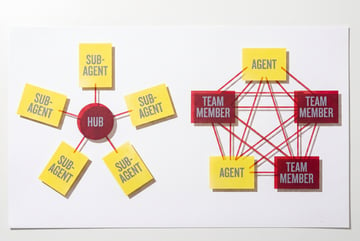
The Karpathy Loop is a specific instance of a more general multi-agent pattern. In a full multi-agent system, you might have:
- A planner agent that breaks a complex task into subtasks
- Specialist agents that execute each subtask
- An evaluator agent that scores outputs
- An orchestrator that manages routing, memory, and loop termination
Each of these agents can be running the same base model with different system prompts, different tools, and different responsibilities. The intelligence of the system emerges from the structure, not just the model.
This is why Karpathy’s move to Anthropic is particularly interesting from a tooling perspective. Anthropic has been building infrastructure for exactly this kind of system — the Model Context Protocol (MCP) is designed to let agents communicate, share context, and invoke each other’s capabilities in structured ways. If Karpathy is working on agent architecture, MCP is exactly the kind of primitive he’d want to be building with.
What This Means for AI Builders Right Now
You don’t have to wait for Anthropic to ship something new to start building with these patterns. The conceptual architecture of the Karpathy Loop is implementable today:
- Define your loop criteria — What does “good enough” look like for your task? Quality rubrics, word counts, checklist compliance, factual verification — pick something measurable
- Build a generator agent — This produces the initial output
- Build an evaluator agent — This critiques the output against your criteria and returns structured feedback
- Wire the loop — Pass the feedback back into the generator’s context and run again
- Add a termination condition — Either a quality score threshold, a max iteration count, or both
This pattern works across a surprising range of use cases: content generation, research synthesis, code review, proposal drafting, data analysis, and more.
Building Recursive Agent Loops With MindStudio
If you want to implement Karpathy Loop-style agent architectures without writing infrastructure code from scratch, MindStudio makes this considerably more accessible.
MindStudio’s visual workflow builder lets you create multi-step agent pipelines where the output of one step feeds directly into the next — including looping logic. You can build a generator-evaluator loop by:
- Creating two AI blocks: one that generates, one that evaluates
- Using conditional routing to check whether the evaluation score meets your threshold
- Looping back to the generator with the evaluator’s feedback if it doesn’t
- Exiting the loop when quality criteria are met
What makes this practical is that MindStudio has Claude, GPT-4o, and Gemini all available in the same builder with no separate API setup. You can use Claude for the evaluation step (where its strong instruction-following and extended context shine) and a different model for fast generation if you want to manage cost and speed across loop iterations.
The platform also handles the infrastructure layer — rate limiting, retries, state management across loop iterations — so you can focus on the logic of your agents rather than the plumbing.
If you’re already building with code, the MindStudio Agent Skills Plugin (@mindstudio-ai/agent) lets you call MindStudio’s capabilities from within Claude Code, LangChain, or any custom agent framework. That means you can implement Karpathy Loop patterns in your existing codebase and offload specific tool calls — web search, email, image generation — to MindStudio without rebuilding your whole stack.
You can start building for free at mindstudio.ai.
What Karpathy’s Presence at Anthropic Signals Long-Term
Reading too much into one hiring move is a trap, but there are a few reasonable inferences here.
Anthropic is serious about agentic AI, not just better chat. The work Karpathy has been doing — Auto Research, recursive loops, autonomous agent systems — is exactly the problem space that produces genuinely capable AI beyond question-answering. His presence suggests Anthropic wants to lead this transition, not just respond to it.
Claude will likely get better as an orchestrator and evaluator. The Karpathy Loop architecture requires models that can self-critique reliably, maintain context across many iterations, and follow nuanced evaluation rubrics. These are areas where Claude already has an edge, and Karpathy’s input on agent research would logically push further in that direction.
The gap between research and developer tooling may close. One of Karpathy’s consistent themes has been accessibility — he’s spent years explaining complex concepts clearly for a broad audience. Having that sensibility inside Anthropic could influence how they document and expose agent capabilities to developers.
For anyone building AI systems today, the practical takeaway is this: recursive, self-improving agent architectures are moving from research curiosity to production pattern. The tools exist, the models support it, and the people shaping the field are actively working on it.
Frequently Asked Questions
What is the Karpathy Loop in AI?
The Karpathy Loop refers to a recursive agent architecture where an AI system generates an output, evaluates it against defined criteria, and iterates based on that feedback until a quality threshold is met. It’s closely associated with Karpathy’s Auto Research project, which applies this pattern to autonomous knowledge synthesis and research tasks.
Why did Andrej Karpathy join Anthropic?
Karpathy joined Anthropic after a period of independent work, including his education startup Eureka Labs. While his specific role details haven’t been fully disclosed, his background in autonomous agent research, recursive AI systems, and foundational model architecture aligns closely with Anthropic’s focus on building capable, safe AI agents and improving Claude’s reasoning and agentic capabilities.
What is Claude’s role in multi-agent systems?
- ✕a coding agent
- ✕no-code
- ✕vibe coding
- ✕a faster Cursor
The one that tells the coding agents what to build.
Claude is increasingly designed to function well as both an orchestrator (directing other agents) and a subagent (executing specific tasks within a larger pipeline). Its strong instruction-following, large context window, and tool use capabilities make it effective for multi-agent architectures, including recursive loops where it needs to evaluate and revise its own outputs over multiple iterations.
How is the Karpathy Loop different from a standard AI agent chain?
A standard agent chain is linear: each step feeds into the next and terminates. The Karpathy Loop is cyclic — it includes an evaluation step that can route output back to an earlier step for revision. This creates a genuine improvement mechanism rather than just sequential execution. The quality of output at iteration 5 is typically meaningfully higher than at iteration 1.
Can you build Karpathy Loop-style agents without coding?
Yes. Platforms like MindStudio let you build recursive agent loops visually — connecting generator and evaluator AI blocks, adding conditional routing based on evaluation scores, and looping until your quality criteria are met. You can access Claude and other major models within the same builder, with no API keys or code required to get started.
What does Karpathy joining Anthropic mean for OpenAI?
Karpathy’s move is more of a signal about where the interesting problems are being worked on than a competitive blow to OpenAI. It suggests that foundational agent research — the kind that produces systems capable of recursive self-improvement and autonomous reasoning — is accelerating across the industry. Both labs will continue doing significant work; the difference is which architectural bets each is making.
Key Takeaways
- Andrej Karpathy’s move to Anthropic signals increased focus on agentic AI systems, recursive reasoning loops, and autonomous research architectures
- The Karpathy Loop is a generator-evaluator cycle where AI agents improve their output through structured feedback across multiple iterations
- Claude’s extended context, strong instruction-following, and tool use make it well-suited for these loop architectures
- Multi-agent systems built around recursive loops represent a meaningful step beyond single-turn AI calls
- Builders can implement these patterns today using MindStudio’s visual workflow builder, which supports Claude and other major models in loop-based pipelines
If you want to start building multi-agent systems with recursive improvement loops, MindStudio gives you the infrastructure to do it without writing backend code from scratch. The patterns Karpathy is working on at a research level are already buildable in production — you just need the right tools.