What Is Andrej Karpathy's LLM Knowledge Base Architecture? The Compiler Analogy Explained
Karpathy's LLM knowledge base treats raw articles like source code and compiles them into a queryable wiki. Here's the full architecture breakdown.
The Compiler Analogy at the Core of Karpathy’s Thinking
Andrej Karpathy has a habit of reframing familiar computing concepts to make sense of what LLMs actually do. His LLM knowledge base architecture is one of the clearest examples of that — and if you’ve struggled to understand why RAG systems feel incomplete, or why “just search your docs” doesn’t scale, this analogy cuts right through the noise.
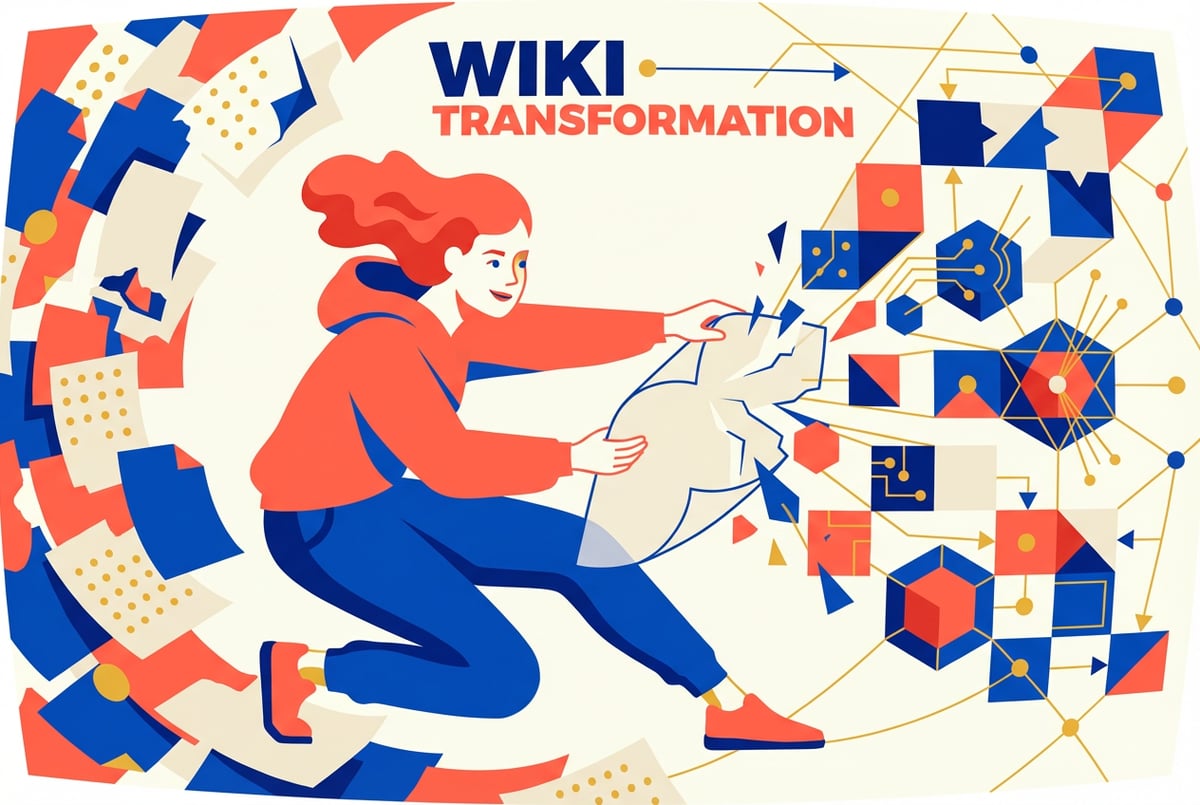
The core idea: treat raw documents the same way a compiler treats source code. You don’t run source code directly. You compile it first. The result is something denser, more structured, and faster to execute. Karpathy applies the same logic to LLM-powered knowledge bases — and the architecture that follows from it is fundamentally different from standard retrieval pipelines.
This article breaks down the architecture step by step, explains why the compiler analogy matters, and shows how you can apply the same design pattern in practice.
What Karpathy Actually Proposed
Karpathy has outlined this thinking across several public discussions, including lectures and posts where he describes LLMs not just as chatbots but as a new kind of computing substrate.
The knowledge base idea stems from a simple observation: most documents are not written to be queried by machines. They’re written for humans. They contain redundancy, implicit context, narrative structure, and unstated assumptions. Feeding raw documents directly into a search index or a vector store preserves all of that noise.
His proposal flips the workflow:
- Feed raw articles into an LLM.
- Let the LLM “compile” them — extract facts, compress meaning, identify relationships.
- Store the compiled output (not the original source) as the queryable artifact.
- At query time, reason over the compiled knowledge rather than the raw text.
The key shift is that the LLM does heavy lifting before the user ever asks a question — not only at query time.
The Compiler Analogy, Explained
If you’ve written code, the analogy will click immediately. If not, here’s the short version.
When you write a program in C++ or Rust, you don’t run the source file directly. You compile it into machine code that the processor can actually execute. The compiled output is:
- Smaller (unnecessary human-readable formatting is stripped)
- Faster to execute (already optimized for the target environment)
- Less ambiguous (the compiler resolves references, checks types, makes implicit structure explicit)
The source code is still important — it’s where you make edits. But at runtime, you work with the compiled artifact.
Karpathy maps this to documents:
| Compiler Stage | Document Pipeline Stage |
|---|---|
| Source code | Raw articles, PDFs, web pages |
| Compilation | LLM processing and summarization |
| Compiled binary | Structured knowledge base / wiki |
| Runtime execution | Querying the knowledge base |
| Compiler errors | LLM flagging gaps or contradictions |
The insight is that LLMs are good at doing what compilers do for code: resolving ambiguity, compressing information, making implicit structure explicit, and producing a form that’s faster to work with.
Why This Matters for RAG Systems
Standard RAG (Retrieval-Augmented Generation) architectures retrieve chunks of raw source text and pass them to a model at query time. That works reasonably well, but it has real limitations:
- Chunking loses context. A 500-token chunk of a 10,000-word article loses most of its surrounding meaning.
- Embedding similarity isn’t semantic equivalence. Two chunks that embed close together don’t always answer the same question.
- The LLM has to do all the reasoning at query time. Every query forces the model to re-interpret raw text from scratch.
Karpathy’s approach offloads most of that reasoning to the compile step. By the time a query arrives, the knowledge is already structured. The query-time model is working with clean, dense summaries rather than raw prose.
The Architecture, Layer by Layer
Layer 1: The Source Layer (Raw Documents)
This is everything you want the knowledge base to know — research papers, blog posts, documentation, transcripts, internal wikis, emails, reports. Think of it as the source tree in a software project.
At this layer, the goal is ingestion, not transformation. You’re collecting and organizing raw material. The quality of your source layer directly affects the quality of your compiled knowledge. Garbage in, garbage out — same as it’s always been.
One practical implication: Karpathy’s framing suggests you should be intentional about what goes into this layer. Not every document is worth compiling. Just like you wouldn’t include generated or deprecated files in a codebase you’re compiling for production, you shouldn’t include low-quality or outdated sources in your input corpus.
Layer 2: The Compilation Layer (LLM Processing)
This is where the analogy does the most work. An LLM processes each document (or logical chunk of a document) and transforms it into a structured artifact. The specific transformation depends on your use case, but common outputs include:
- Atomic fact extraction: Breaking a document into discrete, self-contained statements (“The Transformer architecture was introduced in 2017 by Vaswani et al.”)
- Entity and relationship mapping: Identifying key concepts and how they relate to each other
- Summarization at multiple granularities: A one-sentence summary, a paragraph summary, and a detailed summary
- Question-answer pairs: The LLM generates likely questions the document answers, paired with the answers
- Contradiction and gap flagging: Noting where this document conflicts with or extends others in the corpus
The output is a structured representation — not a restatement of the original prose, but a distillation. Think of it as the compiled binary: it contains the same information, but in a form optimized for retrieval and reasoning.
Layer 3: The Knowledge Store (The “Wiki”)
The compiled artifacts live in a structured store. Karpathy often uses the word “wiki” here — implying something that has linked entries, consistent structure, and can be navigated meaningfully.
This layer is distinct from a vector database, though vector embeddings may be part of it. The key is that the stored artifacts are semantically structured, not just chunked raw text. Each entry has clear boundaries, defined relationships to other entries, and was deliberately authored (by the LLM) rather than mechanically sliced.
A useful mental model: imagine Wikipedia, but the articles were written by an LLM that read your source corpus. Each article covers a concept, cites relevant sources, and links to related concepts. That’s roughly what the knowledge store looks like in this architecture.
Layer 4: The Query Layer
At query time, a user asks a question. An LLM retrieves relevant compiled entries and reasons over them.
Because the stored knowledge is already structured and dense, the query-time model has a much easier job. It doesn’t have to parse raw prose or infer unstated context. It can focus on synthesis: combining multiple clean facts into a coherent answer.
This is the equivalent of running compiled code instead of interpreting source files at runtime. The heavy processing already happened. Execution is fast.
Why This Approach Is Different From Standard Retrieval
It’s worth being explicit about what makes this different from vanilla RAG or semantic search, because the surface-level similarity can obscure the real distinction.
In standard RAG:
- Chunk the raw documents.
- Embed the chunks.
- At query time, find the closest chunks by embedding similarity.
- Pass the retrieved chunks to an LLM.
- The LLM generates an answer from raw text.
In Karpathy’s compiled approach:
- Process raw documents through an LLM to produce structured knowledge artifacts.
- Store those artifacts.
- At query time, retrieve relevant artifacts.
- Pass the structured artifacts to an LLM.
- The LLM synthesizes from pre-processed knowledge.
The difference is in steps 1–4. The compiled approach moves intelligence earlier in the pipeline. This has real consequences:
- Higher retrieval precision. Structured artifacts embed more predictably than raw prose.
- Lower hallucination risk at query time. The model isn’t trying to interpret ambiguous raw text under time pressure.
- Better handling of multi-document reasoning. When facts from multiple documents have been compiled into a consistent structure, synthesizing across them is straightforward.
- More stable answers. The compiled knowledge doesn’t change unless you recompile. Raw retrieval can vary based on chunking parameters, embedding model updates, or index drift.
The tradeoff: compilation costs compute upfront. You pay an LLM API bill to process your source documents before anyone asks a question. For large corpora, this isn’t trivial. But like software compilation, you pay it once (or on update), not on every query.
The Incremental Compilation Problem
Karpathy’s analogy also points to a challenge that compiler designers know well: incremental compilation.
Other agents ship a demo. Remy ships an app.
Real backend. Real database. Real auth. Real plumbing. Remy has it all.

In large codebases, you don’t want to recompile everything every time you change one file. You only recompile what changed, and update downstream artifacts that depend on it.
The same problem applies to LLM knowledge bases. When a new document arrives, or an existing document is updated, you don’t want to reprocess your entire corpus. You need to:
- Compile the new or changed document.
- Identify which existing knowledge artifacts might be affected.
- Update or regenerate those artifacts.
- Propagate any changes to dependent entries.
This is an active area of design in real-world implementations. Some systems handle it by keeping a dependency graph of knowledge artifacts — tracking which compiled entries draw from which source documents. Others take a simpler approach: recompile the affected document and flag related entries for review.
Getting incremental compilation right is what separates a research prototype from a production knowledge base.
Prompt Engineering in the Compilation Step
One of the practical implications of this architecture is that the most important prompt engineering happens at compile time, not query time.
Most teams spend energy on their query prompt — how to phrase the question, how to format the context, how to instruct the model to answer. In the compiled knowledge base approach, the compilation prompt is equally important. Maybe more so.
What you’re asking the LLM to do at compile time:
- What facts should be extracted, and at what granularity?
- How should entities be named consistently across documents?
- How should conflicts between sources be represented?
- What metadata should be attached to each artifact?
- How should relationships between concepts be encoded?
These decisions shape the entire knowledge base. A poorly designed compilation prompt produces structured noise. A well-designed one produces a knowledge graph that genuinely accelerates query-time reasoning.
The field of prompt engineering has matured significantly around query-time prompts, but compilation-time prompt design is still less discussed — and arguably more impactful in this architecture.
Real-World Applications of This Pattern
The compiler analogy isn’t just conceptual. Several real systems and workflows implement variations of this pattern.
Personal research assistants: Process a library of papers and books through a compilation step to produce a structured knowledge base that you can query conversationally.
Enterprise documentation systems: Convert internal wikis, Confluence pages, and policy documents into a compiled knowledge base where employees can ask specific operational questions.
Product intelligence: Feed customer interviews, support tickets, and product reviews through a compilation step to produce structured insights about user needs, pain points, and feature requests.
News and information monitoring: Compile daily feeds into structured summaries, extract entities and trends, and build a queryable record of what’s happened in a given domain over time.
In each case, the pattern is the same: transform raw content into structured knowledge before it’s ever queried, and let the query layer work with the cleaner artifact.
How to Build This With MindStudio
Building a compiled knowledge base pipeline from scratch involves coordinating several LLM calls, managing storage, and designing a retrieval layer. That’s a significant engineering project if you’re starting from code.
Remy doesn't write the code. It manages the agents who do.
Remy runs the project. The specialists do the work. You work with the PM, not the implementers.
MindStudio’s visual workflow builder makes it practical to set this up without writing infrastructure code. You can build a multi-step agent that:
- Ingests source documents — via file upload, URL fetch, or connections to tools like Notion, Google Drive, or Confluence (all available through MindStudio’s 1,000+ integrations).
- Runs a compilation workflow — a sequence of LLM calls that extract facts, generate summaries at multiple granularities, and structure the output.
- Stores compiled artifacts — to Airtable, Notion, or a custom database, with consistent schema.
- Serves query requests — through a conversational agent that retrieves structured artifacts and synthesizes answers.
Because MindStudio supports 200+ models out of the box — including Claude for nuanced comprehension and GPT-4o for high-throughput extraction — you can mix models across the compilation and query layers based on cost and capability. Use a cheaper model for routine extraction; use a stronger model for synthesis.
You can also set up scheduled background agents that reprocess new documents automatically, handling the incremental compilation problem without manual intervention.
You can try MindStudio free at mindstudio.ai.
Frequently Asked Questions
What is the compiler analogy in Karpathy’s LLM architecture?
Karpathy compares raw documents to source code and LLM processing to compilation. Just as a compiler transforms human-readable source files into optimized machine code, an LLM pipeline transforms unstructured articles into a structured, queryable knowledge base. The compiled output is denser, more consistent, and faster to reason over than the raw originals.
How is this different from standard RAG?
Standard RAG retrieves chunks of raw text at query time and passes them to a model. Karpathy’s compiled approach does the heavy LLM processing before any query arrives — creating structured knowledge artifacts that are stored and later retrieved. This moves intelligence earlier in the pipeline, reduces query-time reasoning load, and produces more stable, higher-precision retrieval.
What does the “compiled” output actually look like?
It depends on implementation, but common formats include: extracted atomic facts, entity-relationship summaries, multi-granularity document summaries, pre-generated question-answer pairs, and structured wiki-style entries with explicit links between related concepts. The goal is a form that’s semantically structured rather than prose-heavy.
Does this approach work for large document corpora?
Yes, but it requires solving the incremental compilation problem — only reprocessing documents that have changed, and updating dependent artifacts accordingly. For large corpora, upfront compilation costs can be significant, but per-query costs drop because the query-time model does less work. The tradeoff favors this approach when the same knowledge base is queried frequently.
What models work best for the compilation step?
Models with strong instruction-following and structured output capabilities — like Claude 3.5 Sonnet, GPT-4o, or Gemini 1.5 Pro — perform well for compilation tasks. For high-volume processing, smaller models fine-tuned for extraction (like structured output variants of Mistral or LLaMA) can reduce costs without sacrificing quality on well-defined extraction tasks.
Can individuals use this architecture, not just enterprises?
One coffee. One working app.
You bring the idea. Remy manages the project.
Absolutely. Karpathy has discussed personal knowledge management as a primary use case — building a queryable store of everything you’ve read and want to reference. The architecture scales down as well as it scales up. A personal research library of a few hundred articles is a perfectly valid input corpus.
Key Takeaways
- Karpathy’s compiler analogy treats raw documents as source code: unoptimized, human-readable, not ready to execute.
- The LLM compilation step transforms that source material into structured knowledge artifacts — denser, cleaner, and faster to query.
- This approach differs from standard RAG by moving reasoning earlier in the pipeline rather than doing all interpretation at query time.
- The most important prompt engineering in this architecture happens at compile time, not query time.
- Incremental compilation — updating only what changed — is the key engineering challenge in production implementations.
- Tools like MindStudio let you build this pipeline visually, connecting ingestion, compilation, storage, and query layers without writing infrastructure code.