
Local & Open-Weight Models
Deployment-focused content for open-weight models — running Gemma, Qwen, etc. locally, on phones, laptops, edge devices. Setup guides, hardware requirements, deployment patterns. Single-model reviews and explainers go under AI Model Reviews & Comparisons instead.
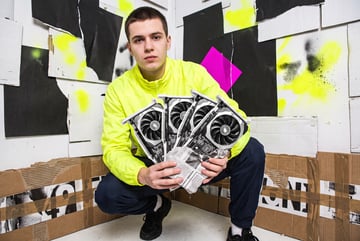
Run Qwen 3.8 Flash Next Locally on Quad RTX 3090s with vLLM
How to run Qwen 3.8 Flash Next locally with vLLM on quad RTX 3090s, with the config flags needed for a fast agentic setup.

Abacus AI Supercomputer: Pricing, Access, and What You Actually Get
Abacus AI Supercomputer starts at $7-10/month for an always-on cloud VM with access to 100+ frontier models. Here's the pricing breakdown.
Apple's New Macs Bet You'll Own AI Instead of Renting It
Apple's refreshed Mac mini and Mac Studio push local AI agents and up to 512GB unified memory, betting owners will skip cloud token bills.
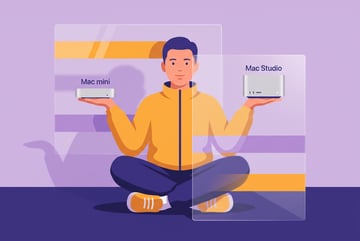
Mac Mini and Mac Studio 2026: Full Pricing and Specs Breakdown
Apple's new Mac mini and Mac Studio lineup, with M5 and M6 chip options, memory tiers up to 512GB, pricing, and release dates for buyers.

JetSpec Local Install: How Much Faster Is Tree-Based Speculative Decoding?
JetSpec's tree-based speculative decoding speeds up LLM inference without quality loss. Here's a local H100 benchmark with Qwen 3.8B and setup notes.
Kimi K3 on 4 Mac Studios vs Abacus AI Supercomputer: App-Build Test
A 4x Mac Studio cluster running Kimi K3 (2.8T params) takes on Abacus AI's cloud Supercomputer building the same web app from one prompt.

Local AI vs Cloud AI Agents: Which Future Should You Bet On?
Apple bets on owned local compute while OpenAI, xAI, and Anthropic bet on rented cloud agents. Here's how the two strategies actually compare.

How to Run Kimi K3 Locally on a 4-Mac Studio Cluster
A hardware guide to running the 2.8 trillion parameter Kimi K3 model locally across four networked Mac Studios with 2TB unified memory.
How to Run Qwen Vision Models Locally with llama.cpp
A practical guide to enabling vision support for Qwen models in llama.cpp, covering mmproj setup, context window, and batching config.
Qwen 3.8 Flash Next Vision at Q4: Does Quantization Cost Accuracy?
A hands-on quad-3090 test of Qwen 3.8 Flash Next's vision support at Q4 quantization, checked against a full-precision Qwen 3.8 27B model.
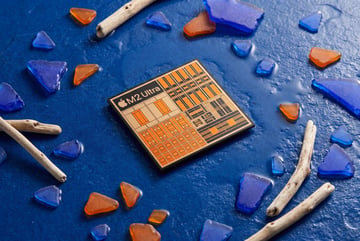
Apple M5 Ultra and M6: Pricing, Specs, and Local AI Performance
Apple's M5 Ultra and M6 chips bring up to 512GB unified memory to local AI compute. Here's what they cost and what models they can run.
How to Run Qwen 3.8 Locally With the Superlinked Inference Engine
A hands-on guide to installing the Superlinked Inference Engine and running Qwen 3.8 27B locally with GPU-tuned profiles and speculative decoding.
Dark Bloom: Rent Out Your Mac for AI Inference and Get Paid
Dark Bloom pays Mac owners to share idle compute for distributed AI inference. Here's how the network, privacy claims, and payouts actually work.

Dark Bloom Earnings: RAM Requirements and Payout Mechanics Explained
What Dark Bloom pays per Mac, the 48GB RAM minimum, and how Stripe payouts work for sharing idle compute with distributed AI inference.
GLM-5.3 Flash Hands-On: Multi-GPU Test, Coding, and Refusals
Hands-on test of GLM-5.3 Flash's 1-bit quant across five GPUs, covering SVG generation, a coding game, and an ethics prompt.
How to Run Hunyuan Video 3 Locally with ComfyUI (Fast Setup)
Run Hunyuan Video 3 locally in ComfyUI using Turbo LoRAs and sage attention to cut generation time to under 90 seconds per clip.
How to Run Tencent's Hy4 Preview Locally with vLLM or SGLang
A practical guide to deploying Tencent's 770B Hy4 preview model locally using FP8 weights, tensor parallelism, and vLLM or SGLang Docker images.
Superlinked Inference Engine vs vLLM: Which One Do You Actually Need?
Superlinked Inference Engine and vLLM solve different problems. Here's how they compare for multi-model serving versus single-model throughput.

GLM-5.3-Flash: Specs, Benchmarks, and Running It Locally
GLM-5.3-Flash's 320B/18B-active MoE, hybrid attention, MIT license, and 1M context, benchmarked against Claude Opus 4.8 and tested locally.
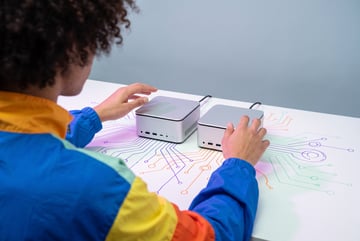
GMKtec EVO X3 vs EVO X2: Which Strix Halo Mini PC to Buy?
GMKtec EVO X2 vs EVO X3 compared on price, ports, and Oculink eGPU support to help you pick the right Strix Halo mini PC.
Nvidia eGPU on AMD Strix Halo: Oculink Setup and Real Speed Gains
How an Oculink port lets an Nvidia RTX GPU pair with AMD's Strix Halo APU in a mini PC, and what that actually does for local LLM speed.

Run GLM 5.3 Flash Locally: VRAM, Quantization, and Hardware Needs
What it takes to run GLM 5.3 Flash locally, including quantization sizes, MoE architecture, and hardware like the new Mac Studio and mini PCs.
How to Run Qwen3.8-Flash-Next Locally with llama.cpp
A practical guide to downloading, quantizing, and serving Qwen3.8-Flash-Next locally with llama.cpp, covering VRAM needs on an H100 and quad 3090 rig.
Splitting a 122B MoE Model Across an Nvidia and AMD GPU with Vulkan
How to run a single 122B-parameter MoE model split across mismatched Nvidia and AMD GPUs using Vulkan and llama.cpp for local inference.