Apple M5 Ultra and M6: Pricing, Specs, and Local AI Performance
Apple's M5 Ultra and M6 chips bring up to 512GB unified memory to local AI compute. Here's what they cost and what models they can run.
What are the M5 Ultra and M6, and why do they matter for AI?
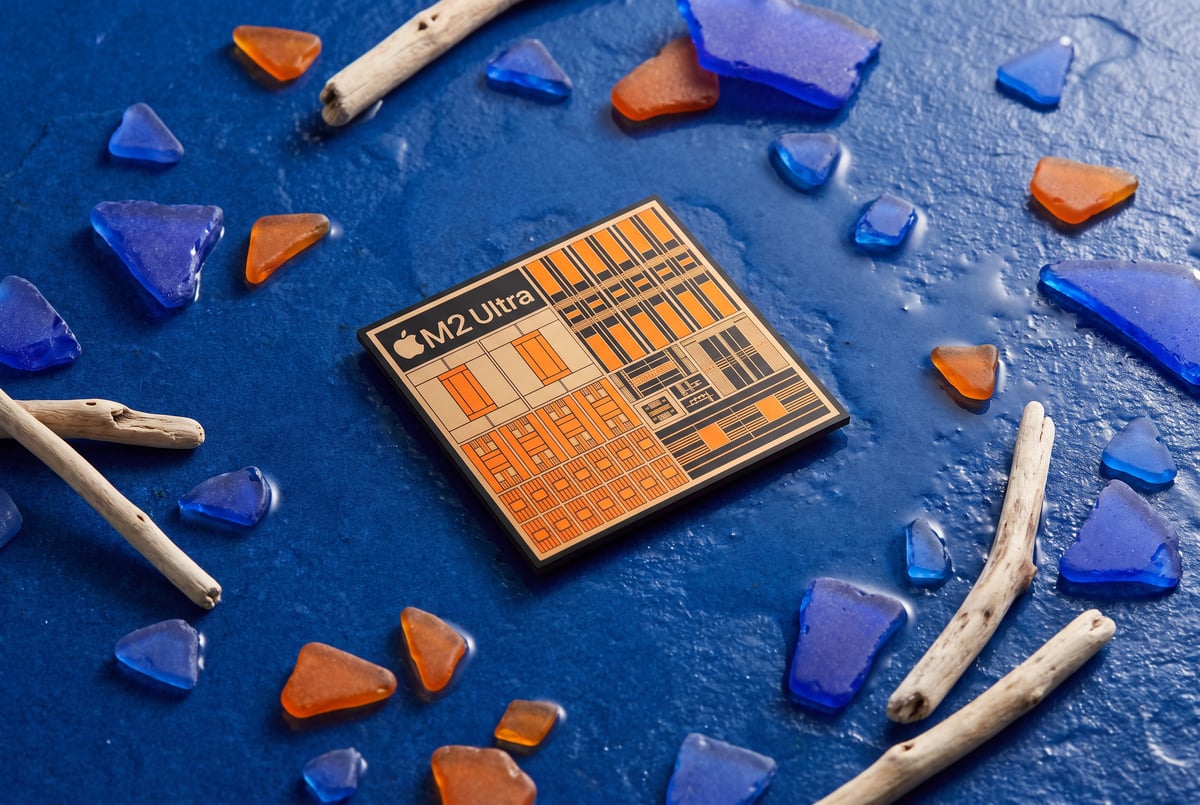
Apple introduced the M6 and M5 Ultra this week, positioning both chips squarely at people who want to run AI models on their own desktop instead of renting cloud compute. The headline number is the M5 Ultra’s peak GPU compute for AI, which Apple says is 4.5 times higher than the previous M3 Ultra generation. Configurations go up to 512GB of unified memory, memory that’s shared between CPU and GPU and can function as usable capacity for loading large language models, similar to VRAM on a dedicated graphics card. That’s the detail that matters most: memory capacity, not just raw speed, is what determines whether a big open-weight model fits on your machine at all.
TL;DR
- Apple’s M5 Ultra delivers roughly 4.5x the peak GPU compute for AI workloads compared to the M3 Ultra it replaces.
- The chip is available in configurations up to 512GB of unified memory, which can be used similarly to VRAM for loading large models locally.
- A 256GB M5 Ultra with 1TB storage costs almost $11,000, and Apple has not yet published pricing for the 512GB configuration.
- The chip targets inference on open-weight models, meaning it’s built for running already-trained models locally, not training new ones from scratch.
- Models like GLM’s newer releases, DeepSeek, and larger Qwen variants are realistic candidates to run on hardware in this class, though very large models will still often make more sense in the cloud.
- The launch lands amid a broader industry shift where OpenAI, Meta, and Google are all building custom AI chips and Nvidia is reportedly betting big on open-weight infrastructure by moving to acquire Hugging Face.
Other agents ship a demo. Remy ships an app.
Real backend. Real database. Real auth. Real plumbing. Remy has it all.

What’s actually new in the M5 Ultra compared to previous chips?
The core upgrade is GPU throughput for AI-specific workloads. Apple claims 4.5 times the peak GPU compute for AI relative to the M3 Ultra, which was the top-tier chip in Apple’s previous generation of Mac Studio and Mac Pro hardware. That’s a big enough jump that a machine running the outgoing M3 Ultra, already considered strong for local AI work, gets meaningfully outpaced by the new silicon.
The other major spec is memory. Apple is offering unified memory configurations reaching 512GB. Unified memory architecture means the CPU and GPU draw from the same pool of RAM rather than the GPU needing its own separate, smaller pool of VRAM like a typical Nvidia graphics card setup. For AI inference, this matters because model size is often bottlenecked by how much memory the GPU can address. A consumer Nvidia GPU might top out at 24GB or 32GB of VRAM. A Mac Studio with 512GB of unified memory can, in principle, load models many times larger, even if the raw compute speed per token is different from what a dedicated data center GPU delivers.
How much do the M5 Ultra and M6 cost?
Pricing details are still incomplete. What’s confirmed is that an M5 Ultra configuration with 256GB of unified memory and a 1TB drive costs close to $11,000. Apple has not released pricing for the 512GB configuration as of this chip’s announcement. Given how memory pricing typically scales on Apple’s high-end configurations, the top-tier unit is likely to cost meaningfully more, though no official number exists yet.
This price tag puts the M5 Ultra well outside impulse-buy territory. It’s a machine aimed at people who specifically want a dedicated, always-on local AI box, not a general-purpose upgrade. For context, that’s a price point competing with small server setups or multi-GPU workstation builds, not with a typical high-end laptop or gaming PC.
What models can the M5 Ultra actually run locally?
This is where the memory ceiling pays off. Open-weight models have been getting both more capable and, in some cases, more efficient, which makes them realistic candidates for local hardware that wasn’t feasible even a year or two ago. Models mentioned as plausible fits for a machine in this class include newer releases from ZAI (the GLM family), DeepSeek’s model lineup, and larger Qwen models.
It’s worth separating two different things: whether a model fits in memory, and whether it runs fast enough to be pleasant to use. A 512GB unified memory pool can technically hold very large open-weight models. But loading a model isn’t the same as running it responsively. Some of the largest current open-weight models are still probably more practical to run through a cloud provider, where multiple high-end GPUs share the inference load, than on a single desktop machine, even a very expensive one. The M5 Ultra pushes that boundary further than any previous Mac, but it doesn’t erase the practical gap between “can load it” and “can use it comfortably for daily coding or chat work.”
Why is Apple building AI-focused desktop chips right now?
The timing lines up with a broader industry pattern: major AI players are increasingly building or acquiring their own compute infrastructure instead of depending entirely on Nvidia. OpenAI recently showed early results from its own inference chip, internally called Jalapeno, claiming performance gains of over 100 times on public open-weight models in certain benchmarks, with the company saying the advantage grows further on its own frontier models (a claim that’s harder to independently verify since those models only run on OpenAI’s own infrastructure). Meta and Google have their own custom silicon efforts underway too, with Google’s TPUs already well established.
Apple’s angle is different from all of these. It’s not trying to compete for data center inference contracts. It’s selling a local, personal AI compute box to developers, researchers, and businesses that want models running entirely on hardware they own, without sending data to a third-party cloud. That’s a meaningful distinction for anyone concerned about privacy, latency, or ongoing API costs. Running a large open-weight model locally means no per-token billing and no data leaving the building, at the cost of a very large upfront hardware purchase.
Is buying an M5 Ultra worth it for local AI work?
For most individual developers, probably not yet. An $11,000-plus machine is a lot to spend when cloud inference on comparable or larger models can be rented by the hour. The math changes for teams or businesses running sustained, high-volume local inference where the upfront cost amortizes against recurring cloud bills, or for anyone with strict requirements around data staying on-premises.
The more interesting signal is directional. Open-weight models have closed a lot of ground against closed models like GPT and Claude in benchmark performance over the last couple of years. As that gap narrows, hardware capable of running serious open-weight models locally becomes more relevant to more people, not just hobbyists. Apple building a 512GB unified memory machine specifically marketed around AI workloads is a bet that this local-inference market is worth serving now, even at a steep price, rather than waiting for it to mature.
Frequently Asked Questions
How much does the Apple M5 Ultra cost?
A configuration with 256GB of unified memory and 1TB of storage costs almost $11,000. Apple has not yet released pricing for the 512GB memory configuration.
What is unified memory and why does it matter for AI?
Unified memory is a shared pool of RAM used by both the CPU and GPU, rather than the GPU having its own separate, smaller memory pool. For AI inference, more unified memory means larger models can be loaded and run on the same machine, since model size is often limited by available memory rather than raw processing speed.
Can the M5 Ultra run models like DeepSeek or GLM locally?
Other agents start typing. Remy starts asking.
Scoping, trade-offs, edge cases — the real work. Before a line of code.
Yes, models in that range, including newer GLM releases, DeepSeek models, and larger Qwen variants, are realistic candidates for local use on a machine with this much unified memory, though very large models may still run more smoothly through a cloud provider.
Is the M5 Ultra built for training AI models or running them?
It’s built for inference, meaning running already-trained models to generate outputs, not training new models from scratch. Training large models from the ground up still typically requires the kind of large-scale GPU clusters that Nvidia hardware dominates.
Why are companies like OpenAI and Apple building their own AI chips now?
Major AI companies are trying to reduce dependence on Nvidia for compute, either by building custom inference chips (as OpenAI and Google have done) or by offering dedicated local hardware (as Apple is doing with the M5 Ultra). It reflects a broader shift toward companies owning more of their own AI infrastructure stack.