Mac Mini and Mac Studio 2026: Full Pricing and Specs Breakdown
Apple's new Mac mini and Mac Studio lineup, with M5 and M6 chip options, memory tiers up to 512GB, pricing, and release dates for buyers.
What are the new Mac mini and Mac Studio prices and specs?
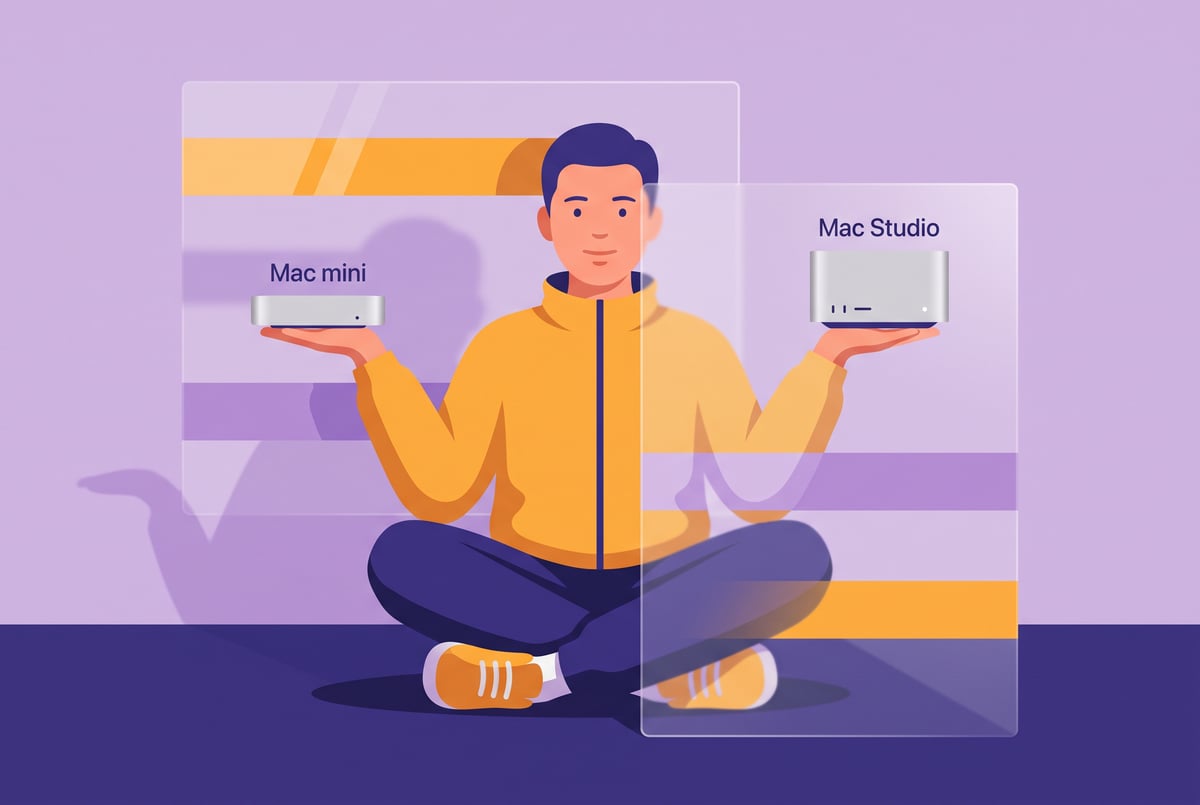
Apple refreshed its entire desktop Mac line in September, and the lineup now spans from an $899 Mac mini to a Mac Studio configuration that pushes into car-price territory. The Mac mini comes in two chip options: M6 (16 to 32GB unified memory) or M5 Pro (up to 64GB, with 307GB/s of memory bandwidth). The Mac Studio starts with M5 Max (up to 128GB) and tops out with M5 Ultra (up to 512GB, 1.2TB/s bandwidth). Studio pricing starts at $2,500 for M5 Max and $5,500 for M5 Ultra, before memory and storage upgrades push the total higher. Machines started shipping September 22, though the 512GB configuration doesn’t arrive until late October.
TL;DR
- The Mac mini ships in two flavors: an M6 base model (16-32GB memory) starting at $899, and an M5 Pro model that reaches 64GB of unified memory with 307GB/s bandwidth.
- The Mac Studio lineup starts at $2,500 for M5 Max (up to 128GB memory) and $5,500 for M5 Ultra, which scales to 256GB and then 512GB at the top end.
- The 512GB configuration is the headline number, but it won’t actually be available until late October, weeks after the rest of the line starts shipping September 22.
- Apple put its newest M6 chip in the cheapest machine while the Pro, Max, and Ultra tiers still run last generation’s M5 silicon, a break from Apple’s usual release pattern.
- The pricing structure reflects a ladder strategy: buyers pick a memory tier based on how many local models or agents they want running simultaneously, not just raw speed.
- Apple’s pitch centers on no token metering, meaning local inference costs only electricity once you’ve paid for the hardware, unlike cloud AI subscriptions billed per token.
- This launch competes indirectly with Nvidia’s DGX Spark, though Apple is selling a general-purpose computer with AI capability built in, not a dedicated AI appliance.
How is the Mac mini lineup priced and configured?
The Mac mini splits into two distinct tiers. The base model runs Apple’s new M6 chip and starts at $899, with unified memory options between 16GB and 32GB. That’s the always-on, sits-on-a-shelf machine Apple positions for running smaller local models and lightweight agent workloads, the kind of setup where you might stack several minis to run parallel agent tasks.
Step up to the M5 Pro version and memory nearly doubles to a maximum of 64GB, with memory bandwidth reaching 307GB/s. That bandwidth increase matters as much as the capacity increase: more bandwidth means the model can move data faster, which translates to quicker token generation when running local inference. For anyone planning to run a single capable local model alongside a couple of lighter agent processes, the M5 Pro tier is the practical entry point rather than the base M6.
How is the Mac Studio lineup priced and configured?
The Mac Studio is where Apple pushes the memory ladder much further. The M5 Max configuration starts at $2,500 and offers up to 128GB of unified memory. That tier is roughly where the “two or three agents running plus a solid local model” use case becomes realistic on Apple hardware.
The M5 Ultra configuration starts at $5,500 and offers 256GB of memory before doubling again to 512GB at the top, paired with 1.2TB/s of memory bandwidth. That 512GB tier is the one drawing headlines, since it’s large enough to hold genuinely big language models entirely on-device. But it also doesn’t ship until late October, arriving weeks after the rest of the line. Adding extra memory and storage on top of the base Ultra configuration pushes total cost well beyond the $5,500 starting point, into the range of a used car.
Why did Apple put its newest chip in the cheapest Mac?
This is the strangest wrinkle in the whole launch. Normally Apple rolls out a new chip generation across the full line at once, base chip, Pro, Max, and Ultra variants arriving together or in short succession. This time, the M6 only appears in the entry-level Mac mini. The Mac mini Pro and the entire Mac Studio line are still running M5-generation silicon (M5 Pro, M5 Max, M5 Ultra), with no M6 Pro, Max, or Ultra announced yet.
The likely explanation isn’t a stumble, it’s urgency. Memory has been in short supply, and demand for local AI compute is high right now. Rather than wait for the M6 family to scale up cleanly across every tier, Apple shipped the memory configurations people can actually use today, using the M5 chips that were ready, and saved the M6 rollout for the higher tiers later. Apple doesn’t need to control the newest chip architecture at every price point to make money. It needs to get large-memory machines into buyers’ hands while the demand for local AI compute is at its peak.
Is buying a Mac Studio or Mac mini for local AI worth it?
Built like a system. Not vibe-coded.
Remy manages the project — every layer architected, not stitched together at the last second.

That depends on which future you’re betting on: renting intelligence from cloud AI labs, or owning it locally. The cloud bet says most people will pick whichever frontier lab (OpenAI, Anthropic, xAI, or others) does the best work, and won’t care about the underlying model or hardware, as long as the job gets done. The local bet says a meaningful slice of technical buyers will pay once for hardware and then only pay for electricity, trading some frontier capability for privacy, fixed costs, and control.
For most casual users, cloud subscriptions will likely remain the simpler choice. But for developers, researchers, or anyone running agent workflows constantly, the economics shift. A 128GB Mac Studio configuration lands in a practical middle ground: enough memory to run a solid main coding or reasoning model alongside two or three lighter agents at once, without paying per-token fees that scale unpredictably with usage. The 512GB tier is more headroom than most people need day to day, useful mainly if you plan to keep that memory saturated with heavy workloads most of the time.
The real limiting factor isn’t the hardware, it’s software friction. There currently is no smooth, universal way to route a task to the right model, whether that model lives locally on your Mac or in the cloud. Frontier labs have little incentive to build that routing layer since it doesn’t help them sell more tokens. Apple has incentive, since it sells more memory and more expensive machines, but Apple isn’t a model company. That gap is one of the more interesting unresolved pieces of this whole shift toward local AI hardware, and it’s part of why Nvidia’s recent acquisition of Hugging Face (the platform most Mac buyers already use to find models) is worth watching closely.
How does this compare to Nvidia’s local AI hardware?
Nvidia’s DGX Spark is the other notable local AI machine on the market, built specifically as a dedicated AI development appliance tied into the CUDA ecosystem and Nvidia’s data center software stack. It’s a purpose-built tool for people who already know they want a local AI box.
Apple’s approach is different: it’s selling a general-purpose computer that happens to be very good at local AI, rather than a single-purpose AI appliance. For most buyers, that’s the more appealing shape. Few people want a separate AI-only machine sitting next to their regular computer. Apple’s bet is that people want their everyday computer, the one running their operating system, browser, and everyday applications, to also be the AI machine. The Mac’s last reported quarterly revenue exceeded $10 billion with a product gross margin around 40%, so Apple doesn’t need to dominate the broader AI compute market. It just needs enough buyers in this hardware tier to keep growing that number.
Frequently Asked Questions
When did the new Mac mini and Mac Studio start shipping?
The new lineup started shipping September 22. The top-tier 512GB Mac Studio configuration is a separate, later release arriving in late October.
What’s the cheapest new Mac mini configuration?
The base Mac mini starts at $899 with the new M6 chip and 16GB of unified memory, expandable to 32GB.
What’s the maximum memory available on a Mac Studio?
The Mac Studio with M5 Ultra maxes out at 512GB of unified memory with 1.2TB/s of memory bandwidth, though that configuration ships later than the rest of the lineup.
Why doesn’t the Mac mini Pro or Mac Studio use the M6 chip?
Other agents start typing. Remy starts asking.
Scoping, trade-offs, edge cases — the real work. Before a line of code.
Apple has not yet released M6 Pro, Max, or Ultra variants. Only the entry-level Mac mini got the new M6 chip at launch, while the higher tiers remain on M5-generation silicon.
Is 512GB of memory enough to run any AI model locally?
No single local machine, including the 512GB Mac Studio, can hold every large frontier model that exists, especially closed models that aren’t available as downloadable weights. It is enough to run substantial local models and multiple agents simultaneously without cloud token costs, which is the tradeoff Apple is selling.