What Is LTX-2 19b? Lightricks' Fast AI Video Generation Model
LTX-2 19b from Lightricks offers fast AI video generation with LoRA and source image support. Learn what makes it unique and how to use it.
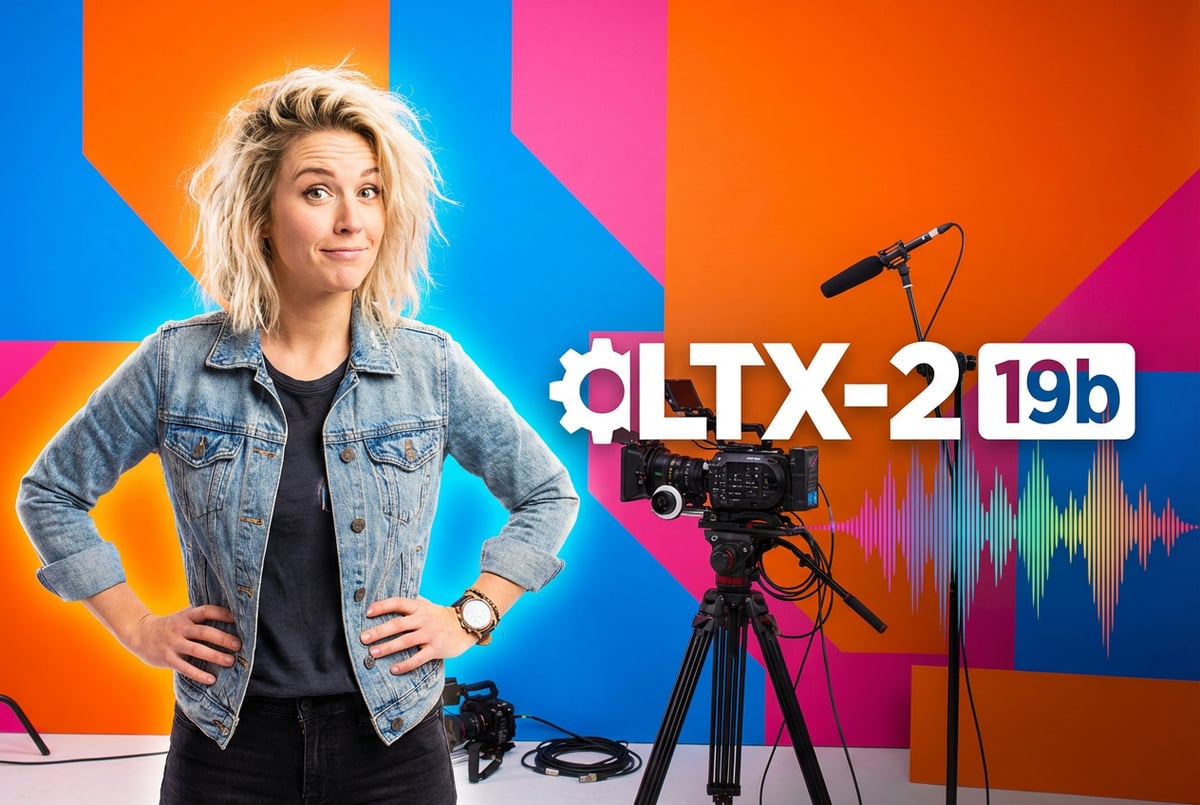
LTX-2 19b is an open-source AI video generation model released by Lightricks in January 2026. It stands out as the first production-ready model that generates synchronized video and audio in a single pass, eliminating the need for separate audio post-production workflows.
The model uses 19 billion parameters split across video generation (14 billion) and audio generation (5 billion). This asymmetric architecture allows it to create up to 20 seconds of 4K video at 50 frames per second with matching sound effects, dialogue, and ambient audio.
What makes LTX-2 19b different from closed-source alternatives is its complete transparency. Lightricks released the full model weights, training code, and documentation under an Apache 2.0 license. Companies generating less than $10 million in annual revenue can use it commercially without licensing fees.
Technical Architecture and Model Design
LTX-2 19b uses a Diffusion Transformer (DiT) architecture split into two specialized streams. The video stream handles spatial detail, motion consistency, and temporal coherence. The audio stream manages sound generation, dialogue timing, and environmental audio.
These streams communicate through bidirectional cross-attention layers. This means audio events align with visual cues automatically. When a door closes on screen, the sound occurs at the exact moment. When characters speak, lip movements sync with dialogue without manual adjustment.
The model processes inputs through modality-specific VAEs (Variational Autoencoders) that compress raw signals into efficient latent representations. This compression achieves a 1:192 ratio, allowing the model to handle high-resolution content without excessive memory requirements.
Everyone else built a construction worker.
We built the contractor.
One file at a time.
UI, API, database, deploy.

For text understanding, LTX-2 19b uses Gemma-3 as its text encoder. This enables more nuanced interpretation of creative prompts compared to earlier models. The system includes “thinking tokens” that enhance semantic understanding and prompt adherence.
Performance Benchmarks and Speed
LTX-2 19b generates video approximately 18 times faster than WAN 2.2 14B when running on the same H100 hardware. This speed advantage comes from architectural optimizations and efficient memory usage.
The model offers three performance tiers:
- Fast Mode: Generates video in 2-3 minutes with good quality for rapid iteration
- Pro Mode: Takes 5-7 minutes but delivers higher visual fidelity and stability
- Ultra Mode: Requires 10-15 minutes for maximum quality output
NVIDIA optimizations have improved performance further. The NVFP8 quantization format reduces model size by 30% and increases speed by 2x. On RTX 50 Series GPUs using NVFP4 format, the model runs 3x faster with 60% less VRAM usage.
Hardware requirements vary by use case. The model runs on consumer GPUs with as little as 8GB of VRAM using optimized versions. For professional work, NVIDIA recommends 24GB+ VRAM for consistent 1080p generation at high frame rates.
Video Generation Capabilities
LTX-2 19b generates native 4K resolution (3840 x 2160) video at up to 50 frames per second. This matches broadcast quality standards, putting it ahead of consumer-focused AI video tools that max out at 1080p.
The model handles multiple input types:
- Text prompts for generating video from descriptions
- Static images for image-to-video conversion
- Reference videos for style transfer
- Audio descriptions for audio-driven generation
- Multi-keyframe conditioning for precise scene transitions
Video length extends up to 20 seconds per clip, nearly double what many competing models offer. This longer duration enables more complete narrative sequences and smoother storytelling within single generations.
The model maintains temporal stability across frames, avoiding common AI video problems like jitter, flickering, or sudden motion inconsistencies. This makes it suitable for professional applications where visual continuity matters.
Synchronized Audio Generation
The native audio generation sets LTX-2 19b apart from other open-source models. Most video generators create silent output, requiring separate audio production. LTX-2 19b generates audio in the same forward pass as video, ensuring natural synchronization.
The audio capabilities include:
- Speech with accurate lip sync timing
- Foley effects matching on-screen actions
- Environmental ambience and background sounds
- Musical scoring that reinforces scene mood
- Stereo audio with spatial positioning
Audio quality remains consistent across the generation. Footsteps occur when feet hit ground. Doors sound when they close. Glass breaks with the right timing when objects shatter on screen. This temporal alignment happens automatically without manual audio editing.
LoRA Support and Model Customization
LTX-2 19b supports LoRA (Low-Rank Adaptation) for efficient model customization. LoRA injects trainable rank decomposition matrices while keeping base model weights frozen. This dramatically reduces the number of trainable parameters while preserving generation quality.
Training a custom LoRA takes 20-40 minutes and costs approximately $9.60 for 2000 training steps. The process requires 10-50 video files demonstrating the style or motion pattern you want to teach the model.
You can apply up to three custom LoRA adapters simultaneously during generation. This enables combining different style elements, character appearances, and motion patterns in a single output.
Available LoRA types include:
- Camera control LoRAs for dolly in/out movements
- Jib up/down camera movements
- Static camera positioning
- Depth-aware generation controls
- OpenPose driven motion
- Style transfer LoRAs for specific visual aesthetics
Built like a system. Not vibe-coded.
Remy manages the project — every layer architected, not stitched together at the last second.
The model also supports IC-LoRAs (Image Conditioning LoRAs) for video-to-video transformations. These allow editing existing video content with AI-guided modifications while maintaining temporal consistency.
Prompt Engineering for Best Results
LTX-2 19b prefers detailed, chronological descriptions of actions and scenes. The model responds better to specific cinematographic language than vague creative directions.
Effective prompts include:
- Specific movements and camera angles
- Lighting conditions and environmental details
- Character appearances and actions
- Audio elements like dialogue or sound effects
- Technical specifications like “steady dolly movement” or “tripod-locked stability”
For smooth motion at 50 FPS, prompts should guide the model toward stable, coherent movement. Keywords like “smooth gimbal tracking” or “fluid camera pan” produce better results than generic motion descriptions.
Seed locking ensures consistency across related shots. Using the same seed value maintains lighting, color, and style when generating multiple clips for the same project. This proves useful for product campaigns, character close-ups, and establishing shots that need visual continuity.
Comparison With Alternative Models
LTX-2 19b ranks #3 globally in image-to-video and #4 in text-to-video on Artificial Analysis’ Video Arena benchmark. This independent testing platform evaluates AI video models through blind comparisons.
Compared to proprietary models like Sora 2 or Veo 3.1, LTX-2 19b offers different trade-offs. Closed-source models may produce slightly higher visual quality in some scenarios, but LTX-2 19b runs locally, costs less per generation, and allows complete customization.
Against open-source alternatives like WAN 2.2, LTX-2 19b demonstrates clear advantages in speed and audio generation. The synchronized audio-video output eliminates a major post-production step that other models require.
The model’s efficiency makes it practical for production use. While cloud-based APIs charge per second of generated video, LTX-2 19b runs on owned hardware with predictable costs. For teams generating significant video volume, this becomes a major cost advantage.
Real-World Use Cases and Applications
Marketing teams use LTX-2 19b for product demonstration videos, social media content with music, and explainer videos. The synchronized audio generation speeds up workflows that previously required separate sound design.
Educational content creators leverage the model for instructional videos, concept explanations, and animated diagrams. The ability to generate up to 20 seconds per clip allows covering complete topics within single generations.
Entertainment and media companies test concepts, create storyboards, and generate preview content using the model. The fast iteration speed (especially in Fast Mode) supports creative exploration without expensive production cycles.
Advertising agencies use the camera control LoRAs for consistent brand aesthetics across campaign assets. Custom LoRAs trained on brand guidelines ensure visual consistency while maintaining production speed.
Independent creators produce content for YouTube, TikTok, and Instagram using the model. The free commercial license for companies under $10 million revenue makes it accessible for small creator businesses.
Integration and Platform Support
LTX-2 19b integrates with multiple platforms and workflows. ComfyUI offers native support with optimized nodes for the model. The ComfyUI integration includes weight streaming to manage VRAM usage and multiple pipeline options.
For developers, the model works with PyTorch and the Diffusers library. Complete API documentation covers text-to-video, image-to-video, and video-to-video endpoints. Custom LoRAs pass through the API using the loras parameter with adjustable scale values.
Seven tools to build an app. Or just Remy.
Editor, preview, AI agents, deploy — all in one tab. Nothing to install.
Third-party platforms like Fal.ai and Pixazo provide hosted API access for teams that prefer managed infrastructure over local deployment. These services handle model updates, optimization, and scaling automatically.
MindStudio offers instant access to LTX-2 19b alongside other leading video generation models. The platform handles all infrastructure complexity, letting you focus on creative work rather than technical setup. You can use LTX-2 19b in automated workflows, combining it with other AI models for complete content production pipelines.
The model also runs on NVIDIA DGX Spark systems for teams wanting desktop-sized supercomputer performance. This configuration provides optimal speed for high-volume generation without cloud dependencies.
Training Data and Ethical Considerations
All training data for LTX-2 19b comes from licensed sources. Lightricks partnered with Getty Images and Shutterstock to ensure proper rights clearance. This eliminates the copyright concerns that plague many AI models trained on scraped internet data.
The licensing approach has practical benefits. Companies using LTX-2 19b face lower legal risk compared to models with uncertain data provenance. For commercial applications, this matters significantly.
The model includes explicit acknowledgments of limitations. It can amplify societal biases present in training data. Prompt matching isn’t perfect. Generated content may not always match expectations, especially for complex or ambiguous requests.
Lightricks recommends human oversight for production deployments. The model serves as a creative tool, not a replacement for human judgment about content appropriateness and quality.
Hardware Requirements and System Setup
Minimum viable setup requires an NVIDIA GPU with 8-16GB VRAM. At this level, expect to use lower resolutions and the distilled model variant for acceptable generation speeds.
Recommended configuration includes:
- NVIDIA GPU with 24GB+ VRAM (RTX 3090, RTX 4090, or higher)
- 64GB+ system RAM
- 200GB+ SSD storage for model weights and generated content
- CUDA 12.1 or higher
- Python 3.10+
Professional setups benefit from A100 (80GB) or H100 GPUs. These handle 4K generation at 50 FPS with full quality settings and minimal generation time.
The model offers multiple checkpoint variants optimized for different hardware capabilities:
- ltx-2-19b-dev: Full model with highest quality
- ltx-2-19b-dev-fp8: 30% smaller with similar quality, 2x faster
- ltx-2-19b-dev-fp4: Smallest version for low VRAM systems
- ltx-2-19b-distilled: Optimized for speed with minimal quality loss
For teams without GPU hardware, cloud GPU providers like AWS, Azure, and Google Cloud offer suitable instances. The model’s efficiency means you can use more affordable GPU options compared to other video generation models.
Model Limitations and Current Constraints
Video generation quality varies with prompt complexity. Simple scenes with clear actions produce more consistent results than abstract concepts or complex multi-character interactions.
Character consistency across multiple generations remains challenging. While LoRA training helps maintain character appearance, generating the same character across different scenes without training requires careful prompting.
The 20-second clip length limitation means longer videos require generating multiple segments and editing them together. This introduces potential continuity issues at segment boundaries.
High-frequency patterns and fine details sometimes show artifacts, especially at higher frame rates. Textures like grass, hair, or complex fabrics may not render with perfect stability across all frames.
Motion blur handling differs from traditional camera footage. Fast movements may not show the same natural motion blur characteristics that would appear in filmed content.
Audio generation, while synchronized, may not match the specific voices or sound characteristics you envision. The model generates appropriate sounds but cannot replicate specific voice actors or exact audio signatures without fine-tuning.
Cost Analysis and ROI Considerations
Local deployment means no per-generation costs beyond electricity and hardware depreciation. For teams generating hundreds of video clips monthly, this represents significant savings compared to cloud API pricing.
Training custom LoRAs costs approximately $9.60 for 2000 steps using third-party services. This one-time investment enables unlimited generations using that style without additional fees.
Hardware investment pays off quickly for regular users. A $2000-3000 GPU that can run LTX-2 19b effectively breaks even after generating content that would cost several thousand dollars through cloud APIs.
The free commercial license for companies under $10 million revenue eliminates ongoing licensing costs. This makes LTX-2 19b particularly attractive for startups and small agencies.
For larger enterprises, the savings compound with volume. A marketing team generating 50 product videos monthly saves thousands compared to traditional video production or cloud-based AI services.
Future Development and Model Evolution
Lightricks continues active development on LTX-2 19b. The open-source nature means community contributions expand capabilities beyond the core team’s roadmap.
Expected improvements include extended video length, better character consistency, and enhanced control over specific generation aspects. The community has already contributed optimized workflows, custom LoRAs, and integration tools.
NVIDIA’s ongoing optimization work suggests further performance improvements coming through new quantization formats and inference optimizations. Each GPU generation brings speed and efficiency gains for the model.
The asymmetric architecture provides a template for future multimodal models. Other teams may adopt similar approaches for combining different media types in single generation passes.
Getting Started With LTX-2 19b
Start by choosing your deployment approach. For technical teams comfortable with local setup, download the model weights from Hugging Face and follow the installation documentation.
For faster deployment without technical setup, use platforms that provide ready-to-use access. This approach works well for testing the model’s capabilities before committing to local infrastructure.
Begin with simple prompts to understand how the model interprets descriptions. Generate short clips (5-10 seconds) using Fast Mode to iterate quickly on prompt engineering.
Test image-to-video capabilities with reference images. This typically produces higher quality results than pure text-to-video generation, especially for specific visual styles.
Experiment with different seed values to find outputs that match your vision. Once you find a good result, lock the seed and iterate on other parameters like camera movement or audio characteristics.
For production use, consider training custom LoRAs for consistent brand aesthetics. This investment pays off when generating content series that need visual coherence.
Conclusion
LTX-2 19b represents a significant milestone in open-source AI video generation. The combination of synchronized audio-video output, 4K resolution support, and efficient performance makes it practical for real production use.
The model’s open-source nature provides flexibility that closed alternatives cannot match. You can run it locally, customize it for specific needs, and integrate it into existing workflows without vendor lock-in.
For teams serious about AI video generation, LTX-2 19b offers the control and transparency needed for professional applications. The model continues improving through active development and community contributions.
Plans first. Then code.
Remy writes the spec, manages the build, and ships the app.
Whether you deploy locally or use managed platforms, LTX-2 19b provides a production-ready foundation for creating synchronized audiovisual content at scale.