Run Inkling 2 Mini Locally with Ollama: Hardware Setup Guide
Inkling 2 Mini fits on a 32GB Mac or a DGX Spark. Here's what the looped MoE model needs and how to run it locally with Ollama.
What is Inkling 2 Mini and why can you run it locally?
Inkling 2 Mini is a small open-weight language model from Thinking Machines built on a looped transformer architecture, released under Apache 2.0. It stores about 26 billion parameters as a mixture of experts, but because only a fraction of those experts activate for any given token, the model’s footprint on disk comes out to roughly 20 gigabytes. That’s small enough to load on a Mac with 32GB of unified memory or a single DGX Spark, which is what makes it one of the more practical large reasoning models to run outside a data center.
TL;DR
- Inkling 2 Mini is Thinking Machines’ smallest released model, built on a looped transformer rather than a standard stack of unique layers.
- The model has 24 total layers split into four blocks: a start block, an end block, and two middle blocks that loop three times per token.
- Looping lets the model do the computational work of roughly 48 layers while only storing the weights for about half that many.
- It’s also a mixture of experts with around 26 billion total parameters, keeping the on-disk size near 20GB despite the extra compute from looping.
- Thinking Machines says it runs on a Mac with 32GB of memory or a single DGX Spark, and it’s distributed as open weights under Apache 2.0 via Ollama.
- Looping boosts multi-step reasoning tasks dramatically (agentic coding went from under 1% success at one pass to about 47% at three passes) but does nothing for factual recall, since facts live in weights, not in extra computation.
- The tradeoff is more compute per token, not more memory, so it pays off on long reasoning tasks but adds cost with little benefit on short chat exchanges.

Remy.

How does a looped transformer actually work?
A standard transformer processes text through a fixed stack of layers once per token. If a model has 24 layers, every new token takes exactly 24 steps through the network, full stop. That’s fine for simple lookups, but it’s a hard ceiling for anything that needs multi-step reasoning, like counting days between two dates across a calendar. Today’s reasoning models get around this by writing out intermediate steps as “thinking tokens,” essentially doing scratch work in plain text. The catch is that every thinking token has to make its own full trip through the stack, so a hard problem can balloon into thousands of extra tokens before the model reaches an answer.
A looped transformer takes a different approach. Instead of writing more tokens or adding more layers (which means storing more weights and needing bigger GPUs), it sends the same token through an existing set of layers multiple times inside a loop. The weights for those layers are stored once, but the computation happens several times. This isn’t a brand-new idea: it traces back to a 2018 paper on Universal Transformers, and smaller models like ByteDance’s Oro and Nvidia’s Dori have already explored similar looping mechanisms. What makes Inkling 2 Mini notable is the scale and the specific design of the loop.
How is Inkling 2 Mini’s loop structured?
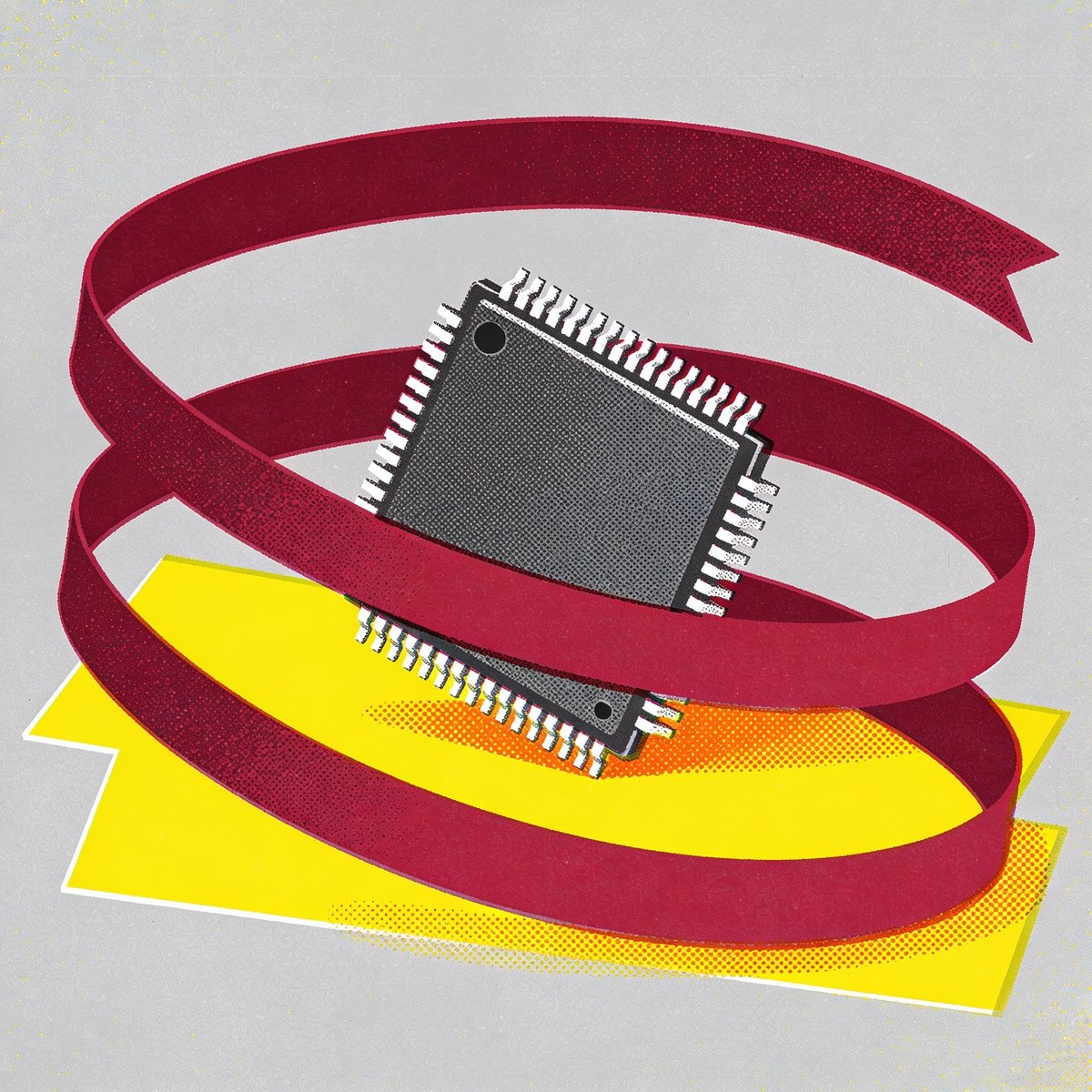
Inkling 2 Mini has 24 layers split into four equal blocks of six layers each. The first block runs once, converting incoming tokens into the model’s internal representation. The last block also runs once, converting that representation back into the next output token. The two blocks in between, 12 layers total, are where the looping happens: every token passes through those middle layers three times before moving on to the final block.
Do the math and the model performs work equivalent to 48 layers while storing weights for roughly half that number. Thinking Machines reportedly tested looping at the start, middle, and end of the stack, and looping the middle layers produced the biggest gains on 27 out of 28 evaluations. Their reasoning: the first and last blocks mostly translate between words and internal representations, while the middle layers carry the actual abstract reasoning, so that’s where extra passes help most. Each pass isn’t starting cold either. The output of one pass (what Thinking Machines calls the “message”) feeds into the next, so the second and third passes build on what came before rather than repeating the same computation.
What does looping actually improve, and what does it not touch?
Thinking Machines also released a research variant where you can manually choose between one and five passes through the loop, using the same weights. That let them isolate exactly what extra passes buy you.
4 hours from idea to a live business app.
Free live class · Wed, Dec 2
On agentic coding tasks that require fixing real issues across many steps, a single pass solved less than 1% of long tasks. Bump that to three passes and success jumped to about 47%. On arithmetic-style reasoning problems (like calculating what day of the week falls weeks after a known date), more passes let the model reach the same answer with less than half the thinking tokens it needed at a single pass. The pattern held across a set of hard science questions too: more looping meant less work spelled out in visible text, because more of it happened inside the loop itself.
What looping doesn’t do is add knowledge. On tasks that test recall of specific facts, extra passes barely moved the score, regardless of how many times the model looped. That makes sense: facts have to be encoded somewhere in the weights, and looping doesn’t add weights, it just reuses the ones that are already there. Gains also flatten out after three passes on most benchmarks, which is likely why three passes is what Thinking Machines baked into the released checkpoint.
What’s the tradeoff with looped models?
Looping saves memory, not compute. Each extra pass still costs real compute time, so individual tokens take longer to generate. The payoff comes from needing fewer tokens overall: if a model needs half as many thinking tokens to reach an answer, slower-but-fewer tokens can still add up to a faster total response. Thinking Machines found that a non-looped version of the model needed more than twice the compute to match the looped version’s quality on language and reasoning tasks.
This tradeoff favors long, complex tasks where there’s a lot of reasoning to compress. On short chat questions with little to think through, you’re paying the looping tax with almost nothing to show for it.
There’s also an interpretability wrinkle. When a model reasons by writing thinking tokens, humans (or other models) can read that chain of thought and catch problems, an approach called chain-of-thought monitoring. Looping moves more of that reasoning inside the model, invisible between passes, which worried people when rumors circulated that a frontier lab might be using this trick. Thinking Machines reports the visible thinking stayed just as readable (similar sentence length, similar plain-English word share) even as it got shorter with more passes. They also gave an outside group, Goodfire, early access to study the loop’s internals; Goodfire found an internal signal that spikes at the end of the first and second passes and clears by the third, theorized to guide what the next pass reads. That’s an early, single-model result and worth treating cautiously.
How do you set up Inkling 2 Mini with Ollama?
Inkling 2 Mini is distributed as open weights under Apache 2.0 and is runnable through Ollama. Based on Thinking Machines’ own guidance, you’ll need one of two setups:
- A Mac with at least 32GB of unified memory, or
- A single DGX Spark
Pull the model through Ollama the same way you would any other local model, and once loaded you get a 26-billion-parameter mixture-of-experts model with a roughly 20GB footprint, running entirely on your machine. Thinking Machines has demonstrated the model building a playable flight simulator on a MacBook in airplane mode, which gives a sense of the kind of agentic, multi-step coding task it’s suited for.
Is Inkling 2 Mini worth running locally?
Build an onboarding app for 4,000 new hires.
Build ↵It depends on the task. For long, multi-step reasoning work (agentic coding, complex math, multi-stage problem solving) the looping genuinely helps, and running locally means no API costs and no data leaving your machine. For anything requiring up-to-date facts or narrow knowledge, pair it with a search tool or document retrieval, since looping doesn’t expand what the model knows. Thinking Machines also flags that it’s not the strongest small model for long, many-turn conversations or instructions with heavy constraints, and that it can get stuck re-checking its own work. Setting limits on output tokens and agent turns is a sensible guardrail.
Frequently Asked Questions
What hardware do I need to run Inkling 2 Mini?
A Mac with 32GB of unified memory or a single DGX Spark, according to Thinking Machines. The model’s on-disk size is around 20GB thanks to its mixture-of-experts design.
Is Inkling 2 Mini free to use?
Yes. It’s released as open weights under the Apache 2.0 license, so it can be used, modified, and run locally without licensing fees.
Does looping make the model smarter at everything?
No. It improves multi-step reasoning tasks like agentic coding and multi-step math, but it does not improve factual recall, since looping reuses existing weights rather than adding new knowledge.
Why does Inkling 2 Mini loop the middle layers instead of the start or end?
Thinking Machines tested looping at different positions and found looping the middle layers produced the best results on 27 of 28 evaluations, reasoning that the first and last layers mainly handle translation between words and internal representations while the middle layers carry abstract reasoning.
Does a looped model run faster than a normal model?
Not per token. Each pass through the loop adds compute time, so individual tokens are slower to generate. The speed benefit comes from needing fewer thinking tokens overall on long, complex tasks, not from faster token generation.