Did Claude AI Solve the Riemann Hypothesis? What We Know So Far
A mathematician working with Claude claims a proof of the 167-year-old Riemann hypothesis. Here's what's verified, what isn't, and why it matters.

What happened with the Riemann hypothesis claim?
A mathematician named Levent Alpoge announced on a personal webpage that he, working with Anthropic’s Claude, had produced a proof of the Riemann hypothesis, one of the most famous unsolved problems in mathematics and one of the seven Millennium Prize Problems with a million-dollar reward attached. The announcement included a formal proof written in Lean, a programming language mathematicians use to let a computer verify that a logical argument actually holds together. As of this writing, the claim has not been confirmed by independent human experts, though mathematicians online are actively checking the work.
TL;DR
- Levent Alpoge, a mathematician with a track record of fast, unconventional results this year, says he and Claude produced a proof of the Riemann hypothesis after what he describes as a 42-day sprint.
- The proof comes with a Lean formalization, a machine-checkable version of the logic, split across 14 downloads and reportedly running to roughly 18 million lines and a quarter million pages.
- No independent verification has been completed yet. Mathematicians, including Terence Tao, have publicly noted that this claim has had far less time for scrutiny than Alpoge’s earlier results.
- A second, independent proof from mathematician Alessandro Masullo (working title “The Music of the Primes”) surfaced around the same time, which is common when a long-standing problem suddenly looks solvable.
- The Riemann hypothesis concerns the distribution of prime numbers, and a huge amount of modern number theory assumes it’s true without being able to prove it, so a verified proof would validate decades of downstream work.
- Alpoge has a history of publishing on social media rather than through peer-reviewed journals, including an earlier high-profile episode involving the Navier-Stokes existence and smoothness problem that drew in OpenAI researchers.
- The timing collided with Anthropic’s IPO, which reportedly delayed public discussion of the claim due to standard pricing-period restrictions around a newly public company.
Build an enterprise app with Dmitry Shapiro. Leave certified.

Who is Levent Alpoge, and why does his track record matter?
Alpoge isn’t a random claimant. According to accounts circulating around this story, he spent 2025 producing a string of significant results at unusual speed: disproving the 3D Jacobian conjecture, finding new Hadamard matrices, and contributing to work on the 3D Euler blowup problem alongside mathematician Tristan Buckmaster, which connects to the Navier-Stokes existence and smoothness controversy involving OpenAI earlier this year.
That history matters for two reasons. First, it means the mathematical community already had a baseline of trust (and some wariness) around his methods before this claim appeared. Second, it explains why he didn’t go through a traditional journal. Alpoge reportedly treats X (formerly Twitter) as his primary publishing platform, posting results directly rather than submitting to peer review first. That approach gets results in front of experts fast, but it also means claims arrive without the months or years of vetting that journal publication normally provides.
How does the Lean proof factor into verification?
A Lean proof is a formal, machine-checkable version of a mathematical argument. Instead of a human reading pages of prose and symbols and deciding “yes, this follows,” the argument gets translated into code that a computer can verify step by step. If the code compiles and checks out, it’s strong evidence the logic holds, because there’s no room for hand-waving or skipped steps.
That’s different from simply asserting a result is true. Having a Lean proof doesn’t guarantee a result is meaningful or correctly connected to the real-world problem it claims to solve, but it does rule out a huge category of errors. In this case, the Lean formalization reportedly spans about 18 million lines across roughly a quarter million pages, split into 14 separate downloads. Mathematicians on forums dedicated to Lean have been going through this material since it was posted. A competing proof of the same hypothesis, submitted around the same time by Alessandro Masullo after what’s described as 12 years of work, reportedly does not include a Lean proof, which is one reason the Alpoge/Claude version is drawing more attention despite being newer.
Why does the Riemann hypothesis matter so much?
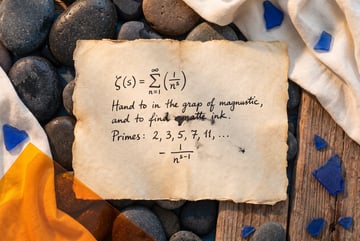
Prime numbers (2, 3, 5, 7, 11, and so on) are the building blocks of all other whole numbers. Every composite number can be broken down into primes, but primes themselves can’t be broken down further. Up close, their distribution looks essentially random. Riemann’s 1859 hypothesis proposed that there’s actually a deep, predictable structure underneath that apparent randomness, expressed through a mathematical object called the zeta function. The hypothesis says that certain special points connected to this function (its “non-trivial zeros”) all line up in a specific way.
Build an onboarding app for 4,000 new hires.
Build ↵That might sound abstract, but an enormous amount of modern mathematics has been built on the assumption that the Riemann hypothesis is true, even though nobody could prove it. Results in number theory, cryptography, and other fields often come with an asterisk: “true if the Riemann hypothesis holds.” A confirmed proof wouldn’t just answer an old question, it would retroactively validate a huge body of existing mathematical work that has been resting on an unproven assumption for 167 years.
Is the Claude-assisted proof actually verified?
Not yet, and that distinction matters. Terence Tao, one of the most prominent living mathematicians, publicly noted that this claim is the least “digested” of recent AI-assisted math results, meaning it’s had the least time for the community to check it compared to earlier announcements. The process of verification for a result this large isn’t quick: with millions of lines of formal proof and hundreds of thousands of pages of supporting material, checking everything carefully takes real time, even with Lean code to lean on.
What’s notable so far is less about confirmation and more about the absence of refutation. No mathematician has publicly identified a fatal flaw. Some have expressed confidence the result holds up. That’s a meaningfully different state than “proven,” but it’s also different from the skepticism that typically greets extraordinary claims posted outside normal peer review. The appearance of a second, independently developed proof of the same hypothesis around the same time adds another data point, though it also hasn’t been fully verified either.
What role did Claude actually play?
Alpoge has described working with Claude on this problem for weeks, calling it a sprint that started from what he referred to as a “toy setting,” an initial simplified version of an approach that he and Claude then worked to scale up. He’s said that in the later stages, Claude’s contributions outpaced his own. The underlying mathematical techniques and frameworks involved are products of human mathematics built up over generations; what Claude reportedly did was help extend, combine, and push that existing machinery toward a solution at a pace and scale that would be difficult for a single mathematician working alone.
This mirrors a pattern seen in other recent AI-assisted scientific results: the raw materials are human-made, but the specific path the AI takes through that material doesn’t always look like something a human would have arrived at unprompted. Whether that pattern holds up under scrutiny here is exactly what the verification process is meant to determine.
Frequently Asked Questions
Is the Riemann hypothesis proof confirmed to be correct?
No. As of this writing, no independent body of mathematicians has completed verification. The claim is being actively reviewed, and a formal Lean proof has been posted for scrutiny, but full confirmation takes time.
What is the Riemann hypothesis in simple terms?
It’s a 1859 conjecture by Bernhard Riemann proposing that prime numbers, which look randomly distributed, actually follow a hidden structured pattern describable through a mathematical function called the zeta function. It has remained unproven for 167 years.
Who is Levent Alpoge?
A mathematician who, in 2025, produced a series of fast, high-profile results including work related to the 3D Jacobian conjecture and the Euler blowup problem, often publishing directly on social media rather than through traditional peer-reviewed journals.
Why did a second mathematician also claim a proof around the same time?
| Vendor | Tier | Risk | ApprovalNEW |
|---|---|---|---|
| Northwind Supply | Tier 1 | Low | Approved |
| Acme Logistics | Tier 2 | Medium | Approve |
| Helios Data | Tier 1 | High | Pending |
| Granite Freight | Tier 3 | Low | Approved |
| Pinecrest Labs | Tier 2 | Low | Approve |
When a long-standing open problem suddenly appears solvable, it’s common for multiple researchers working independently to go public at once, especially if one announcement prompts another to release unfinished or recently completed work rather than risk being scooped.
Does this mean AI can now solve any math problem?
No. This is a single, unverified claim involving one specific problem, developed with significant human direction and mathematical expertise. It doesn’t demonstrate general AI capability to solve arbitrary unsolved problems in mathematics.