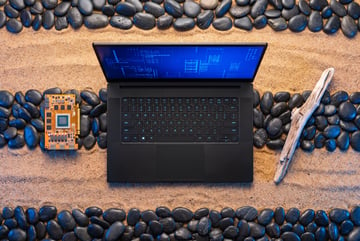
Nvidia RTX Spark and Surface Laptop Ultra: Full Specs and Pricing
Nvidia's RTX Spark chip debuts in Microsoft's Surface Laptop Ultra, Dev Box, and DGX Station. Here's the pricing, release dates, and specs.

What is Nvidia RTX Spark?
RTX Spark is Nvidia’s new superchip that fuses a Blackwell RTX graphics chip with a 20 core Nvidia Grace CPU into a single rectangular package built from two dies fused together. It packs 6,144 CUDA cores, up to 128 GB of unified memory, and up to one petaflop of AI performance, all in a form factor small enough to fit inside a thin laptop. Nvidia says it took more than 4,000 engineering years to build, and the pitch is simple: compress what used to require a gaming PC, a workstation, and a chunk of a data center into one chip.
TL;DR
- RTX Spark combines a Blackwell RTX GPU with a 20 core Grace CPU, 6,144 CUDA cores, up to 128 GB unified memory, and up to one petaflop of AI compute in a laptop sized package.
- Surface Laptop Ultra is the first device built on RTX Spark, starting at $2,599, shipping October 16, and capable of running models with more than 120 billion parameters entirely on the device.
- Microsoft’s own benchmarks claim the Surface Laptop Ultra beats a 16 inch MacBook Pro with M5 Pro by 2.1x on first token latency, 4.3x on AI image generation, and 6.2x on AI video generation, though these are vendor numbers, not independent tests.
- A Surface RTX Spark Dev Box aimed at developers costs $5,999 and arrives in November, alongside RTX Spark machines from Asus, Dell, HP, Lenovo, and MSI.
- At the top of the lineup, the DGX Station for Windows uses Nvidia’s GB300 Grace Blackwell Ultra chip with 748 GB of memory and 20 petaflops of compute, built to run models up to a trillion parameters or serve as a local inference hub for dozens of agents.
- Nvidia frames the one petaflop figure against its original DGX-1 supercomputer, which also hit one petaflop but cost roughly a quarter of a billion dollars and weighed 500 pounds.
- The hardware push is paired with software work from Microsoft to shrink frontier models (like a compressed version of its MAI-Code-1.1-Flash coding model) so they actually fit and run well on this class of device.
How much does the Surface Laptop Ultra cost and what do you get?
The Surface Laptop Ultra starts at $2,599 and ships October 16. For that price, Microsoft is putting a 15 inch mini-LED display rated up to 2,000 nits in a chassis that weighs under four and a half pounds, powered by the RTX Spark chip. The headline capability is local inference: Microsoft says the laptop can run AI models with more than 120 billion parameters without touching the cloud. That’s a meaningful jump from the kind of on-device AI most laptops have handled until now, which has mostly been limited to much smaller models for tasks like background blur or live captions.
Microsoft’s comparison numbers against Apple’s 16 inch MacBook Pro with the M5 Pro chip claim the Surface Laptop Ultra is 2.1 times faster to first token, 4.3 times faster at AI image generation, and 6.2 times faster at AI video generation. Those are Microsoft’s own benchmarks, run on Microsoft’s own hardware choices, so they’re worth treating as a vendor claim until independent reviewers get their hands on the device and run their own tests.
What is the Surface RTX Spark Dev Box and who is it for?
The Surface RTX Spark Dev Box is a $5,999 machine arriving in November, positioned above the consumer laptop for developers who need more headroom. It runs the same RTX Spark chip but in a form factor built for sustained workloads rather than portability. Nvidia’s broader OEM partners (Asus, Dell, HP, Lenovo, and MSI) are also shipping their own RTX Spark machines, which suggests this chip isn’t a Microsoft exclusive. It’s being positioned as a new tier of hardware that sits between a laptop and a workstation, aimed squarely at people building and testing local AI agents, coding tools, and inference pipelines without needing constant cloud access.
What is the DGX Station for Windows and how does it differ?
The DGX Station for Windows is the top of the RTX Spark family, expected later this year, and it’s built on a different chip entirely: Nvidia’s GB300 Grace Blackwell Ultra. It comes with 748 GB of memory and 20 petaflops of AI compute, dwarfing the one petaflop figure of RTX Spark itself. Nvidia says it’s designed to run models with up to a trillion parameters locally, or to function as what the company calls a small token factory, serving more than 32 agents running at once. This is clearly not a consumer device. It’s aimed at organizations that want DGX class local inference inside a Windows environment rather than renting cloud GPU capacity.
Jensen Huang also said Nvidia has tested over 1,200 of the most demanding applications on the new platform, a figure meant to signal that the RTX Spark lineup isn’t just a tech demo but has been validated against real software workloads.
Why does local compute matter for AI costs?
One coffee. One working app.
You bring the idea. Remy manages the project.

Running an AI model costs money every time it processes a token, and that adds up fast once you move from chatbots to agents that call tools, read files, and make decisions continuously. Microsoft’s framing, echoed by Windows chief Pavan Davaluri, is that organizations want “every AI token to count.” If a task can run on a chip already sitting in a laptop, that inference is effectively free, since there’s no cloud compute bill attached.
Microsoft says this is already happening at meaningful scale. According to Davaluri, Copilot Plus PCs are running more than 2 trillion inferences a month locally across features like search, imaging, and video calls, and over 40% of business laptops now ship as Copilot Plus PCs. RTX Spark is meant to push that further by making local hardware capable of running genuinely large models (120 billion parameters and up) rather than just small utility models.
How is Microsoft shrinking models to fit this hardware?
Hardware is only half the story. Microsoft also needs models small enough to run well on-device but still competent enough to be useful. Its approach is visible in MAI-Code-1.1-Flash, a coding model built as a mixture of experts with 137 billion total parameters but only 6.8 billion active at any one time. Microsoft compressed it to 3-bit precision, cutting its size by roughly 80% down to about 53 GB, while keeping its full 256,000 token context window intact. The compressed model scores 70.8% on SWE-bench Verified versus 72.6% for the uncompressed version, a drop of under two points for a massive size reduction.
That model plugs into GitHub Copilot through a routing system GitHub calls Hydrofusion. In its automatic mode, Copilot decides per request whether to run locally (free, using on-device compute) or send the task to a larger cloud model. Microsoft says this is launching as an experimental preview in the GitHub Copilot app, its command line tool, and VS Code. Separately, Windows ML now supports llama.cpp, letting developers run open source models such as Nvidia’s Nemotron or DeepSeek’s V3 family locally across GPU, NPU, or CPU.
Is RTX Spark hardware worth it right now?
For most people, the honest answer depends on whether the software ecosystem catches up. The chip itself is a genuine engineering leap: Nvidia points out that its original DGX-1 supercomputer, which also hit one petaflop of performance, cost around a quarter of a billion dollars and weighed 500 pounds, while RTX Spark puts comparable raw throughput into a laptop. That’s a real and verifiable shift in what’s physically possible on a personal device.
Whether it’s worth $2,599 for a laptop or $5,999 for a dev box comes down to how much local, large-model inference you actually need today. Developers running local coding agents, privacy-sensitive workflows, or offline AI tasks get clear value. Casual users who mostly use cloud chatbots may not notice a difference yet, since much of the benefit depends on apps like Copilot, VS Code, and third-party tools actually routing work to local models instead of the cloud by default.
Frequently Asked Questions
What is Nvidia RTX Spark used for?
It’s a superchip designed to bring data-center-class AI inference to laptops and desktops, letting devices run large language models (100 billion parameters and beyond) entirely on-device instead of relying on cloud servers.
When does the Surface Laptop Ultra ship and how much does it cost?
It starts at $2,599 and ships October 16, with a 15 inch mini-LED display and the RTX Spark chip inside.
What’s the difference between the Surface Laptop Ultra, the Dev Box, and the DGX Station?
The Laptop Ultra is the consumer device built on RTX Spark. The Dev Box ($5,999, November) uses the same chip in a developer-focused form factor. The DGX Station for Windows is a separate, more powerful machine using Nvidia’s GB300 Grace Blackwell Ultra chip with 748 GB of memory and 20 petaflops of compute, aimed at running models up to a trillion parameters or serving many agents at once.
Are Microsoft’s performance claims against the MacBook Pro independently verified?
No. The figures (2.1x faster first token, 4.3x faster image generation, 6.2x faster video generation versus a MacBook Pro with M5 Pro) come from Microsoft’s own testing. Independent benchmarks haven’t been published yet.
Do I need an RTX Spark device to run AI models locally?
Not necessarily. Other paths exist, like Windows ML’s new support for llama.cpp across GPU, NPU, and CPU, or Perplexity’s local Windows agent, which requires an RTX graphics card with at least 24 GB of video memory. RTX Spark specifically enables running much larger models (120 billion plus parameters) than typical consumer GPUs can handle.