Claude Routines vs n8n: Is Anthropic's New Feature a Real Automation Platform?
Claude Routines compete directly with n8n and Make.com. Here's how they compare on scheduling, triggers, integrations, and real-world automation use cases.
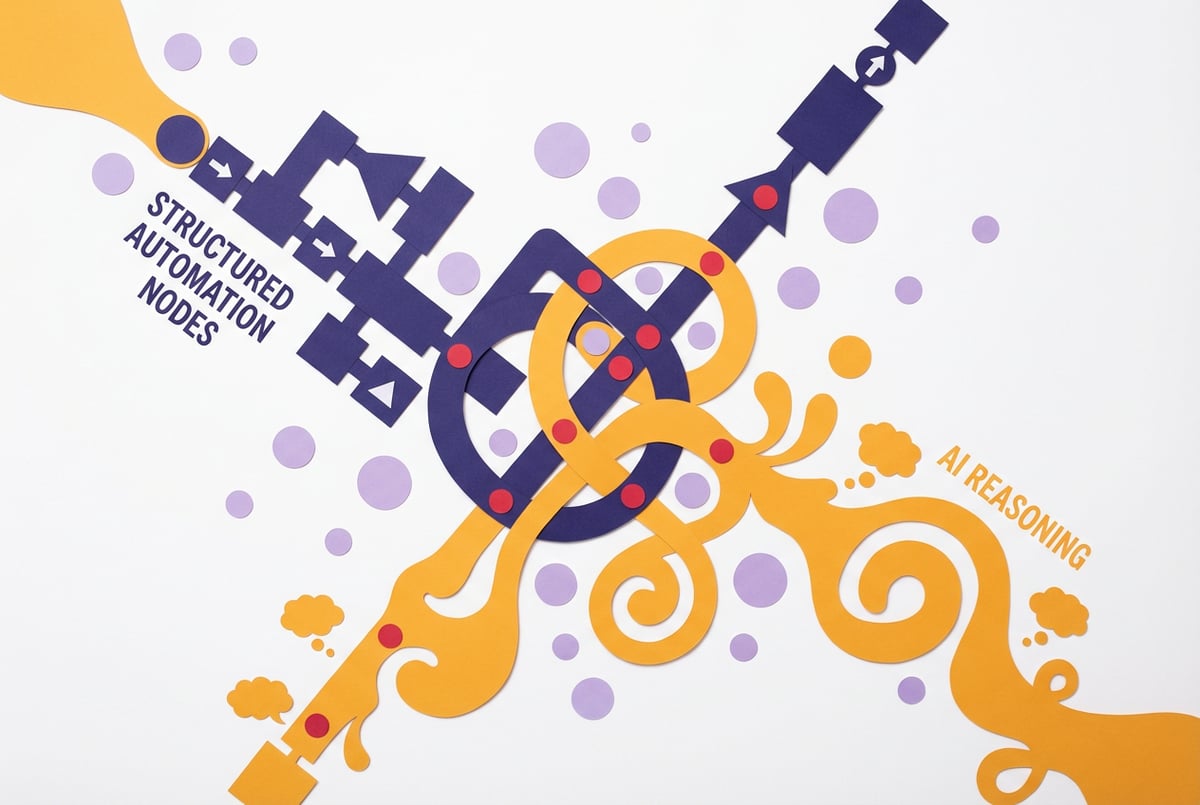
What You’re Actually Comparing Here
Claude Routines and n8n are both trying to automate work. But they start from very different places, serve different audiences, and solve different problems. Putting them in the same comparison is a bit like comparing a spreadsheet to a database — they overlap in what they can do, but they’re not built for the same job.
This article breaks down exactly where Claude Routines and n8n diverge on scheduling, triggers, integrations, and real-world use cases. By the end, you’ll have a clear answer for which one belongs in your stack — or whether you need both.
The short version: Claude Routines is an AI-first scheduling layer built around Claude’s reasoning capabilities. n8n is a mature, general-purpose workflow automation platform with a massive integration library. They’re not direct replacements for each other, but the overlap is real enough that choosing between them matters.
What Claude Routines Actually Are
Claude Routines is Anthropic’s feature for running scheduled Claude agent tasks without requiring a persistent connection or an open terminal. You define what the agent should do, when it should run, and Claude handles the execution on Anthropic’s infrastructure.
If you’ve used Claude Code Loop or scheduled tasks, Routines are the managed version of that concept — you don’t need to babysit a cron job or keep your machine awake. As explained in our Claude Routines overview, the feature runs server-side through Anthropic’s infrastructure, making it genuinely “set it and forget it” for Claude-powered workflows.
Other agents start typing. Remy starts asking.
Scoping, trade-offs, edge cases — the real work. Before a line of code.

Routines sit inside Anthropic’s broader platform alongside Managed Agents, Vaults, and Claude Code. They’re not a standalone automation tool — they’re a scheduling capability bolted onto an AI agent runtime. That distinction matters a lot when you start comparing them to n8n.
What Routines Can Do
- Scheduled execution: Run a Claude agent on a cron-like schedule (daily reports, weekly summaries, hourly checks)
- Serverless operation: No local machine required — Anthropic hosts and runs the agent
- Claude-native context: The agent has full Claude reasoning capabilities, can browse the web, write and execute code, and use tools
- Memory and state: Can persist information between runs via Managed Agents infrastructure
- Notification outputs: Can send results via email, Slack, or other configured endpoints
What Routines Can’t Do (Yet)
- Event-driven triggers: You can’t fire a Routine when a webhook hits, a form is submitted, or a new row appears in a database — at least not natively
- Branching logic across services: There’s no visual canvas for connecting nodes, conditional paths, or multi-service flows
- Broad integration library: Claude can call APIs via code, but there’s no pre-built connector library of 400+ apps
- On-premise deployment: Routines run on Anthropic’s infrastructure — self-hosting isn’t an option
What n8n Actually Is
n8n is an open-source workflow automation platform that’s been around since 2019. It has a visual node-based editor, supports 400+ integrations out of the box, and runs on-premise or in the cloud. It’s a serious tool used by engineering teams for complex multi-service automation.
n8n’s core model is trigger → action chains. Something happens (a webhook fires, a schedule hits, a form is submitted), and n8n executes a sequence of steps across your connected services. Each step is a node — you drag, connect, and configure them in a visual canvas.
Unlike Zapier or Make.com, n8n is genuinely developer-friendly. You can write JavaScript inside nodes, use expressions to transform data, create sub-workflows, and deploy it yourself if you want full control over your data.
For a fuller breakdown of how n8n compares to other automation platforms, see n8n vs AI-Native Automation Platforms.
What n8n Does Well
- Trigger variety: Webhooks, schedules, polling, form submissions, manual execution, event listeners — the full range
- Integration library: 400+ pre-built connectors covering CRMs, databases, messaging platforms, dev tools, file storage, and more
- Visual workflow builder: Drag-and-drop canvas with clear execution paths, easy to audit and debug
- Conditional logic: If/else branches, loops, merge nodes, error handling — sophisticated flow control without code
- Self-hosting: Run it on your own infrastructure for full data control and no per-task fees
- Community: Large active community, extensive templates, good documentation
Where n8n Falls Short
- AI reasoning: You can call an OpenAI or Anthropic API node, but n8n itself doesn’t reason — it executes fixed steps. If the logic requires judgment, you’re bolting AI onto a rigid flow rather than running an intelligent agent
- Dynamic task handling: n8n workflows are pre-defined. If a task requires the agent to decide its own next steps mid-execution, n8n can’t do that natively
- Setup overhead: Self-hosted n8n requires server provisioning, Docker, database management, and regular maintenance
- AI-native workflows: The platform was built for deterministic automation, not probabilistic agent behavior
Head-to-Head: The Core Dimensions
Scheduling and Triggers
n8n wins here — and it’s not close.
Built like a system. Not vibe-coded.
Remy manages the project — every layer architected, not stitched together at the last second.
n8n supports cron schedules, webhooks, polling, manual triggers, and custom event listeners. You can fire a workflow when a Stripe payment completes, when a GitHub PR is opened, or when a row is added to your database. The trigger model is comprehensive and battle-tested.
Claude Routines currently supports time-based scheduling. You set when the agent runs. Event-driven execution — where something external kicks off the Routine — isn’t a first-class feature yet. For workflows where timing is everything and you need precise trigger conditions, n8n is the clear choice.
That said, Claude Routines has an advantage in one narrow case: if your scheduled task requires real judgment rather than fixed steps, Routines can handle ambiguity that n8n cannot. Building scheduled AI agents with Claude Code shows why the reasoning layer matters for certain kinds of recurring tasks.
Integration Ecosystem
n8n wins again.
Four hundred-plus pre-built integrations is a substantial library. Google Workspace, Slack, HubSpot, Salesforce, Airtable, Notion, GitHub, Jira, Stripe — n8n connects to them natively, with authentication handled through a credentials manager.
Claude Routines can interact with external services, but it does so by having Claude write and execute API calls. That’s powerful for a developer, but it’s not the same as having a pre-built, maintained connector. You’ll spend more time on setup and deal with more potential failure points.
If your workflow requires connecting five services that n8n already supports out of the box, n8n will get you running faster and more reliably.
AI Reasoning Capabilities
Claude Routines wins — by design.
This is the fundamental difference. n8n calls AI APIs as nodes. Claude Routines is an AI agent. The distinction matters enormously for certain use cases.
In n8n, you might call GPT to summarize text as one step in a workflow. But the flow itself — which steps to take, in what order, when to stop — is fixed and pre-defined by you.
In Claude Routines, Claude is the orchestrator. It can decide mid-task to search for more information, reconsider its approach, write code to process data, or handle an edge case you didn’t anticipate. For tasks that require judgment rather than just execution, this is a meaningful advantage.
The gap between agentic workflows and traditional automation comes down to exactly this: can the system adapt based on what it encounters, or does it always follow the same path?
Conditional Logic and Branching
n8n wins for deterministic flows; Claude Routines wins for adaptive ones.
n8n has excellent support for conditional logic, loops, and branching — if/else nodes, switch cases, merge nodes, error handlers. If you know all possible branches in advance and they map to discrete services, n8n handles this cleanly and visually.
Claude Routines handles branching differently. Claude doesn’t follow a pre-defined decision tree — it reasons about what to do next based on context. This means it can handle novel situations, but it’s harder to audit, test, and guarantee behavior for.
For compliance-sensitive workflows where you need to show exactly what happened and why, n8n’s explicit branching is easier to document. For open-ended tasks where the output depends on data you can’t anticipate, Claude’s reasoning is more capable.
Developer Experience
Depends on who the developer is.
- ✕a coding agent
- ✕no-code
- ✕vibe coding
- ✕a faster Cursor
The one that tells the coding agents what to build.
n8n is designed for developers who think in systems — connecting services, transforming data, managing state across steps. The visual canvas makes it easy to understand the whole flow at once. You can drop down to JavaScript when you need more control. Self-hosting gives you full ownership.
Claude Routines is designed for people who think in tasks — what do I want Claude to do, on what schedule? The setup is simpler, the cognitive model is different. You’re not connecting nodes; you’re describing a job. If you’re comfortable with Claude Code and the Managed Agents ecosystem, Routines feels natural. If you’re an n8n power user, the lack of a visual canvas and explicit integration library will feel limiting.
For teams evaluating the broader question of when to use drag-and-drop versus Claude Code, the developer experience gap is one of the biggest practical considerations.
Hosting and Infrastructure
n8n wins on flexibility; Claude Routines wins on zero-maintenance.
n8n can be self-hosted (full control, no per-task fees, your data stays on your servers) or cloud-hosted through n8n’s managed service. Self-hosting is genuinely popular among teams with data sensitivity requirements.
Claude Routines runs on Anthropic’s infrastructure. There’s nothing to deploy, maintain, or scale. But you’re also locked into Anthropic’s environment. For teams in regulated industries or those with strict data residency requirements, that’s a real constraint.
Pricing Model
Different enough to require individual evaluation.
n8n’s self-hosted version is free and open-source. The cloud version charges based on workflow executions. For high-volume automation, self-hosting is often dramatically cheaper.
Claude Routines pricing is tied to Claude’s token-based billing. Each Routine run consumes tokens based on the complexity and length of the task. For quick scheduled tasks, this can be very affordable. For long-running, complex agent tasks that execute frequently, costs can add up.
The right comparison depends heavily on your actual usage patterns — volume of runs, complexity per run, and whether you can self-host.
Real-World Use Cases: Which Tool Fits Which Job
Use n8n When:
- You’re automating multi-step service integrations. New lead in HubSpot → create task in Asana → send Slack message → log to Google Sheet. This is n8n’s bread and butter.
- You need event-driven triggers. Any time an external event should kick off a workflow, n8n handles this reliably.
- Your flows are deterministic. If you can map out every branch in advance, n8n’s visual canvas makes those flows easy to build, test, and maintain.
- You need self-hosted data control. n8n running on your own server means your data never leaves your infrastructure.
- You’re replacing Zapier or Make.com. n8n is the natural upgrade path for teams outgrowing simpler automation tools — see why teams switch from Make.com for context on what usually drives that move.
Use Claude Routines When:
- The task requires judgment. Monitoring a situation and deciding what to report, summarizing a complex document differently based on its content, researching a topic and synthesizing findings — these require reasoning, not fixed steps.
- You want zero infrastructure. No server, no Docker, no maintenance. Define the task, set the schedule, done.
- You’re already in the Claude Code ecosystem. If you’re using Claude Code and Managed Agents, Routines is the natural way to schedule recurring agent tasks. Read more about what Anthropic’s Managed Agents offers for the full picture.
- The output needs to be intelligent, not just data-moved. If the scheduled task produces analysis, recommendations, or written output rather than just data transfer, Claude’s capabilities shine.
Seven tools to build an app. Or just Remy.
Editor, preview, AI agents, deploy — all in one tab. Nothing to install.
The Overlap Zone
There’s a class of tasks where both tools could work, and the better choice depends on your priorities:
- Daily report generation: n8n can pull data and format it; Claude Routines can pull data and interpret it. Do you want structured data movement or intelligent analysis?
- Monitoring and alerting: n8n can check conditions and fire alerts; Claude Routines can evaluate a situation and decide whether it’s actually worth alerting about.
- Content workflows: n8n can move content between platforms; Claude Routines can generate, edit, or improve content as part of the flow.
Can You Use Both?
Yes, and many teams do. The combination is genuinely useful.
n8n handles the plumbing — ingesting data from multiple sources, routing events, connecting the service graph. Claude Routines (or Managed Agents more broadly) handles the thinking — analyzing what was collected, generating outputs, making judgment calls.
This is the pattern Anthropic’s platform strategy seems to be betting on: Claude as the reasoning layer, not as a replacement for every part of your automation stack. n8n can call Anthropic’s API and pass results to Claude; Claude can output structured data that n8n routes onward.
The main friction in combining them is operational complexity. You now have two systems to monitor, two failure modes to debug, two billing relationships to manage.
Where Remy Fits
If you’re evaluating Claude Routines vs n8n, you’re likely thinking about how to build applications or workflows that need both intelligent behavior and reliable execution. That’s where Remy is worth knowing about.
Remy is a spec-driven development environment — you describe your application in annotated markdown, and it compiles that into a full-stack app with a real backend, database, auth, and deployment. When your automation need isn’t “schedule this task” but rather “build a system that does this automatically,” Remy gives you a complete application rather than a patchwork of connected tools.
For example, instead of building a Claude Routine that sends daily summaries + an n8n workflow that populates the data + a separate dashboard to view history, you could build a single spec-driven app in Remy that handles data collection, AI-powered analysis, scheduling, and a live dashboard in one coherent system. The infrastructure runs on years of production-grade backend that supports 200+ AI models and 1,000+ integrations.
It’s a different abstraction level entirely. Claude Routines and n8n are workflow-layer tools. Remy is for when you need a real application, not just a workflow.
You can try Remy at goremy.ai.
FAQ
Is Claude Routines a real automation platform or just a scheduling feature?
Claude Routines is a scheduling feature within Anthropic’s broader platform — not a standalone automation platform in the way n8n is. It doesn’t have a visual workflow builder, a broad integration library, or event-driven triggers. What it does have is the ability to run Claude agents on a schedule without requiring a persistent machine. For AI-driven recurring tasks, it’s powerful. For general-purpose workflow automation, it’s incomplete compared to n8n.
Can Claude Routines replace n8n?
Not completely, and probably not for most teams. n8n excels at deterministic multi-service integrations with event-driven triggers and complex branching logic. Claude Routines excels at AI-driven tasks that require reasoning. If your workflows are mostly data movement and service connectivity, n8n is more capable. If your workflows require intelligent interpretation and judgment, Claude Routines handles things n8n can’t. Many teams will find they want both rather than choosing one.
Does n8n support AI agents natively?
n8n has added AI nodes that let you call LLM APIs as part of a workflow, and more recently has introduced some agentic capabilities. But the core n8n model is still deterministic node execution — you define the steps, n8n follows them. For true agentic behavior where the AI decides its own next steps based on context, dedicated platforms purpose-built for agentic workflows are more capable. The distinction between automation and AI agents explains why this matters in practice.
How does Claude Routines handle failures or errors?
This is an area where n8n has a clear advantage. n8n has explicit error handling nodes, retry logic, and error routing built into the visual canvas — you can define exactly what happens when a step fails. Claude Routines’ error handling is less transparent. If a Routine fails, you’ll typically see an error log, but the debugging experience is less immediate than n8n’s visual execution trace. For production-critical workflows where failure handling needs to be explicit and auditable, n8n is currently the more mature choice.
What’s the cost difference between Claude Routines and n8n?
n8n’s self-hosted version is free and open-source — your main cost is server infrastructure. Their cloud plan charges per workflow execution. Claude Routines bills on Anthropic’s token-based model, so costs scale with the complexity and frequency of your agent tasks. For simple, high-frequency data-movement workflows, self-hosted n8n is often cheaper. For complex, judgment-intensive tasks that run less frequently, Claude Routines can be cost-effective. The right answer depends heavily on your actual usage pattern.
Can I trigger Claude Routines from external events like webhooks?
Not natively as of April 2026 — Claude Routines are time-based rather than event-triggered. If you need event-driven execution of a Claude agent (e.g., run an analysis whenever a webhook fires), you’d need to combine Claude with a trigger layer like n8n, Trigger.dev, or similar. Trigger.dev is worth looking at specifically for code-first teams who want event-driven agentic workflows without a visual canvas.
How to Choose
The honest recommendation:
Choose n8n if:
- You need event-driven triggers and a broad integration library
- Your workflows are deterministic and benefit from a visual canvas
- You want self-hosted data control
- You’re automating multi-service data flows without heavy AI reasoning
Choose Claude Routines if:
- Your scheduled tasks require genuine reasoning and judgment
- You’re already using Claude Code and Managed Agents
- You want zero infrastructure overhead
- The task produces intelligent output, not just moved data
Use both if:
- Your workflows need reliable service connectivity (n8n) AND intelligent analysis at specific steps (Claude)
- You’re comfortable managing two systems
Consider a different path if:
- You need a complete application, not just a workflow layer — in which case, spec-driven development with Remy gives you a real backend, database, auth, and AI capabilities in one coherent system rather than a stack of stitched-together automation tools.
Key Takeaways
- Claude Routines is a scheduling feature for Claude agents — powerful for AI-driven recurring tasks, limited as a general automation platform
- n8n is a mature workflow automation tool with 400+ integrations, event-driven triggers, and strong support for deterministic multi-service flows
- The core difference is reasoning vs. execution: Claude Routines thinks, n8n moves
- For most teams, these tools complement each other rather than compete directly
- If your need is a complete intelligent application rather than a workflow, spec-driven development is worth exploring — try Remy to see what that looks like in practice