What Is Agent Orchestration? Why It's the Biggest Unsolved Problem in the AI Stack
Scheduling, lifecycle management, supervision hierarchies, and FinOps for agents don't exist yet as managed infrastructure. Here's what's missing.
The Gap Between Agent Demos and Agent Reality
Multi-agent systems are everywhere in demos. In production, they’re a different story.
The research assistant that summarizes documents in a prototype falls apart when you need it running 24/7, handling failures gracefully, staying within budget, and reporting back to a supervisor agent that’s managing five other agents simultaneously. Agent orchestration — the infrastructure layer that makes multi-agent systems actually work — is where most real-world deployments hit a wall.
This isn’t a model problem. The underlying AI capabilities are maturing fast. The problem is everything around the model: scheduling agents to run at the right time, managing their lifecycles across long-running tasks, building supervision hierarchies that handle failures without human intervention, and tracking costs before a single misconfigured agent drains your cloud budget.
These problems don’t have solved, productized answers yet. Here’s what’s actually missing.
What Agent Orchestration Actually Means
Before getting into what’s broken, it helps to be precise about what agent orchestration includes — because the term gets used loosely.
At the simplest level, orchestration is coordination. It’s the mechanism that decides which agents run, when, in what order, with what inputs, and what happens when something goes wrong.
In a single-agent setup, this is trivial. One agent does one thing. But as soon as you have multiple agents working in parallel or in sequence — a planner agent breaking down tasks, executor agents handling subtasks, a verifier agent checking outputs — you need infrastructure that handles:
- Task routing: Which agent handles which piece of work?
- State management: What does each agent know about what’s already been done?
- Dependency resolution: Agent B can’t start until Agent A finishes — how is that enforced?
- Error handling: If Agent C fails halfway through, what happens to the downstream agents depending on it?
- Resource management: How many agents can run simultaneously without blowing cost or rate limits?
These are engineering problems, not AI problems. And most of the current tooling treats them as an afterthought.
The Four Unsolved Problems
Scheduling
Cron jobs work for simple tasks. They don’t work for agents.
A traditional cron job runs a function at a defined interval. It doesn’t know whether the last run succeeded, doesn’t adapt to upstream conditions, and doesn’t coordinate with other concurrent processes. For most software, that’s fine. For agents that need to fetch live data, reason about it, and trigger downstream actions, it creates compounding problems.
What agent scheduling actually requires:
- Conditional triggers: Run Agent X only when a certain data condition is met, not just at 9am every Monday
- Event-driven execution: Start a pipeline when a webhook fires, an email arrives, or another agent completes
- Backpressure handling: If the upstream data pipeline is slow, don’t start the next agent with stale or incomplete context
- Idempotency guarantees: If the scheduler retries a failed agent run, it shouldn’t duplicate work or corrupt state
Most teams cobble this together with a mix of cron, message queues, and custom glue code. It works until it doesn’t. And when it breaks in production, it’s often hard to diagnose because there’s no unified view of what the scheduler intended vs. what actually ran.
Lifecycle Management
Agents aren’t stateless functions. They can run for seconds or hours. Some maintain memory across multiple invocations. Others need to pause, wait for human input, then resume. Managing that lifecycle is genuinely hard.
The specific challenges:
Long-running tasks. Large language model APIs have timeouts. If your agent needs to work on something for 20 minutes — reading documents, iterating on output, making multiple tool calls — you need infrastructure that handles token windows, context compression, and session persistence. Most orchestration frameworks hand-wave this.
Checkpointing. If an agent is 80% through a complex task and fails, you need to restart from a checkpoint, not from scratch. This requires durable state storage and clear definitions of what constitutes a recoverable vs. unrecoverable failure.
Human-in-the-loop pauses. Many enterprise workflows require human approval at certain steps. The agent needs to pause, surface the decision to a human, wait (potentially for hours or days), then resume with the human’s input incorporated. Building this in a way that’s reliable and doesn’t leak memory or drop context is a serious infrastructure problem.
Version management. If you update an agent mid-run — new prompt, new model, new tool — what happens to agents already in flight? Most systems don’t have an answer.
Supervision Hierarchies
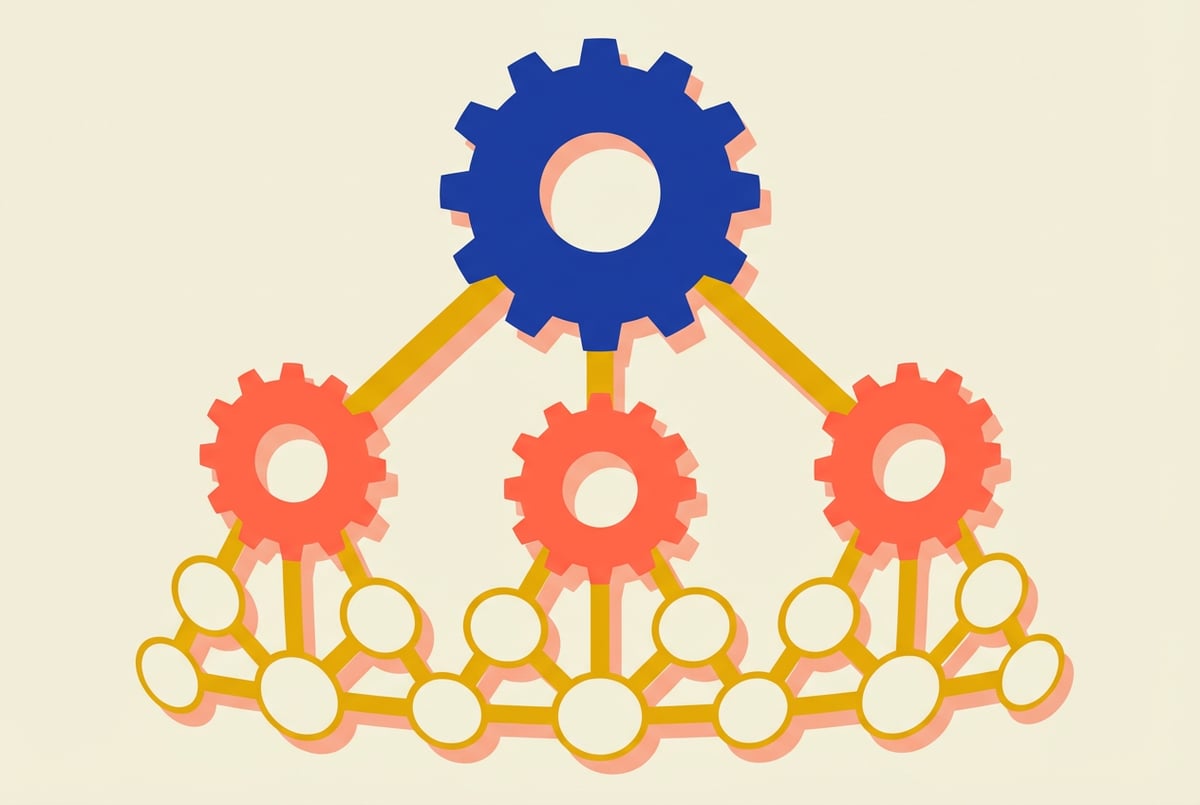
The most sophisticated multi-agent patterns involve hierarchical structures: orchestrator agents that plan and delegate, subagents that execute, and verifier agents that check outputs before they propagate.
This mirrors how organizations work. A manager breaks a project into tasks, delegates to team members, reviews their output, and escalates exceptions. The problem is that in software, this hierarchy requires explicit infrastructure support.
What supervision hierarchies need:
- A clear protocol for how an orchestrator agent passes tasks to subagents and gets results back
- Mechanisms for subagents to signal that they’re stuck, uncertain, or out of scope — and escalate rather than hallucinate
- Audit trails that show which agent produced which output, so errors can be traced to their source
- Circuit breakers: if a subagent consistently fails, the orchestrator should stop delegating to it and try an alternative
One coffee. One working app.
You bring the idea. Remy manages the project.

None of these patterns are standardized. Frameworks like LangGraph, AutoGen, and CrewAI each implement supervision differently, and they don’t interoperate. If your orchestrator agent is built in one framework and your subagents in another, you’re writing a lot of glue.
The deeper issue is that most current multi-agent frameworks treat agent communication as a software problem (function calls, return values) rather than an infrastructure problem (message durability, delivery guarantees, backpressure). That works for demos. It breaks under production load.
FinOps for Agents
This is the problem that surprises teams the most.
Token costs scale differently than compute costs. A single misconfigured agent that enters a loop — calling a tool, getting a response, calling the tool again because it didn’t recognize its own prior output — can run up thousands of dollars before anyone notices. Unlike a runaway EC2 instance, there’s no standard tooling for real-time agent cost visibility.
What’s missing:
- Per-agent cost attribution: When 15 agents are running across a workflow, which one consumed 70% of the token budget?
- Budget enforcement: Hard limits that actually stop an agent from running rather than just alerting after the fact
- Cost forecasting: Before you run a workflow, estimate what it will cost based on expected input size, model selection, and tool call frequency
- Model routing: Automatically route simpler subtasks to cheaper models (GPT-4o mini, Claude Haiku) and reserve expensive models for complex reasoning steps
Some of this exists in nascent form — LLM observability tools like LangSmith and Helicone capture cost data at the model call level. But none of them integrate with workflow-level orchestration to enforce budgets at runtime. You can see what you spent; you can’t reliably control what you spend.
The FinOps gap is particularly acute in enterprise settings, where finance teams need agent workloads to behave like any other managed compute resource: tagged, budgeted, and predictable.
Why Existing Frameworks Don’t Fully Solve This
The current landscape for multi-agent frameworks includes LangGraph, AutoGen, CrewAI, and newer entrants like Agency Swarm and LlamaIndex Workflows. Each has real strengths. None of them fully address the orchestration problems described above.
The common limitations:
They’re libraries, not infrastructure. You get APIs and abstractions, but you’re still responsible for deploying, scaling, and monitoring everything yourself. Running agents reliably in production requires Kubernetes, queuing systems, observability stacks, and database infrastructure — none of which comes included.
They optimize for single-session reasoning. Most frameworks are designed around a single run of a single agent. Multi-agent patterns are supported, but persistence across sessions, long-horizon tasks, and robust failure recovery are often bolted on rather than first-class.
Observability is an afterthought. Understanding what a complex multi-agent system actually did — which agent made which decision, what context it had, where it went wrong — requires extensive custom logging. The frameworks don’t provide this out of the box.
They don’t talk to each other. There’s no standard protocol for inter-agent communication equivalent to HTTP for web services. Each framework uses its own conventions. This makes mixing frameworks difficult and makes the ecosystem fragmented.
Other agents ship a demo. Remy ships an app.
Real backend. Real database. Real auth. Real plumbing. Remy has it all.
The Model Context Protocol (MCP), introduced by Anthropic, is a step toward standardizing how agents communicate with tools and data sources. It’s promising infrastructure. But MCP addresses tool connectivity, not orchestration — it doesn’t solve scheduling, lifecycle management, or FinOps.
The Multi-Agent Coordination Problem in Practice
Here’s a concrete example of where things fall apart.
Imagine an enterprise procurement workflow with five agents:
- A request intake agent that reads supplier emails and extracts structured data
- A vendor verification agent that checks credentials against a database
- A pricing analysis agent that compares quotes against historical data
- A compliance review agent that flags policy violations
- An approval routing agent that sends summaries to the right decision-maker
In a demo, this works beautifully. In production:
- The intake agent processes emails at unpredictable intervals — how does it trigger the verification agent without polling constantly?
- The pricing analysis agent needs data from both the intake and vendor agents — what if one finishes before the other?
- The compliance agent occasionally surfaces edge cases that require a human decision before approval routing can proceed — how does the workflow pause and resume?
- One vendor’s API returns data slowly — how does the system handle a subagent that takes 10x longer than expected without blocking everything downstream?
- At the end of the month, the finance team wants to know what this workflow cost per supplier request — where does that data live?
Each of these is solvable in isolation. Solving all of them in a unified, maintainable way is where teams spend months and still end up with fragile systems.
What Managed Agent Infrastructure Would Actually Look Like
The unsolved problem isn’t any single capability — it’s the absence of a coherent managed infrastructure layer that handles all of this the way AWS handles compute.
What would “solved” look like?
Declarative agent specifications. You define what an agent does, what triggers it, what it can spend, and what it needs to succeed. The infrastructure handles execution, retry, and monitoring.
Durable workflow state. Workflow progress is persisted automatically. If an agent crashes, it restarts from the last checkpoint without duplicating work.
Native human-in-the-loop support. Pause states are first-class. An agent that needs human input sends a notification, waits reliably, and resumes with the response in context.
Cost envelopes. Every agent run has a defined budget. Exceeding it stops the agent, not just alerts a dashboard.
Supervision primitives. Orchestrator-to-subagent delegation is a native pattern with built-in audit trails, escalation paths, and failure handling.
Model-agnostic routing. The infrastructure decides which model to use for each step based on task complexity and cost constraints, not hardcoded choices in the agent code.
We’re not there yet as an industry. Pieces exist. The integrated layer doesn’t.
How MindStudio Approaches Agent Orchestration
MindStudio doesn’t claim to have solved every orchestration problem in the enterprise AI stack. But it’s one of the few platforms that treats orchestration as a first-class concern rather than something developers figure out on their own.
A few specific things that matter here:
Multiple trigger types, natively. Agents built on MindStudio can be triggered by schedules, webhooks, emails, API calls, or other agents — without custom glue code. This addresses a core scheduling problem: getting the right agent to run in response to the right event.
Workflow chaining. You can build multi-step workflows where one agent’s output becomes another agent’s input, with branching logic, conditional steps, and error handling built into the visual builder. This isn’t a general-purpose orchestration layer, but it covers a large class of real enterprise workflows without requiring infrastructure expertise.
Agent Skills for developers. For teams building custom multi-agent systems with LangChain, CrewAI, or their own frameworks, the MindStudio Agent Skills SDK gives those agents access to 120+ typed capabilities — sending emails, running web searches, triggering other workflows — with the infrastructure layer (auth, rate limiting, retries) already handled. It’s a way to offload the “plumbing” that typically eats engineering time.
Model flexibility. With 200+ models available, you can route different agents in a workflow to different models based on what the task actually requires — which is the beginning of cost-aware model selection.
The deeper orchestration problems — true supervision hierarchies, enterprise FinOps, stateful long-horizon tasks — remain hard across the industry. But MindStudio reduces the time it takes to get a real multi-agent workflow into production from months to days for a lot of common use cases. You can try it free at mindstudio.ai.
Frequently Asked Questions
What is agent orchestration?
Agent orchestration is the infrastructure layer that coordinates multiple AI agents — determining what runs, when, in what order, with what context, and what happens when something fails. It includes task routing, state management, scheduling, error handling, and resource governance. Without it, multi-agent systems are difficult to run reliably in production.
What’s the difference between an AI agent and an orchestrator?
An AI agent is a system that perceives inputs, reasons, and takes actions — typically using a language model as its core reasoning engine. An orchestrator is the system that manages one or more agents: assigning tasks, routing outputs, handling failures, and maintaining overall workflow state. An orchestrator can itself be an AI agent (an “orchestrator agent”), or it can be traditional software logic.
Why is multi-agent coordination hard in production?
Multi-agent systems introduce complexity that doesn’t exist in single-agent setups: agents depend on each other’s outputs, can run in parallel, may have different latencies and failure modes, and accumulate costs quickly. Production systems need durable state, reliable scheduling, error recovery, human-in-the-loop support, and cost controls — none of which are provided out of the box by current LLM APIs or most agent frameworks.
What is FinOps for AI agents?
FinOps for AI agents refers to cost visibility, attribution, and control for agent workloads. Because agents make multiple model calls and tool invocations per task, costs can scale unexpectedly. FinOps practices for agents include per-agent cost tracking, budget enforcement that stops agents at runtime rather than alerting after the fact, cost forecasting, and intelligent model routing to minimize spend without sacrificing output quality.
What tools exist for agent orchestration today?
Remy is new. The platform isn't.
Remy is the latest expression of years of platform work. Not a hastily wrapped LLM.
Current tools include LangGraph (for stateful multi-agent graphs), AutoGen (Microsoft’s multi-agent conversation framework), CrewAI (role-based agent collaboration), and LlamaIndex Workflows. For observability, tools like LangSmith and Helicone capture model-level costs and traces. MCP provides a standard for agent-to-tool communication. No single tool provides a complete, managed orchestration layer covering scheduling, lifecycle management, supervision hierarchies, and FinOps in an integrated way.
How do supervision hierarchies work in multi-agent systems?
A supervision hierarchy is a structure where a high-level “orchestrator” agent breaks tasks into subtasks and delegates them to specialized “subagents.” The subagents report results back to the orchestrator, which evaluates them, handles failures, and decides next steps. Effective supervision requires defined escalation protocols (subagents flagging uncertainty rather than guessing), audit trails linking outputs to the agents that produced them, and circuit breakers that stop delegating to consistently failing subagents.
Key Takeaways
- Agent orchestration — scheduling, lifecycle management, supervision hierarchies, and FinOps — is the primary reason multi-agent systems work in demos but struggle in production.
- Current frameworks (LangGraph, AutoGen, CrewAI) are libraries, not managed infrastructure. They require teams to build their own deployment, monitoring, and state management layers.
- FinOps is the most underestimated problem: runaway agent loops can generate costs fast, and there’s no standard tooling for enforcing agent-level budgets at runtime.
- Supervision hierarchies require native infrastructure support — standardized inter-agent communication, audit trails, and failure escalation — that doesn’t exist as a general standard yet.
- MCP is a promising step toward standardizing agent-to-tool communication, but it doesn’t address orchestration.
- Platforms like MindStudio reduce orchestration complexity for common enterprise workflows, but the industry still lacks a unified managed infrastructure layer for the full problem space.
The organizations that get ahead on agentic AI in the next two years won’t just pick better models — they’ll build or adopt better orchestration. That’s where the real leverage is, and it’s still largely up for grabs.